Union Budget Allocations and Agrarian Sector Fiscal Support
Source:Indian Express ↗
Why It Matters
The Union Budget's allocation and policy direction for agriculture are critical indicators of the government's approach to the rural economy. Understanding the critiques surrounding stagnant allocations and the need for structural reforms (like MSP and capital investment) is essential for answering GS3 questions on government budgeting, agricultural subsidies, and farmers' income.
Summary
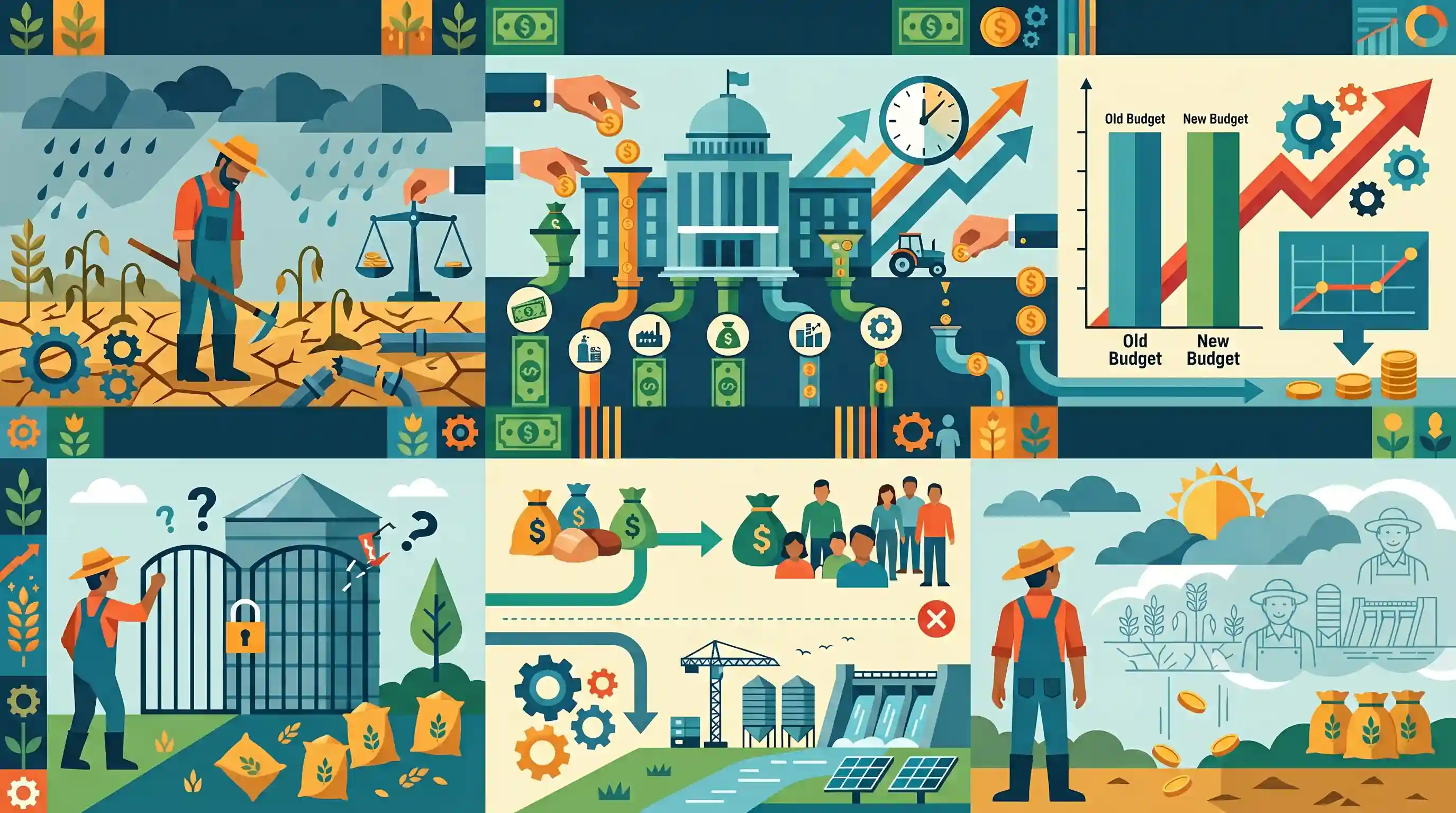
The opinion piece critiques the recent Union Budget for overlooking the agriculture sector and the systemic challenges faced by farmers. It argues that despite the persistent agrarian distress, the Budget failed to deliver meaningful interventions, with allocations for key safety net and agricultural schemes remaining stagnant when adjusted for inflation. Furthermore, the absence of policy direction on crucial structural reforms—such as a legal guarantee for Minimum Support Price (MSP) and the much-needed transition from consumption subsidies to capital investments in rural infrastructure—highlights a missed opportunity to foster long-term agricultural resilience and improve farmers' incomes.
Key Points
- The Union Budget has been criticized for lacking substantial, targeted interventions for the agriculture sector, failing to adequately address the ongoing rural distress.
- Budgetary allocations for pivotal schemes like PM-KISAN and MGNREGA have remained stagnant in real terms, minimizing their impact against the backdrop of rural inflation.
- The Budget remained largely silent on pressing structural demands of the farming community, including a legal guarantee for the Minimum Support Price (MSP) and comprehensive market reforms.
- Experts urge a shift in focus from short-term subsidies to long-term capital investments in agriculture, such as developing post-harvest infrastructure and supporting climate-resilient farming.
Important Terms
Minimum Support Price (MSP)

A pre-announced price floor at which the government purchases crops from farmers to prevent price crashes. It covers 22 mandated crops and sugarcane, based on CACP recommendations.
UPSC context
GS Paper 3 (Agriculture). Tests understanding of price stabilization, food security, and government market intervention.
PM-KISAN
A Central Sector Scheme providing ₹6,000 annual income support to all landholding farmer families in three installments via Direct Benefit Transfer (DBT) for agricultural inputs.
UPSC context
GS Paper 3 (Direct subsidies). Evaluates knowledge of income support models and rural fiscal policy.
MGNREGA
A rights-based social security measure guaranteeing 100 days of unskilled manual work per year to rural households, serving as a vital safety net during lean agricultural periods.
UPSC context
GS Paper 2 (Social Justice) and GS Paper 3 (Employment). Critical for understanding rural safety nets.
Pradhan Mantri Fasal Bima Yojana (PMFBY)
A government-subsidized crop insurance scheme protecting farmers against losses from natural calamities and pests. It features low, uniform premiums for Kharif (2%), Rabi (1.5%), and commercial crops.
UPSC context
GS Paper 3 (Agriculture/Insurance). Tests risk management strategies and use of technology in farming.
Agrarian Distress
A persistent state of economic hardship in farming caused by low incomes, rising debt, price volatility, and climate risks, leading to social and economic rural crises.
UPSC context
GS Paper 3 (Indian Economy). Core theme for discussing structural reforms and rural socio-economic challenges.
Prelims Trap
PM-KISAN provides uniform direct income support to all farming households, including tenant farmers and landless agricultural labourers.
PM-KISAN strictly requires land ownership records. Tenant farmers and landless agricultural labourers are systematically excluded from the scheme.
Static Concepts Connected
How are the different cost calculations for MSP (A2, A2+FL, C2) defined?
- A2 Cost: Actual paid-out costs incurred by farmers on inputs like seeds, fertilizers, pesticides, hired labour, and fuel.
- A2+FL Cost: Includes A2 plus the imputed value of unpaid family labour. The government currently calculates MSP to ensure at least a 50% return over A2+FL.
- C2 Cost: A comprehensive cost including A2+FL plus imputed rent on owned land and interest on fixed capital. The Swaminathan Commission recommended the C2+50% formula.
What is Gross Capital Formation in Agriculture (GCFA) and how do subsidies impact it?
- Definition: GCFA refers to the creation of long-term productive assets in the farm sector, such as irrigation networks, cold storages, buffer silos, and heavy farm machinery.
- Subsidy Crowding-Out: High budgetary expenditure on recurring consumption subsidies (like fertilizers and free electricity) heavily crowds out the fiscal space available for GCFA, stalling structural modernization.
Cross-Topic Patterns
MSP Guarantee & WTO 'De Minimis' limit
A legal MSP guarantee risks breaching the WTO Agreement on Agriculture's 10% 'de minimis' subsidy limit for developing nations, complicating India's trade diplomacy and reliance on the Peace Clause.
DBT limitations vs. Universal Safety Nets
Targeted DBTs like PM-KISAN rely on formal data (land records), systematically excluding vulnerable groups (tenants, landless). This highlights why universal, demand-driven safety nets like MGNREGA remain indispensable during rural distress.

Expect a 2026 question contrasting the fiscal footprint of agricultural subsidies versus Gross Capital Formation in Agriculture (GCFA).
Linked PYQs · 4
Linked PYQs · 4
- 2023MainsGS3
What are the direct and indirect subsidies provided to farm sector in India? Discuss the issues raised by the World Trade Organization (WTO) in relation to agricultural subsidies.
- 2018MainsGS3
What do you mean by Minimum Support Price (MSP)? How will MSP rescue the farmers from the low income trap?
- 2017MainsGS3
How do subsidies affect the cropping pattern, crop diversity and economy of farmers? What is the significance of crop insurance, minimum support price and food processing for small and marginal farmers?
- 2013MainsGS3
What are the different types of agriculture subsidies given to farmers at the national and at state levels ? Critically analyse the agricultural subsidy regime with reference to the distortions created by it.
