Thirupparankundram Temple Dispute and Judicial Precedent Limits
Source:The Hindu ↗
Why It Matters
This issue illustrates the ongoing constitutional tension between judicial oversight and customary religious practices. It touches upon secularism, the right to freedom of religion, and the role of the State in maintaining communal harmony while navigating historically sensitive sites.
Summary
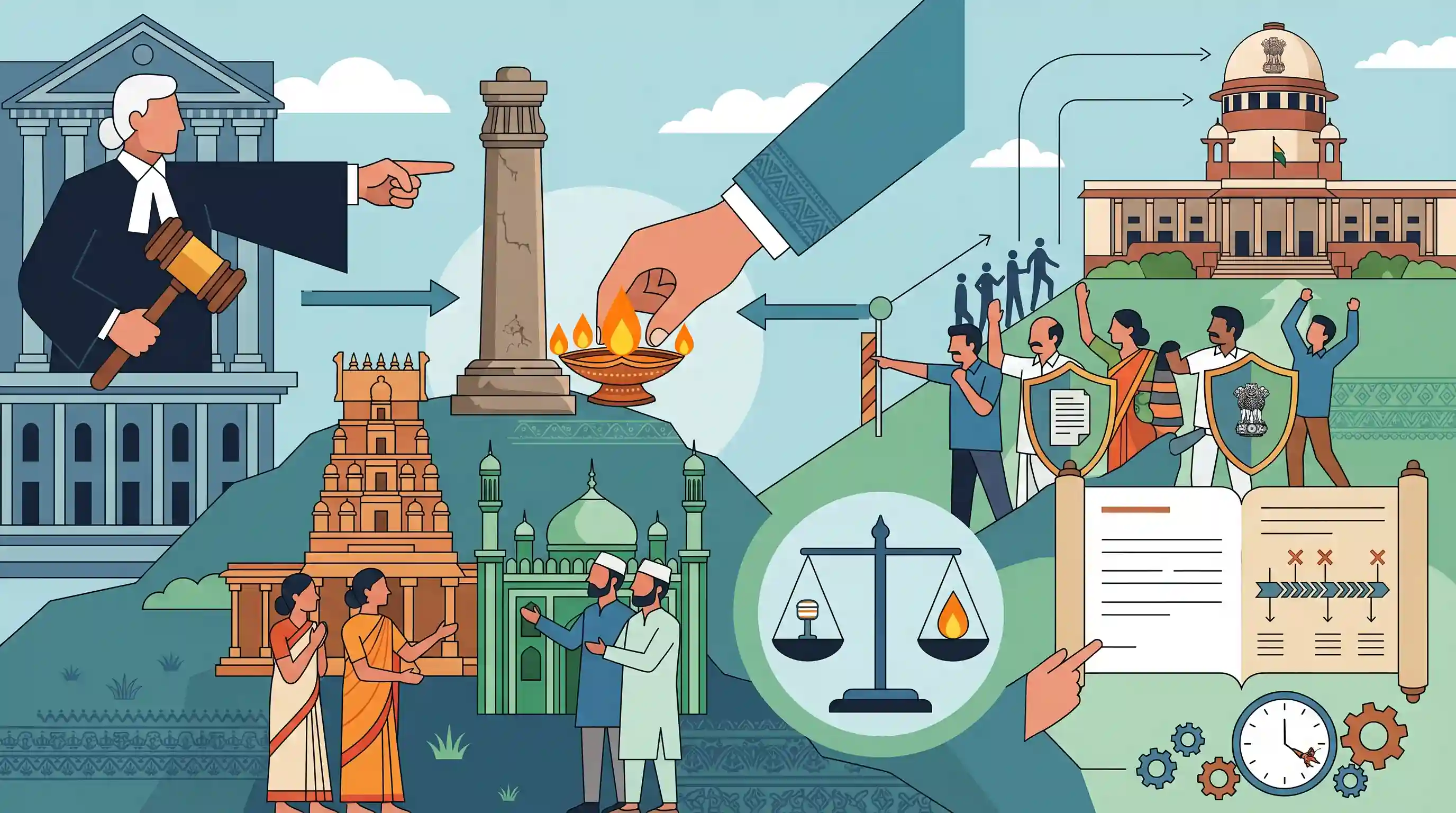
The Tamil Nadu government has decided to appeal to the Supreme Court against a directive from the Madras High Court regarding the lighting of the 'Karthigai Deepam' in Thirupparankundram. The High Court had ordered the Subramaniya Swamy Temple to light the lamp at a stone pillar located near a local dargah atop a hill. However, the State contends that there is no historical record or customary precedent for this practice in the last 100 years. The government argues that judicial intervention should not enforce new practices that deviate from established traditions, emphasizing the need to maintain long-standing communal harmony.
Key Points
- The Madras High Court directed the Subramaniya Swamy Temple to light the 'Karthigai Deepam' at a stone pillar near a dargah atop Thirupparankundram hill.
- The Tamil Nadu government asserts there is no historical or traditional evidence over the past century to support this practice at the specified site.
- The state argues that the judiciary should not mandate the introduction of new religious practices, which may disrupt customary norms and communal harmony.
- The government plans to appeal the High Court's decision in the Supreme Court to protect established cultural traditions from unwarranted judicial intervention.
Important Terms
Essential Religious Practices (ERP)

A judicial doctrine used to determine if a practice is integral to a religion and thus protected under Article 25. Established in the 1954 Shirur Mutt case.
UPSC context
GS Paper II (Polity/Fundamental Rights). Tests understanding of the limits of religious freedom versus state regulation.
Judicial Intervention in Religious Matters
The role of constitutional courts in interpreting religious texts and traditions to resolve legal disputes, balancing faith-based rights with constitutional morality and public order.
UPSC context
GS Paper II (Judiciary/Governance). Examines the "principled distance" model of Indian secularism and judicial overreach concerns.
Thirupparankundram Subramaniya Swamy Temple
One of the six sacred abodes (Arupadaiveedu) of Lord Muruga in Tamil Nadu, featuring a cave temple on a hill that also houses Islamic and Jain sites.
UPSC context
GS Paper I (Art & Culture). Relevant for temple architecture, religious pluralism, and composite heritage.
Special Leave Petition (SLP)
A discretionary power under Article 136 of the Constitution allowing the Supreme Court to grant special leave to appeal against any judgment from any court or tribunal.
UPSC context
GS Paper II (Judiciary). Tests knowledge of the Supreme Court's appellate jurisdiction and extraordinary powers.
Secularism (Indian Model)
The Indian model of secularism where the state maintains a "principled distance" from all religions, intervening to promote social reform and equality while protecting essential traditions.
UPSC context
GS Paper I (Society) and GS Paper II (Polity). Contrasts Indian pluralism with the Western "separation of church and state."
Hindu Religious and Charitable Endowments (HR&CE) Department
A state government body that manages and governs the administration of Hindu temples and charitable endowments, balancing religious autonomy with administrative oversight.
UPSC context
GS Paper II (Governance). Relevant for debates on state control of religious institutions and administrative law.
Prelims Trap
"Article 25 provides absolute protection to all traditional religious practices against State intervention."
Only "essential religious practices" are protected, and they remain explicitly subject to reasonable restrictions like public order, morality, and health.
Static Concepts Connected
What is the Essential Religious Practices (ERP) doctrine?
- Origin: Established by the Supreme Court in the landmark Shirur Mutt Case (1954).
- The Test: Determines what practices are integral to a faith; only these "essential" elements are protected under Articles 25 and 26.
- Limitations: Even protected practices are not absolute and remain subject to public order, morality, and health.
What characterizes Thirupparankundram's historical and architectural significance?
- Pandyan Origins: It is a prominent example of 8th-century early Pandyan rock-cut cave architecture.
- Nayak Additions: The temple was later expanded with highly intricate structural mandapams during the Madurai Nayak period.
- Literary Link: The site is deeply connected to Karthigai Deepam, a festival finding historical mention in Sangam literature texts like Ahananuru.
Cross-Topic Patterns
ERP Doctrine vs Customary Autonomy
Like the Sabarimala dispute, this case highlights the constitutional tension between judicial intervention in religious affairs and the protection of established local customs.
Living Heritage + Sangam Literature
Connects living religious festivals (Karthigai Deepam) to their ancient literary mentions (Ahananuru) and the evolution of early Pandyan rock-cut architecture.

Expect a multi-statement question blending the ERP doctrine's 'public order' restrictions with Pandyan rock-cut architecture in 2026.
Linked PYQs · 4
Linked PYQs · 4
- 2021MainsGS2
‘Constitutional Morality’ is rooted in the Constitution itself and is founded on its essential facets. Explain the doctrine of ‘Constitutional Morality’ with the help of relevant judicial decisions.
- 2024MainsGS2
Discuss India as a secular state and compare with the secular principles of the US constitution.
- 2022MainsGS1
How will you explain that medieval Indian temple sculptures represent the social life of those days ?
- 2019PrelimsGS1
Building 'Kalyaana Mandapas' was a notable feature in the temple construction in the kingdom of
