Thirupparankundram Dargah Namaz Restriction and Religious Rights
Source:The Hindu ↗
Why It Matters
Demonstrates how Indian constitutional jurisprudence resolves conflicts between religious rights (Articles 25 & 26) and property rights or public order. It highlights the practical application of the 'essential religious practice' doctrine and the delicate balancing required in historically shared religious spaces where practices might obstruct another community's access.
Summary
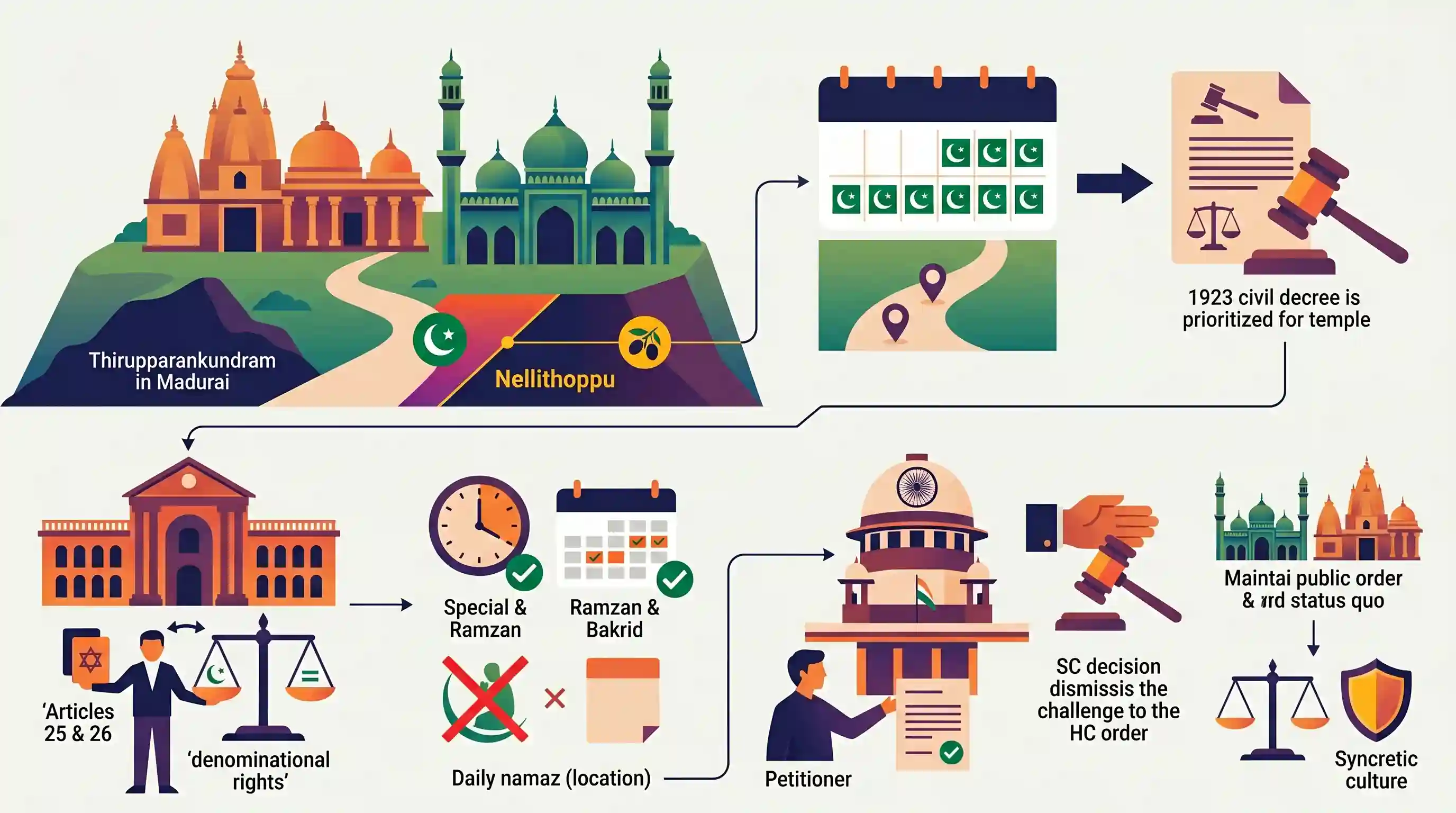
The Supreme Court has refused to entertain a challenge against Madras High Court orders that restrict the offering of namaz at a specific area (Nellithoppu) of the Sikkandar Badhusha Avuliya Dargah in Madurai to only Ramzan and Bakrid. The Dargah shares the Thirupparankundram hill with the Kasi Viswanathar Temple. The petitioner contended that the restriction violated Articles 25 and 26 of the Constitution, which protect the continuous practice of faith and denominational rights. However, the High Court held that the daily namaz at that location was a recent practice that obstructed the pathway to the temple, violating a 1923 civil court decree. The Supreme Court dismissed the special leave petition without expressing an opinion on the underlying rights, effectively prioritizing the status quo and public order over claims of essential religious practices in a disputed shared space.
Key Points
- The Supreme Court dismissed a petition challenging a Madras High Court order that restricted namaz at the Nellithoppu area of the Sikkandar Badhusha Avuliya Dargah, located atop Thirupparankundram hill in Madurai.
- The restrictions limit prayer at the spot exclusively to the festival days of Ramzan and Bakrid, stemming from disputes over a pathway leading to the nearby Kasi Viswanathar Temple.
- The petitioner argued that everyday namaz is an essential religious practice, and restricting it arbitrarily violates Article 25 (freedom of religion) and Article 26 (right of denominations to manage religious affairs).
- The High Court reasoned that the everyday practice at that specific spot was of 'recent origin' and would obstruct the temple pathway, thereby violating a century-old civil court decree from 1923 regarding property boundaries.
- The Supreme Court's refusal to intervene underscores the judiciary's approach to balancing fundamental religious freedoms with practical considerations like property rights, public order, and the maintenance of shared spaces.
Important Terms
Article 25

Guarantees individual freedom of conscience and the right to freely profess, practice, and propagate religion, subject to public order, morality, and health.
UPSC context
GS Paper II: Fundamental Rights. Tests understanding of individual religious freedom and its reasonable restrictions.
Article 26
Grants religious denominations the collective right to manage their own affairs in matters of religion, establish institutions, and own or administer property.
UPSC context
GS Paper II: Polity. Focuses on group/denominational rights versus individual rights under Article 25.
Essential Religious Practice
A judicial test established in the Shirur Mutt case (1954) to determine which rituals or practices are integral to a religion and thus constitutionally protected.
UPSC context
GS Paper II: Judiciary/Secularism. Crucial for analyzing court interventions in religious customs (e.g., Sabarimala, Hijab cases).
Special Leave Petition (SLP)
Under Article 136, the Supreme Court has discretionary power to grant special permission to appeal against any judgment or order from any court/tribunal in India.
UPSC context
GS Paper II: Structure and Functioning of the Judiciary. Tests knowledge of the SC's extraordinary appellate jurisdiction.
Public Order
A constitutional ground used by the State to restrict fundamental rights (Articles 25/26) to maintain peace, safety, and communal harmony.
UPSC context
GS Paper II/III: Polity and Internal Security. Tests the balance between civil liberties and state interests.
Prelims Trap
"A petitioner has a constitutional right to appeal to the Supreme Court under Article 136 (Special Leave Petition)."
Article 136 is a discretionary privilege, not a constitutional right to appeal. The Supreme Court can dismiss an SLP without assigning reasons, maintaining the status quo of lower court orders.
Static Concepts Connected
What are the constitutional limitations on Freedom of Religion under Article 25?
- Primary Grounds: Article 25 freedoms are explicitly subordinate to public order, morality, and health, allowing the State to restrict disruptive practices.
- Other Fundamental Rights: The right is also subject to other provisions of Part III, meaning it cannot violate equality or non-discrimination.
- Secular Regulation: The State retains the power to regulate or restrict economic, financial, political, or secular activities associated with religious practice.
What is the 'Essential Religious Practices' (ERP) doctrine?
- Judicial Origin: It was formulated by the Supreme Court in the 1954 Shirur Mutt case to determine the scope of constitutional protection for religion.
- Core Criteria: Only practices deemed fundamental and integral to a religion are protected under Article 25. Extraneous or recent additions are excluded.
- Judicial Review: It empowers courts to scrutinize religious rituals and decide if restricting them alters the very nature of the religion.
Cross-Topic Patterns
Thirupparankundram's pluralistic heritage
Thirupparankundram hill is a cultural trifecta—hosting Jain cave beds, Tamil Brahmi inscriptions, an 8th-century Murugan rock-cut temple, and a Dargah. It is a prime candidate for questions on India's syncretic history.
ERP test + shared sacred spaces
Legal disputes over shared sacred geography increasingly require courts to balance 19th-century civil property decrees, the 1991 Places of Worship Act, and the judicially created Essential Religious Practices test.

Expect a 2026 Prelims question mixing Thirupparankundram's syncretic heritage (Jain/Hindu/Islamic) with Article 25 public order caveats.
Linked PYQs · 3
Linked PYQs · 3
- 2024MainsGS2
Discuss India as a secular state and compare with the secular principles of the US constitution.
- 2019MainsGS2
What can France learn from the Indian Constitution's approach to secularism?
- 2022MainsGS1
Are tolerance, assimilation and pluralism the key elements in the making of an Indian form of secularism? Justify your answer.
