High Seas Treaty Implementation and Global Ocean Governance
Source:Indian Express ↗
Why It Matters
Ocean governance is heavily tested in UPSC (e.g., UNCLOS, High Seas Treaty, ISA). The UN Ocean Conference highlights the intersection of international diplomacy (GS2) and environmental sustainability (GS3), emphasizing India's maritime interests, deep ocean mission, and adherence to international maritime laws.
Summary
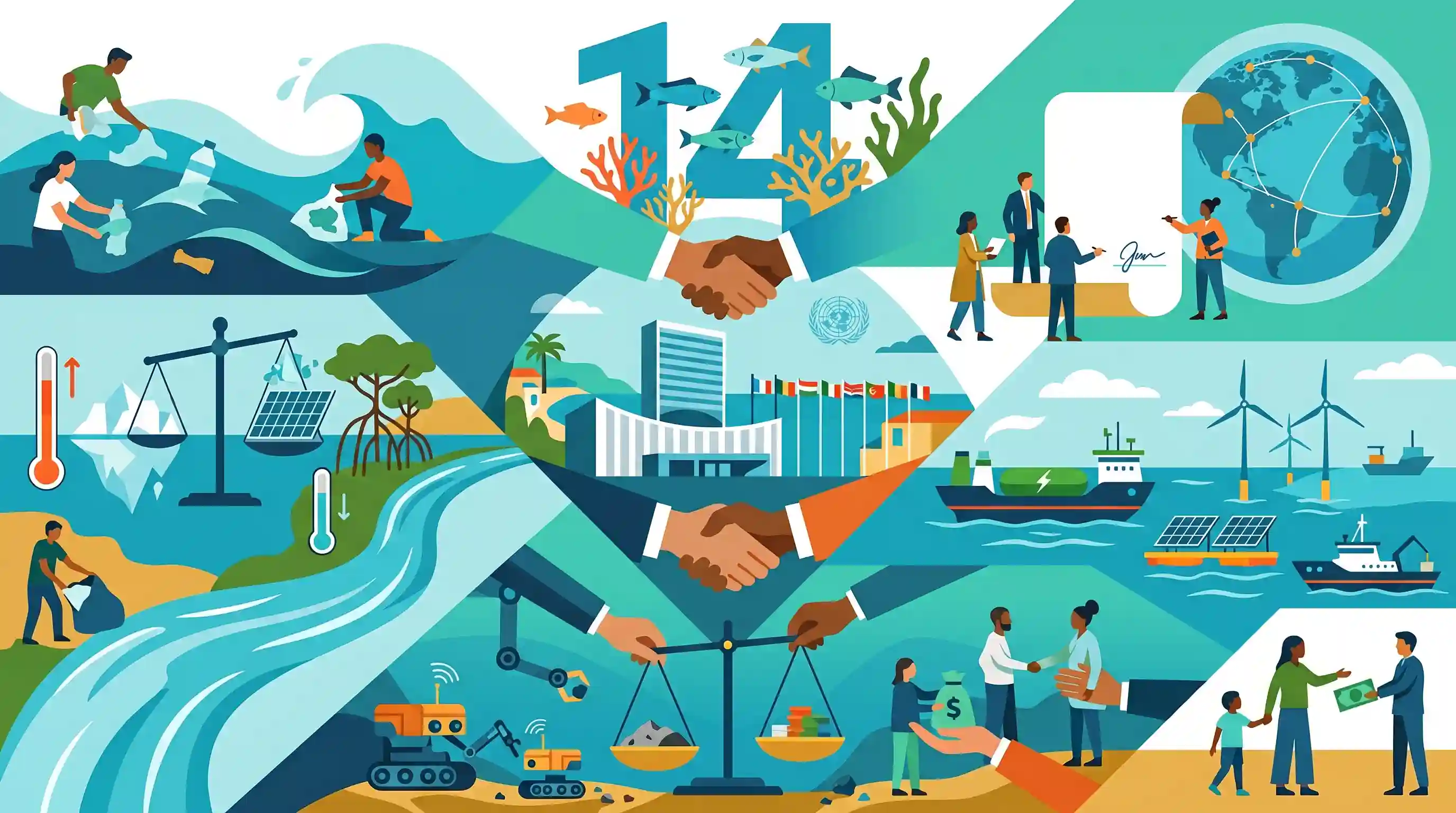
The article highlights the significance of the upcoming Third United Nations Ocean Conference (UNOC-3), set to take place in Nice, France, as a vital opportunity to build global consensus on ocean governance. With the pressing need to achieve Sustainable Development Goal 14 (Life Below Water), the conference will focus on combating marine pollution, mitigating climate change impacts on oceans, and promoting a sustainable Blue Economy. It underscores the urgency of ratifying the High Seas Treaty (BBNJ Agreement) to protect marine biodiversity beyond national jurisdictions and the need for equitable frameworks governing emerging activities like deep-seabed mining. The event serves as a platform for diplomatic cooperation to address disparities between developed and developing nations in maritime capacity and conservation financing.
Key Points
- The upcoming Third UN Ocean Conference (UNOC-3), to be co-hosted by France and Costa Rica in Nice in 2025, represents a crucial juncture for global maritime governance.
- UNOC-3 aims to accelerate actions towards achieving Sustainable Development Goal 14 (SDG 14: Life Below Water), focusing on marine conservation, reducing ocean pollution, and sustainable management of marine resources.
- A major priority is building consensus on ratifying and implementing the landmark Biodiversity Beyond National Jurisdiction (BBNJ) Agreement, commonly known as the High Seas Treaty.
- Discussions will heavily feature the sustainable expansion of the Blue Economy, alongside debates over regulations surrounding deep-seabed mining under the purview of the International Seabed Authority.
- The conference offers an opportunity to bridge the divide between the Global North and South regarding climate finance, technology transfer, and capacity building for coastal and island nations.
Important Terms
United Nations Convention on the Law of the Sea (UNCLOS)

Adopted in 1982, it is the comprehensive international legal framework—often called the "Constitution of the Oceans"—governing maritime zones, navigation rights, and resource management across the world's oceans.
UPSC context
GS Paper II (International Relations) & III (Environment); key for maritime boundaries, EEZs, and global ocean governance.
High Seas Treaty (BBNJ Agreement)
A 2023 legally binding agreement under UNCLOS aimed at protecting marine biodiversity in the 'High Seas'—areas beyond national jurisdictions—which comprise nearly two-thirds of the global ocean.
UPSC context
GS Paper III (Environment); focuses on marine genetic resources and the '30x30' biodiversity conservation target.
Blue Economy
The sustainable use of ocean resources for economic growth, improved livelihoods, and jobs while preserving the health of marine ecosystems; a major focus for India’s coastal development.
UPSC context
GS Paper III (Economic Development); relates to fisheries, deep-sea mining, and sustainable maritime infrastructure.
Sustainable Development Goal 14 (SDG 14)
Titled 'Life Below Water,' this 2030 Agenda goal seeks to prevent marine pollution, manage coastal ecosystems sustainably, and end overfishing to ensure ocean health.
UPSC context
GS Paper III (Environment); standard reference for questions on conservation and global sustainable development commitments.
International Seabed Authority (ISA)
An intergovernmental body established under UNCLOS to regulate and control mineral-related activities in the international seabed area, ensuring environmental protection and equitable benefit sharing.
UPSC context
GS Paper II (International Institutions); critical for topics regarding deep-sea mining and the 'common heritage of mankind.'
Third United Nations Ocean Conference (UNOC-3)
A global summit scheduled for June 2025 in Nice, France, aimed at building consensus on the 'Nice Ocean Action Plan' and accelerating progress on SDG 14.
UPSC context
GS Paper II (International Forums); marks a critical milestone for future global maritime and environmental diplomacy.
Prelims Trap
"The International Seabed Authority (ISA) regulates marine biodiversity and fishing in the High Seas."
The ISA regulates ONLY mineral-related activities (deep-seabed mining) in the seabed beyond national jurisdiction, not water-column biodiversity or fishing.
Static Concepts Connected
What are the primary maritime zones established under UNCLOS?
- Territorial Sea: Extends up to 12 nautical miles from the baseline; the coastal state exercises full sovereignty over the air space, water, and seabed.
- Exclusive Economic Zone: Extends up to 200 nautical miles; the coastal state has sovereign rights for exploring, exploiting, and managing resources in the water column and seabed.
- The Area: The seabed and subsoil beyond national jurisdiction, governed by the ISA and designated as the common heritage of mankind.
What is the High Seas Treaty (BBNJ Agreement) and its core objective?
- Legal framework: It is a legally binding implementation agreement under UNCLOS, not a standalone parallel treaty overriding it.
- Core objectives: Establishing Marine Protected Areas (MPAs) beyond national jurisdictions and ensuring equitable sharing of benefits from Marine Genetic Resources (MGRs).
- Ratification status: It has not yet entered into force; it requires 60 ratifications by UN member states to become operational.
Cross-Topic Patterns
India's Deep Ocean Mission
UNOC-3 debates on the ISA's deep-seabed mining regulations directly dictate the future of India's Samudrayaan project and extraction of polymetallic nodules in the Indian Ocean.
Climate Finance and Marine Genetic Resources
The fight over equitable sharing of Marine Genetic Resources (MGRs) under BBNJ mirrors the Global South's demands for technology transfer and CBDR at UNFCCC COP summits.

Expect a multi-statement Prelims question mixing BBNJ provisions (Marine Genetic Resources) with the ISA's deep-seabed mining domain.
Linked PYQs · 4
Linked PYQs · 4
- 2022PrelimsGS1
With reference to the United Nations Convention on the Law of Sea, consider the following statements : 1. A coastal state has the right to establish the breadth of its territorial sea up to a limit not exceeding 12 nautical miles, measured from baseline determined in accordance with the convention. 2. Ships of all states, whether coastal or land-locked, enjoy the right of innocent passage through the territorial sea. 3. The Exclusive Economic Zone shall not extend beyond 200 nautical miles from the baseline from which the breadth of the territorial sea is measured. Which of the statements given above are correct?
- 2021PrelimsGS1
Consider the following statements : 1. The Global Ocean Commission grants licences for seabed exploration and mining in international waters. 2. India has received licences for seabed mineral exploration in international waters. 3. 'Rare earth minerals' are present on seafloor in international waters. Which of the statements given above are correct?
- 2023MainsGS2
‘Sea is an important Component of the Cosmos’ Discuss in the light of the above statement the role of the IMO (International Maritime Organisation) in protecting environment and enhancing maritime safety and security.
- 2021PrelimsGS1
What is blue carbon?
