Annapurna Yojana third financial installment disbursement schedule
Source:thestatesman ↗
Why It Matters
Understanding state-level welfare schemes, direct benefit transfers (DBT) for women, and the administrative intersection between citizenship/voting rights and scheme eligibility is crucial for WBCS Prelims and State-specific Polity/Governance topics.
Summary
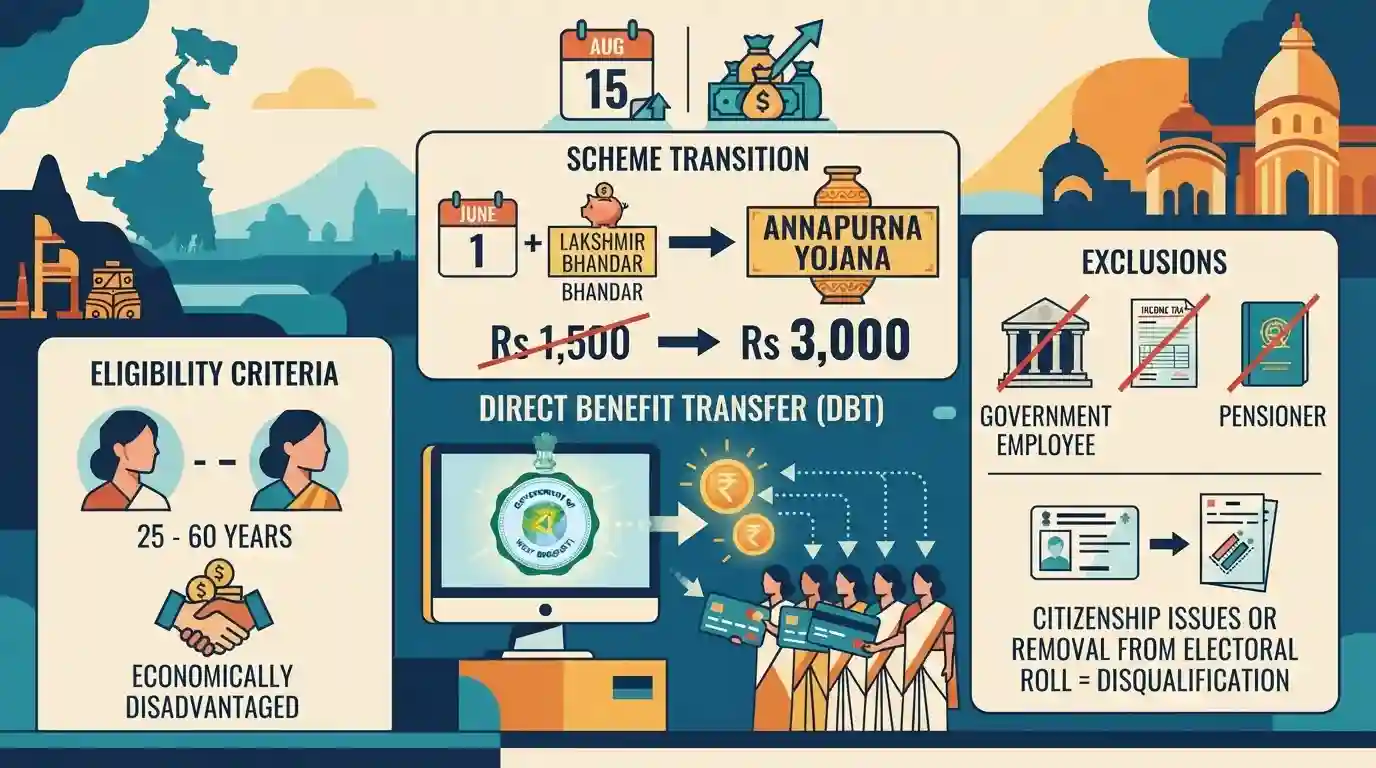
The West Bengal government is set to disburse the third installment of the 'Annapurna Yojana' (also known as Annapurna Bhandar) after August 15. Introduced on June 1 by the state's new administration, the scheme replaces the previous 'Lakshmir Bhandar' initiative and increases the monthly financial assistance for eligible women aged 25 to 60 from Rs 1,500 to Rs 3,000. Beneficiaries must meet strict eligibility criteria, including being economically disadvantaged Indian citizens. Individuals such as government employees, income taxpayers, and pensioners are excluded. Furthermore, citizenship issues or removal from the electoral roll could lead to disqualification.
Key Points
- The West Bengal government will disburse the third monthly installment of the Annapurna Bhandar scheme after August 15.
- The scheme replaces the previous Lakshmir Bhandar initiative, doubling the monthly financial assistance for eligible women from Rs 1,500 to Rs 3,000.
- Eligibility is restricted to economically disadvantaged female Indian citizens between the ages of 25 and 60.
- Government employees, pensioners, income taxpayers, and elected representatives of local bodies are excluded from the scheme.
- Beneficiaries facing citizenship disputes or whose names are removed from the electoral roll may lose their eligibility for the scheme.
Important Terms
Annapurna Yojana

A 2026 West Bengal welfare scheme providing ₹3,000 monthly to eligible women aged 25-60 via Direct Benefit Transfer. It strictly excludes income-tax payers, government employees, and those without valid citizenship.
UPSC context
GS Paper 2 (Welfare Schemes). Highlights conditional cash transfers, women's financial empowerment, and the intersection of state welfare with citizenship criteria.
Lakshmir Bhandar
A flagship direct-benefit transfer scheme launched in 2021 by the previous West Bengal government to provide basic monthly income to women. It was replaced by the Annapurna Yojana in June 2026.
UPSC context
GS Paper 2 (Welfare Schemes). Essential for comparative analysis of state-level basic income models and assessing fiscal burdens on state economies.
Annapurna Bhandar
An alternative, interchangeable name for the Annapurna Yojana, representing West Bengal's revised 2026 direct cash transfer scheme for women's socio-economic upliftment.
UPSC context
GS Paper 2 (Welfare Schemes). Important to recognize as official state notifications and public discourse use both terms simultaneously for the scheme.
Prelims Trap
The Annapurna Yojana is a Centrally Sponsored Scheme providing food grains to senior citizens.
UPSC preys on name overlap. The central 'Annapurna Scheme' (2000) gives food grains to indigent seniors, whereas this news covers West Bengal's state DBT scheme for women aged 25-60.
Static Concepts Connected
What is the legal framework governing the preparation of electoral rolls in India?
- Article 324: Vests the superintendence, direction, and control of the preparation of electoral rolls in the Election Commission of India (ECI).
- RPA 1950: Contains the detailed statutory framework governing the qualification of voters and the preparation/revision of electoral rolls.
- Article 325 & 326: Grants universal adult suffrage, stating that no person shall be ineligible for inclusion on the electoral roll on grounds of religion, race, caste, or sex.
Which core constitutional rights and privileges are exclusively limited to Indian citizens?
- Fundamental Rights: Articles 15, 16, 19, 29, and 30 are explicitly reserved for citizens, denying them to foreign nationals.
- Political Rights: Only citizens can be registered as voters (RPA 1950) or hold offices like the President, Vice-President, or Supreme Court Judge.
- Welfare Eligibility: While basic rights like Article 21 apply to non-citizens, states can constitutionally restrict targeted financial welfare (like state DBTs) to citizens.
Cross-Topic Patterns
Welfare schemes & citizenship tests
Using ECI's Special Intensive Revision (SIR) to filter state DBT beneficiaries marks a novel administrative integration of voter-roll purification with welfare expenditure targeting.
State DBTs and fiscal burden
The doubling of unconditional cash transfers highlights competitive welfarism among states, frequently raising macroeconomic concerns regarding state fiscal deficits and Article 293 borrowing limits.

Expect a multi-statement Polity question testing the overlap between state welfare eligibility, ECI electoral rolls (RPA 1950), and citizenship.
Linked PYQs · 3
Linked PYQs · 3
- 2019WBCS_PRELIMSGS1
Right to vote and to be elected in India is a
- 2023WBCS_PRELIMSGS1
Who among the following has been given the power by the Indian Constitution to 'impose reasonable restrictions' on the fundamental rights?
- 2020WBCS_PRELIMSGS1
The Governor of West Bengal is
