Rajasthan High Court Protects Maternity Leave Rights for Third Child
Source:times-of-india ↗
Why It Matters
This judgment is highly relevant for RPSC RAS Prelims as it deals directly with Rajasthan Service Rules and the state's two-child policy, contrasting them with central welfare laws and constitutional rights (DPSP). It highlights the evolving jurisprudence on women's rights in government employment in Rajasthan.
Summary
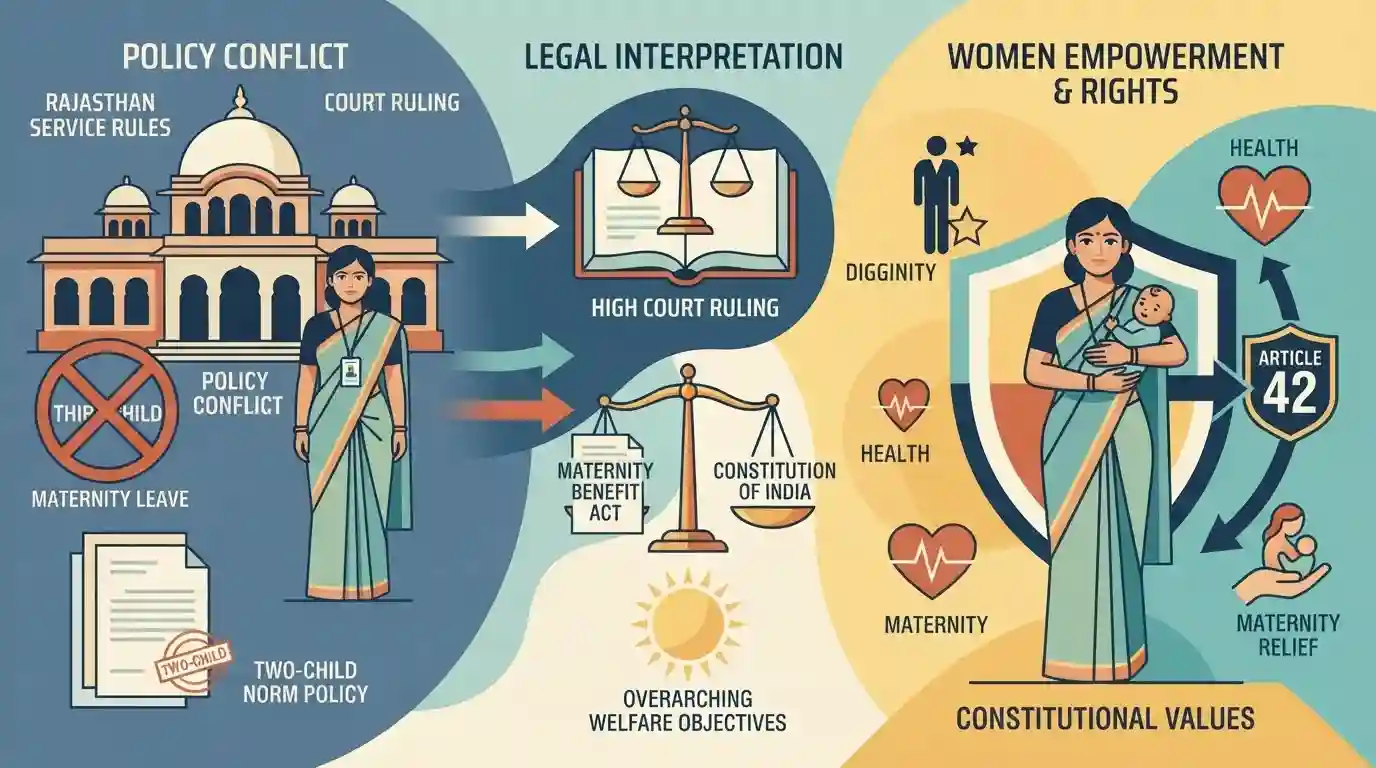
The Rajasthan High Court has delivered a significant ruling stating that a female government employee's right to a second maternity leave cannot be denied merely because she is pregnant with her third child. The Court observed that maternity leave provisions under the Rajasthan Service Rules must be read in harmony with the overarching welfare objectives of the Maternity Benefit Act and the Constitution of India. It emphasized that state policies aimed at population control, such as the two-child norm, should not be applied so strictly as to deprive women of their fundamental right to dignity, health, and maternity relief as enshrined in Article 42.
Key Points
- The Rajasthan High Court ruled that a woman government employee cannot be denied her second maternity leave solely because the upcoming delivery is for her third child.
- The Court emphasized that the provisions of the Maternity Benefit Act, 1961, being a central welfare legislation, and constitutional mandates regarding maternity relief cannot be interpreted narrowly.
- The judgment addresses the conflict between Rajasthan's strict two-child norm in civil service rules and a woman's fundamental right to maternity benefits.
- The ruling reinforces Directive Principles of State Policy, particularly Article 42, which directs the State to make provisions for securing just and humane conditions of work and maternity relief.
Prelims Trap
"Women employees are completely barred from availing maternity leave for a third child under Indian law."
The central Maternity Benefit Act, 1961 does not bar leave for a third child; it merely reduces the paid leave duration from 26 weeks to 12 weeks.
Static Concepts Connected
What constitutional provisions safeguard maternity relief and women's reproductive rights in India?
- Article 42: Directs the State to make provisions for securing just and humane conditions of work and for maternity relief (DPSP).
- Article 21: The Supreme Court interprets a woman's reproductive choices, dignity, and right to maternity benefits as intrinsic to the fundamental Right to Life and Personal Liberty.
How does the two-child norm legally impact Rajasthan state government employees?
- Service Disqualification: Candidates having more than two children born on or after June 1, 2002, are generally disqualified from state government appointments and face deferred promotions.
- Child Care Leave: Under Rule 103C of the Rajasthan Service Rules, the 730-day Child Care Leave (CCL) is strictly restricted to the care of the two eldest surviving children.
Cross-Topic Patterns
Population Control vs DPSP Welfare
Highlights the judicial balancing act between Rajasthan's strict demographic goals (two-child norm in service rules) and the overarching constitutional mandate of Article 42 (maternity relief).
Central Welfare Laws vs State Service Rules
Demonstrates how central welfare legislation (Maternity Benefit Act, 1961) serves as an interpretive guide to prevent narrow application of state-level service rules (Rajasthan Service Rules).

Expect a multi-statement question blending Article 42, Rajasthan Service Rules (Rule 103), and 3rd-child leave limits in the central Act.
Linked PYQs · 2
Linked PYQs · 2
- 2021RPSC_PRELIMSGS1
Which of the following pairs of Directive Principles of State Policy as described in the Constitution of India is correctly matched?
- 2023RPSC_PRELIMSGS1
Match the following list – P (Directive Principles) with list – R (Article): List – P List – R A. Equal justice and free legal aid I. Article 48 A B. Protection of the environment II. Article 39 A C. Right to work III. Article 41 D. Preservation of monuments IV. Article 49 Choose the correct option: . A B C D
