Delhi Winter Smog and Air Quality Index Deterioration
Source:The Hindu ↗
Why It Matters
The persistent issue of winter smog and poor air quality in Delhi is a highly testable area in UPSC GS3 (Environment) and GS1 (Geography). Candidates must understand the scientific mechanisms of fog formation, temperature inversion, the role of meteorological factors in trapping pollutants, and the parameters used by the CPCB to measure the Air Quality Index (AQI).
Summary
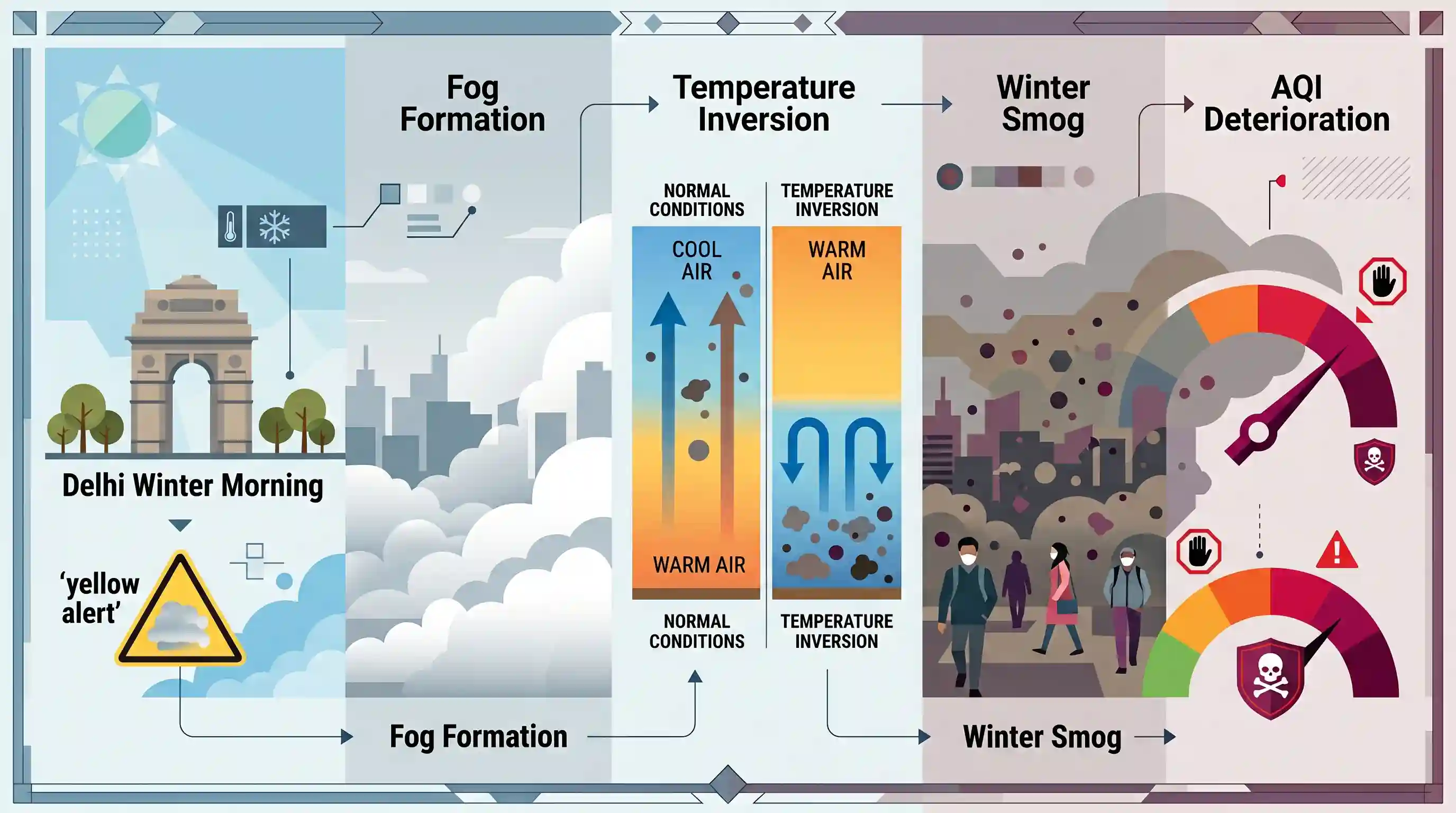
Delhi experienced thick fog on a winter morning, leading the India Meteorological Department (IMD) to issue a 'yellow alert'. These stagnant weather conditions, coupled with a minimum temperature of 8.2°C, trapped pollutants close to the surface, causing the city's Air Quality Index (AQI) to deteriorate sharply to the 'very poor' category. The incident underscores the severe environmental and geographic challenges North India faces during winter, where fog and temperature inversion exacerbate urban air pollution.
Key Points
- A thick layer of fog enveloped Delhi on a Wednesday morning, prompting the IMD to issue a 'yellow alert' for dense fog.
- The reduced visibility and stagnant weather conditions caused Delhi's Air Quality Index (AQI) to plummet into the 'very poor' category, recording an AQI of 319.
- The minimum temperature recorded at the Safdarjung weather station dropped to 8.2°C, which is a notch below normal for this time of year.
- The situation highlights the persistent wintertime phenomenon in North India where cold temperatures, fog, and low wind speeds trap particulate matter, leading to severe air pollution episodes.
Important Terms
India Meteorological Department (IMD)

Established in 1875 under the Ministry of Earth Sciences, it is India's principal agency for weather forecasting, meteorological observations, and seismic monitoring. It uses color-coded alerts for severe weather.
UPSC context
GS Paper I (Geography) and III (Disaster Management); tests institutional frameworks for weather monitoring and early warning systems.
Central Pollution Control Board (CPCB)
A statutory body established in 1974 under the MoEFCC. It coordinates pollution control activities, sets environmental standards, and provides technical services for the Air and Water Acts.
UPSC context
GS Paper III (Environment & Ecology); focuses on statutory bodies and their roles in environmental governance and law enforcement.
National Air Quality Index (AQI)
A 2014 initiative that converts complex air quality data into a single number and color code. It monitors eight pollutants: PM10, PM2.5, NO2, SO2, CO, O3, NH3, and Pb.
UPSC context
GS Paper III (Environment); critical for understanding air pollution metrics, public health advisories, and urban monitoring technicalities.
Temperature Inversion
A meteorological phenomenon where warm air traps a cooler layer near the ground, reversing the normal lapse rate. This prevents pollutant dispersion, leading to severe winter smog.
UPSC context
GS Paper I (Physical Geography); explains atmospheric stability, winter smog formation, and geographic challenges in the Indo-Gangetic Plain.
Yellow Alert
An IMD weather warning meaning 'Be Aware.' It indicates marginally bad weather (like thick fog) that may disrupt daily activities or worsen, requiring authorities and the public to stay updated.
UPSC context
GS Paper III (Disaster Management); tests knowledge of color-coded early warning systems used to communicate meteorological risks.
Graded Response Action Plan (GRAP)
A set of emergency anti-pollution measures for Delhi-NCR triggered by specific AQI thresholds. It includes four stages (Poor to Severe Plus) with corresponding administrative restrictions.
UPSC context
GS Paper III (Environment); focuses on policy interventions and administrative responses to seasonal environmental crises in the capital region.
Prelims Trap
Carbon dioxide (CO2) is one of the eight atmospheric pollutants measured to calculate the National Air Quality Index (AQI).
Aspirants often confuse CO2 (a major greenhouse gas) with Carbon Monoxide (CO). The National AQI measures CO, but it does NOT measure CO2.
Static Concepts Connected
How does temperature inversion exacerbate urban winter pollution?
- Normal lapse rate: Usually, temperature decreases with altitude, allowing warm, polluted surface air to rise and naturally disperse into the upper atmosphere.
- Inversion layer: During winter nights, the ground cools rapidly, making surface air colder than the air above it, effectively forming a warm air 'lid' over the region.
- Pollutant trapping: This highly stable atmospheric condition stops vertical air mixing, trapping PM2.5, vehicular emissions, and dust dangerously close to the ground.
What are the ideal conditions for the formation of radiation fog?
- Clear skies: Essential for maximum terrestrial long-wave radiation escape at night, which rapidly cools the Earth's surface.
- Calm winds: Light or calm winds prevent the mixing of cold surface air with the warmer air above, allowing the fog layer to settle.
- High humidity: Sufficient moisture is needed so that the rapid terrestrial cooling pushes the air temperature down to its dew point, causing condensation.
Cross-Topic Patterns
CAQM and environmental federalism
CAQM's statutory power to supersede state pollution control boards in Delhi, Punjab, Haryana, Rajasthan, and UP raises frequent constitutional debates regarding environmental federalism and state autonomy.
Winter smog and agricultural MSP policies
Delhi's geographic vulnerability is worsened by upwind stubble burning, creating a direct link between urban air quality crises and agricultural policies like MSP that incentivize water-intensive paddy.

Expect a 2026 question linking climatology (temperature inversion, radiation fog) with the statutory powers of the CAQM and GRAP.
Linked PYQs · 3
Linked PYQs · 3
- 2016PrelimsGS1
In the cities of our country, which among the following atmospheric gases are normally considered in calculating the value of Air Quality Index? 1. Carbon dioxide 2. Carbon monoxide 3. Nitrogen dioxide 4. Sulfur dioxide 5. Methane Select the correct answer using the code given below.
- 2022PrelimsGS1
In the context of WHO Air Quality Guidelines, consider the following statements: 1. The 24-hour mean of PM2.5 should not exceed 15 µg/m³ and annual mean of PM2.5 should not exceed 5 µg/m³. 2. In a year, the highest levels of ozone pollution occur during the periods of inclement weather. 3. PM10 can penetrate the lung barrier and enter the bloodstream. 4. Excessive ozone in the air can trigger asthma. Which of the statements given above are correct?
- 2022MainsGS3
Discuss in detail the photochemical smog emphasizing its formation, effects and mitigation. Explain the 1999 Gothenburg Protocol.
