Soil Sakhis Transform Agriculture in Maharashtra Drought Regions
Source:The Hindu ↗
Why It Matters
Provides a highly replicable case study for Mains GS2/GS3 on how grassroots women's empowerment can be effectively coupled with technology-driven agricultural extension services to achieve climate-resilient farming and rural prosperity.
Summary
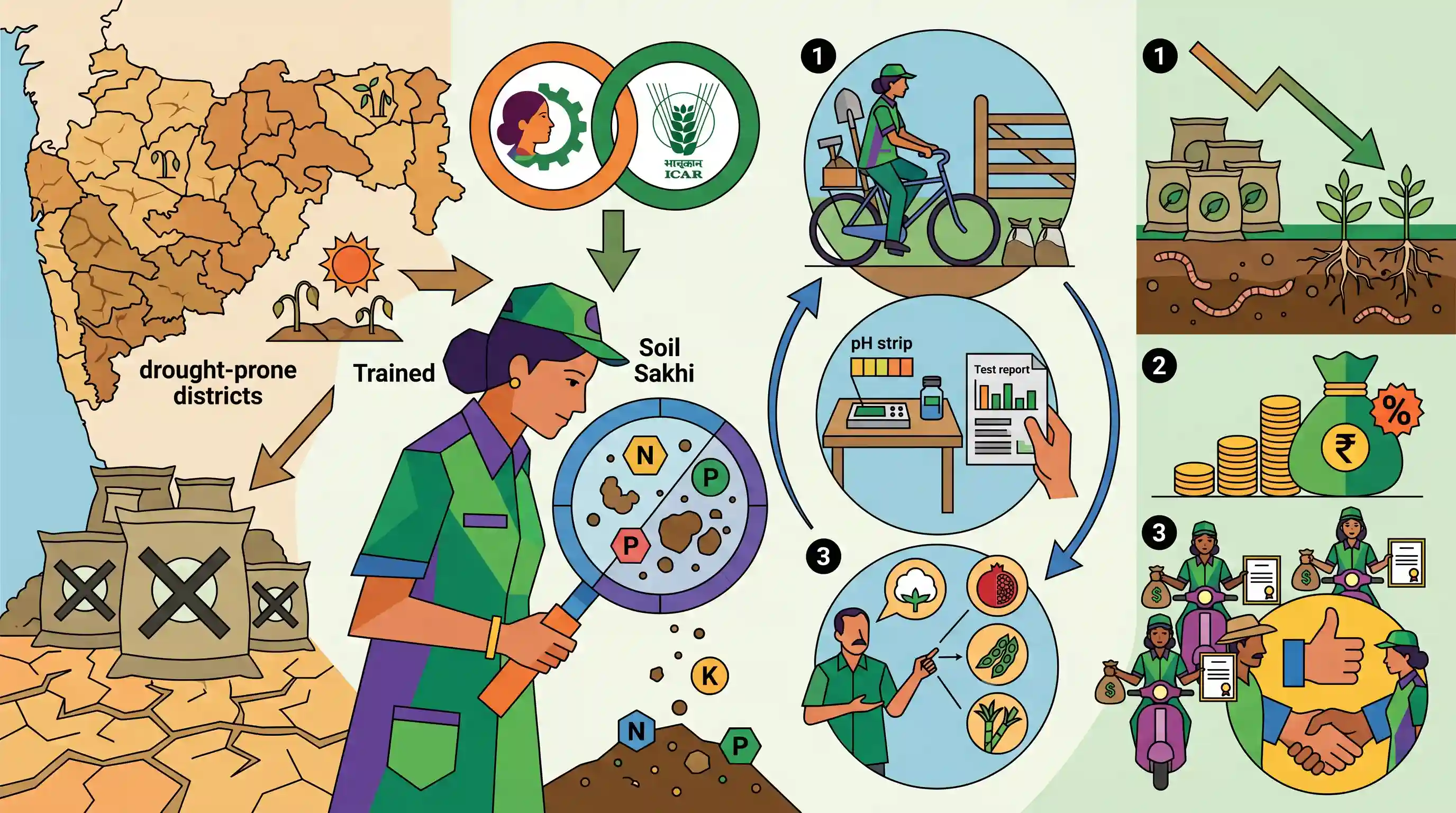
In Maharashtra's drought-prone districts, 'soil sakhis'—women from marginalized communities—are driving an agricultural transformation by bringing scientific soil testing to farmers' doorsteps. An initiative of the Mann Deshi Foundation in collaboration with ICAR, these trained women collect soil samples and provide specific advisory on crop nutrition. The project has reduced fertilizer overuse by 20-30%, saving farmers money and improving soil health, while simultaneously creating new livelihood streams and empowering rural women as respected agricultural experts.
Key Points
- 'Soil sakhis', women from marginalized communities trained as para-agronomists, are facilitating scientific soil testing in drought-prone regions of Maharashtra.
- Spearheaded by the Mann Deshi Foundation and ICAR-NRCP, the initiative trains women to collect soil/water samples and provide tailored nutrient advisories to farmers.
- The intervention has helped farmers reduce fertilizer use by 20-30%, lowering input costs, improving soil health, and mitigating greenhouse gas emissions.
- Beyond agricultural impact, the programme financially empowers rural women, elevating their social status and decision-making power within their communities.
Important Terms
Soil Sakhis

Rural women trained as community agronomists to provide doorstep soil testing and scientific advisory, bridging the gap between laboratories and marginal farmers.
UPSC context
GS Paper II (Role of Women & SHGs) and GS Paper III (Agriculture & Extension services). Tests grassroots empowerment models.
Mann Deshi Foundation
A leading NGO focusing on rural women's empowerment through financial inclusion (Mann Deshi Bank) and agricultural initiatives like the 'Soil Sakhi' program.
UPSC context
GS Paper II (Development Processes & NGOs). Relevant for examples of non-state actors in rural transformation.
Indian Council of Agricultural Research (ICAR)
The apex national body for coordinating and managing agricultural research and education in India, operating under the Ministry of Agriculture and Farmers Welfare.
UPSC context
GS Paper III (Technology in Agriculture). Key institution for research-led agricultural growth and food security.
ICAR-National Research Centre on Pomegranate (NRCP)
A Solapur-based ICAR institute dedicated to specialized research, advisory, and training for pomegranate cultivation, specifically for drought-prone regions.
UPSC context
GS Paper III (Major Crops/Cropping Patterns). Illustrates crop-specific research interventions for marginal farmers.
Soil Health Card (SHC) Scheme
A flagship government scheme providing farmers with reports on 12 nutrient parameters to promote balanced fertilizer use and sustainable soil management.
UPSC context
GS Paper III (Soil Health & Agriculture). A core component of government agricultural productivity policies.
Agricultural Extension
The process of delivering scientific knowledge, techniques, and information to farmers to improve productivity, livelihoods, and sustainable practices.
UPSC context
GS Paper III (E-technology in aid of farmers). Crucial for technology transfer and last-mile connectivity.
Feminisation of Agriculture
The increasing participation of women in agricultural labor and management, often a result of male migration from rural to urban areas.
UPSC context
GS Paper I (Social Issues) and GS Paper III (Agriculture). Focuses on changing rural demographics and labor.
Prelims Trap
Soil Sakhis are centrally sponsored government extension workers employed under the National Soil Health Card scheme.
Aspirants often confuse NGO-led initiatives with official government cadres. Soil Sakhis here are driven by an NGO (Mann Deshi), not state-appointed agents.
Static Concepts Connected
What are the 12 parameters tested under the Soil Health Card (SHC) Scheme?
- Macronutrients: Nitrogen (N), Phosphorus (P), and Potassium (K)—which are currently heavily skewed in Indian farming.
- Micronutrients & Secondary: Zinc, Iron, Copper, Manganese, Boron, and Sulphur (secondary).
- Physical parameters: pH (acidity), Electrical Conductivity (EC), and Organic Carbon (OC) to judge overall soil health.
What is the 'Feminization of Agriculture' in India?
- Core Driver: Increasing rural-to-urban migration by men for non-farm jobs leaves women with the primary responsibility of managing day-to-day agricultural activities.
- Major Hurdle: Despite contributing over 70% of farm labor, women rarely hold land titles, severely restricting their access to institutional credit, insurance, and subsidies.
- Extension Gap: State agricultural extension services are overwhelmingly male-dominated, making community-led models essential for female technology adoption.
Cross-Topic Patterns
NRLM + Agriculture Extension gap
Community resource persons (like Krishi Sakhis or Soil Sakhis) bridge the critical GS2-GS3 gap where formal state agriculture departments fail at last-mile delivery of farming advisory.
Fertilizer Subsidies + GHG Emissions
Rationalizing NPK application via localized soil testing directly lowers nitrous oxide (N2O) emissions—a highly potent greenhouse gas stemming from India's systemic urea overuse.

Expect a 2026 Mains question linking the 'feminization of agriculture' with SHG-driven extension services and climate-smart farming.
Linked PYQs · 4
Linked PYQs · 4
- 2017PrelimsGS1
Consider the following statements: The nation-wide 'Soil Health Card Scheme' aims at 1. expanding the cultivable area under irrigation. 2. enabling the banks to assess the quantum of loans to be granted to farmers on the basis of soil quality. 3. checking the overuse of fertilizers in farmlands. Which of the above statements is/are correct?
- 2020MainsGS2
Micro-Finance as an anti-poverty vaccine, is aimed at asset creation and income security of the rural poor in India". Evaluate the role of the Self Help Groups in achieving the twin objectives along with empowering women in rural India.
- 2014MainsGS2
The penetration of Self Help Groups (SHGs) in rural areas in promoting participation in development programmes is facing socio-cultural hurdles. Examine.
- 2019MainsGS1
“Empowering women is the key to control population growth.” Discuss.
