India Strategies to Navigate AI Disruption and Workforce Reskilling
Source:Indian Express ↗
Why It Matters
Artificial Intelligence is a focal point in the UPSC syllabus across multiple papers (GS3 Science & Tech, GS3 Economy/Employment, and GS4 Ethics). Understanding the socio-economic impacts of AI, particularly on India's large workforce, and the governance frameworks required to regulate it are essential for both Prelims and Mains.
Summary
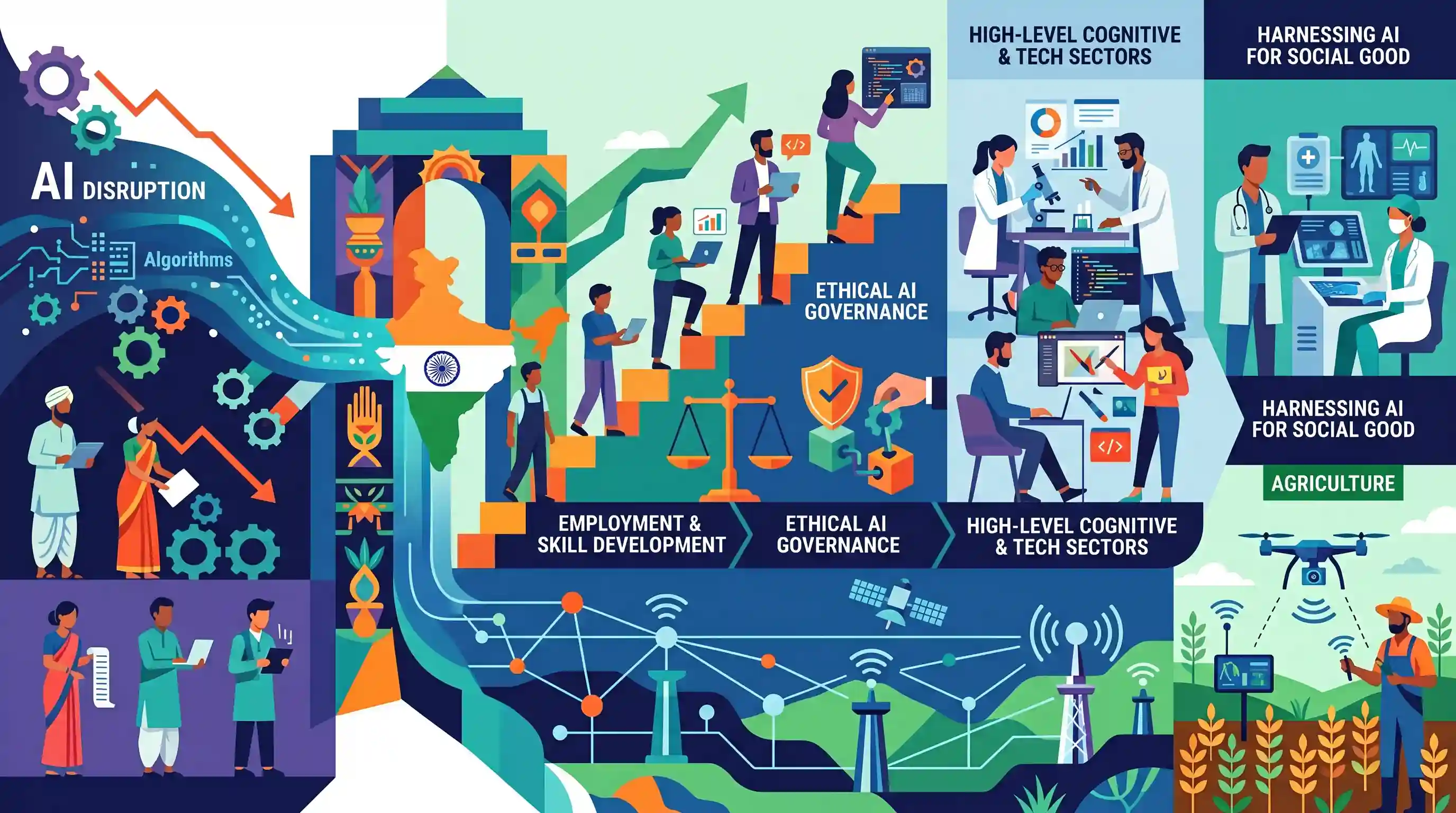
The article discusses how India can proactively prepare for the impending "great AI disruption." It highlights the dual impact of Artificial Intelligence on the economy: displacing routine jobs while creating opportunities in high-level cognitive and tech-driven sectors. To effectively navigate this transition, the author advocates for massive reskilling programs, building a balanced regulatory framework to ensure ethical AI deployment, and leveraging India's robust Digital Public Infrastructure (DPI). By focusing on these areas, India can harness AI for social good—improving sectors like healthcare and agriculture—while mitigating risks related to workforce displacement and algorithmic bias.
Key Points
- AI presents a significant disruption to India's labor market, requiring a transition from routine tech jobs to advanced cognitive roles.
- Proactive reskilling and upskilling initiatives, ideally through public-private partnerships, are essential to maintain workforce relevance.
- India requires a balanced regulatory framework for AI that promotes innovation while addressing data privacy, algorithmic bias, and ethical concerns.
- Strategic deployment of AI in sectors like healthcare, agriculture, and education can significantly enhance public service delivery and socio-economic development.
- Leveraging existing Digital Public Infrastructure (DPI) can democratize access to AI technologies across the country.
Important Terms
IndiaAI Mission

A comprehensive national initiative under the Ministry of Electronics and IT (MeitY) to establish a robust AI ecosystem through seven pillars, including high-performance computing (GPUs), indigenous datasets, and specialized skill development.
UPSC context
GS Paper III (Science & Tech); relevant for questions on technological sovereignty and India's strategy to become a global AI leader.
Digital Public Infrastructure (DPI)
A collection of shared digital systems (like Aadhaar, UPI, and DigiLocker) built on open standards and interoperable protocols that enable societal-scale delivery of public and private services.
UPSC context
GS Paper II (Governance) and III (Economy); tests understanding of e-governance, financial inclusion, and the 'India Stack' model.
National Strategy for Artificial Intelligence (NSAI)
A roadmap released by NITI Aayog in 2018 focusing on the '#AIforAll' vision, identifying five core sectors for AI intervention: healthcare, agriculture, education, smart cities, and smart mobility.
UPSC context
GS Paper III (Science & Tech); essential for discussing the evolution of India's policy framework and ethical AI deployment.
NITI Aayog
The premier policy think tank of the Government of India, established in 2015 to replace the Planning Commission; it facilitates cooperative federalism and provides strategic and technical advice.
UPSC context
GS Paper II (Governance/Statutory Bodies); central to topics on policy formulation, federalism, and long-term developmental planning.
Digital India
A flagship umbrella program launched in 2015 to transform India into a digitally empowered society and knowledge economy through broadband expansion, e-governance, and universal digital literacy.
UPSC context
GS Paper II (E-governance) and III (Infrastructure); tests the broader vision of bridging the digital divide and enabling a tech-driven economy.
Prelims Trap
"NITI Aayog's National Strategy for AI establishes a legally binding regulatory framework."
India currently lacks a standalone, statutory AI law. NITI Aayog’s "National Strategy for Artificial Intelligence" is purely advisory, not a legally binding framework.
Static Concepts Connected
What are the foundational layers of India's DPI (India Stack)?
- Identity Layer: Powered by Aadhaar, providing a unique biometric digital identity to citizens.
- Payments Layer: Powered by UPI, enabling fast, interoperable, and cashless fiat transactions.
- Data Layer: Driven by DEPA (Data Empowerment and Protection Architecture), allowing secure, consent-based data sharing.
What are the primary ethical concerns regarding AI deployment?
- Algorithmic Bias: Systems inheriting and amplifying historical prejudices and discrimination from their training datasets.
- Black Box Problem: The lack of transparency or explainability in how complex AI models reach specific decisions.
- Data Privacy: The scraping and utilization of personal information for model training without explicit user consent.
Cross-Topic Patterns
AI automation vs Demographic Dividend
AI-driven displacement of routine IT and BPO jobs threatens India's demographic dividend, making public-private upskilling critical for inclusive growth.
AI + Climate-Smart Agriculture
Predictive AI models using satellite data help optimize fertilizer usage and crop planning, mitigating the impacts of erratic monsoons on food security.

Expect a GS3 question evaluating AI's threat to India's IT sector employment, or a Prelims MCQ linking AI platforms to DPI layers.
Linked PYQs · 5
Linked PYQs · 5
- 2023MainsGS3
Introduce the concept of Artificial Intelligence (AI). How does Al help clinical diagnosis? Do you perceive any threat to privacy of the individual in the use of Al in healthcare?
- 2024MainsGS4
The application of Artificial Intelligence as a dependable source of input for administrative rational decision-making is a debatable issue. Critically examine the statement from the ethical point of view.
- 2022MainsGS3
Economic growth in the recent past has been led by increase in labour productivity." Explain this statement. Suggest the growth pattern that will lead to creation of more jobs without compromising labour productivity.
- 2020PrelimsGS1
With the present state of development, Artificial Intelligence can effectively do which of the following? 1. Bring down electricity consumption in industrial units 2. Create meaningful short stories and songs 3. Disease diagnosis 4. Text-to-Speech Conversion 5. Wireless transmission of electrical energy Select the correct answer using the code given below:
- 2015MainsGS3
What are the areas of prohibitive labour that can be sustainably managed by robots ? Discuss the initiatives that can propel research in premier research institutes for substantive and gainful innovation.
