COVID-19 new variants surveillance and public health preparedness
Source:Indian Express ↗
Why It Matters
Provides a balanced governance and public health perspective on managing endemic diseases, which is crucial for GS2 (Health Policy) and GS3 (Science & Technology - Vaccines/Mutations).
Summary
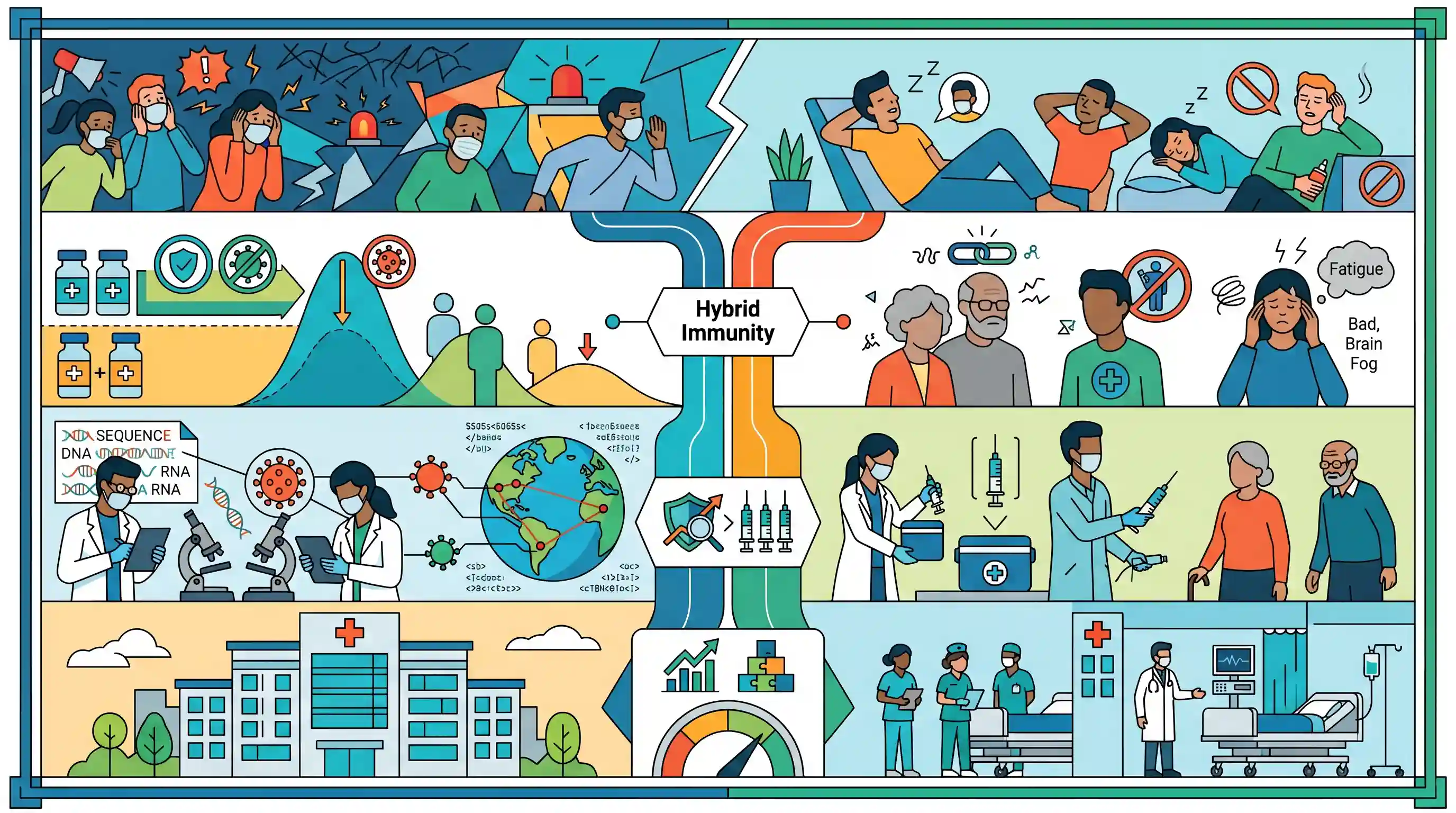
The article cautions against the two extremes of widespread panic and complacent dismissal regarding new COVID-19 variants. While hybrid immunity from prior infections and vaccinations has significantly reduced the severity of the disease, equating it to seasonal flu ignores the persistent threats of Long COVID and heightened risks for the elderly and immunocompromised. The author advocates for a balanced public health approach that includes sustained genomic surveillance to track viral mutations, targeted booster vaccination for vulnerable demographics, and maintaining robust healthcare infrastructure to prevent future surges from overwhelming the system.
Key Points
- The emergence of new COVID-19 variants is a natural evolutionary process of the virus, but severe outcomes are mitigated by widespread hybrid immunity in the population.
- Despite lower mortality rates compared to earlier waves, COVID-19 should not be dismissed as mere seasonal flu due to the enduring risks of Long COVID and severe complications in vulnerable groups.
- Elderly populations and those with significant comorbidities require continued protection, including targeted booster vaccination strategies.
- Sustained genomic surveillance (via networks like INSACOG) and robust public health tracking are essential to detect immune-escape variants early.
- There is a critical need to maintain primary healthcare readiness rather than dismantling the pandemic-era infrastructure.
Important Terms
INSACOG (Indian SARS-CoV-2 Genomics Consortium)

A national consortium of laboratories established by the Indian government to monitor genomic variations in SARS-CoV-2 through whole genome sequencing and identify emerging variants of concern.
UPSC context
GS Paper 3 (Biotechnology); tests India's institutional preparedness and disease surveillance infrastructure.
Genomic Surveillance
The systematic monitoring of pathogen genetic material to track evolution, identify variants, and understand transmission patterns to inform public health decisions.
UPSC context
GS Paper 3 (Science & Tech); relevant for biotechnology applications in pandemic preparedness.
Hybrid Immunity
Enhanced immune protection acquired through a combination of natural infection and vaccination, offering higher magnitude and durability of protection against severe disease.
UPSC context
GS Paper 3 (Science & Tech); tests understanding of immunology and vaccine efficacy.
Long COVID
A chronic condition characterized by persistent or new symptoms (such as fatigue and brain fog) occurring at least three months after the initial SARS-CoV-2 infection.
UPSC context
GS Paper 2 (Health); relevant for public health challenges and social sector management.
World Health Organization (WHO)
A specialized United Nations agency for international public health that coordinates global pandemic responses and provides scientific guidelines and technical protocols.
UPSC context
GS Paper 2 (International Relations); tests knowledge of global health governance and institutional mandates.
Prelims Trap
Hybrid immunity is achieved only when an individual receives doses from two different vaccine platforms.
Hybrid immunity specifically refers to the combination of immunity from natural infection AND vaccination, not heterologous vaccination (mixing vaccines). UPSC often swaps these definitions.
Static Concepts Connected
What is INSACOG and what role does it play in disease surveillance?
- Joint Initiative: It is a national multi-laboratory network set up by MoHFW, Department of Biotechnology (DBT), ICMR, and CSIR.
- Genomic Sequencing: It uses Whole Genome Sequencing (WGS) to detect immune-escape variants, track viral evolution, and monitor genomic variations of SARS-CoV-2 in India.
Why do RNA viruses like SARS-CoV-2 mutate faster than DNA viruses?
- No Proofreading: RNA polymerases generally lack the proofreading mechanisms present in DNA replication, leading to higher uncorrected error rates during viral replication.
- Chemical Instability: Single-stranded RNA is chemically less stable than double-stranded DNA, making it inherently more prone to genetic changes and rapid evolution.
Cross-Topic Patterns
Public Health & Cooperative Federalism
Pandemic surveillance tests federal structures. Maintaining primary healthcare (a State subject) relies heavily on Central funding like the PM Ayushman Bharat Health Infrastructure Mission (PM-ABHIM).
AMR and Viral Outbreaks
Misuse of antibiotics during viral surges (like COVID or seasonal flu) accelerates Antimicrobial Resistance (AMR), connecting public health surveillance directly to the One Health approach.

Applications of Whole Genome Sequencing in disease surveillance (INSACOG, One Health) are highly probable multi-statement targets for 2026.
Linked PYQs · 4
Linked PYQs · 4
- 2020MainsGS2
Critically examine the role of WHO in providing global health security during the Covid-19 pandemic.
- 2021MainsGS2
“Besides being a moral imperative of a Welfare State, primary health structure is a necessary precondition for sustainable development.” Analyze.
- 2022MainsGS3
What is the basic principle behind vaccine development ? How do vaccines work? What approaches were adopted by the Indian vaccine manufacturers to produce COVID-19 vaccines ?
- 2022PrelimsGS1
In the context of vaccines manufactured to prevent COVID-19 pandemic, consider the following statements : 1. The Serum Institute of India produced COVID-19 vaccine named Covishield using mRNA platform. 2. Sputnik V vaccine is manufactured using vector based platform. 3. COVAXIN is an inactivated pathogen based vaccine. Which of the statements given above are correct?
