MPLADS Scheme Constitutional Validity and Local Area Development
Source:The Hindu ↗
Why It Matters
MPLADS is a recurring debate in Indian polity. The topic requires aspirants to balance the constitutional arguments (separation of powers) against practical governance benefits (grassroots asset creation), making it highly relevant for GS2 answers on legislative functioning and government schemes.
Summary
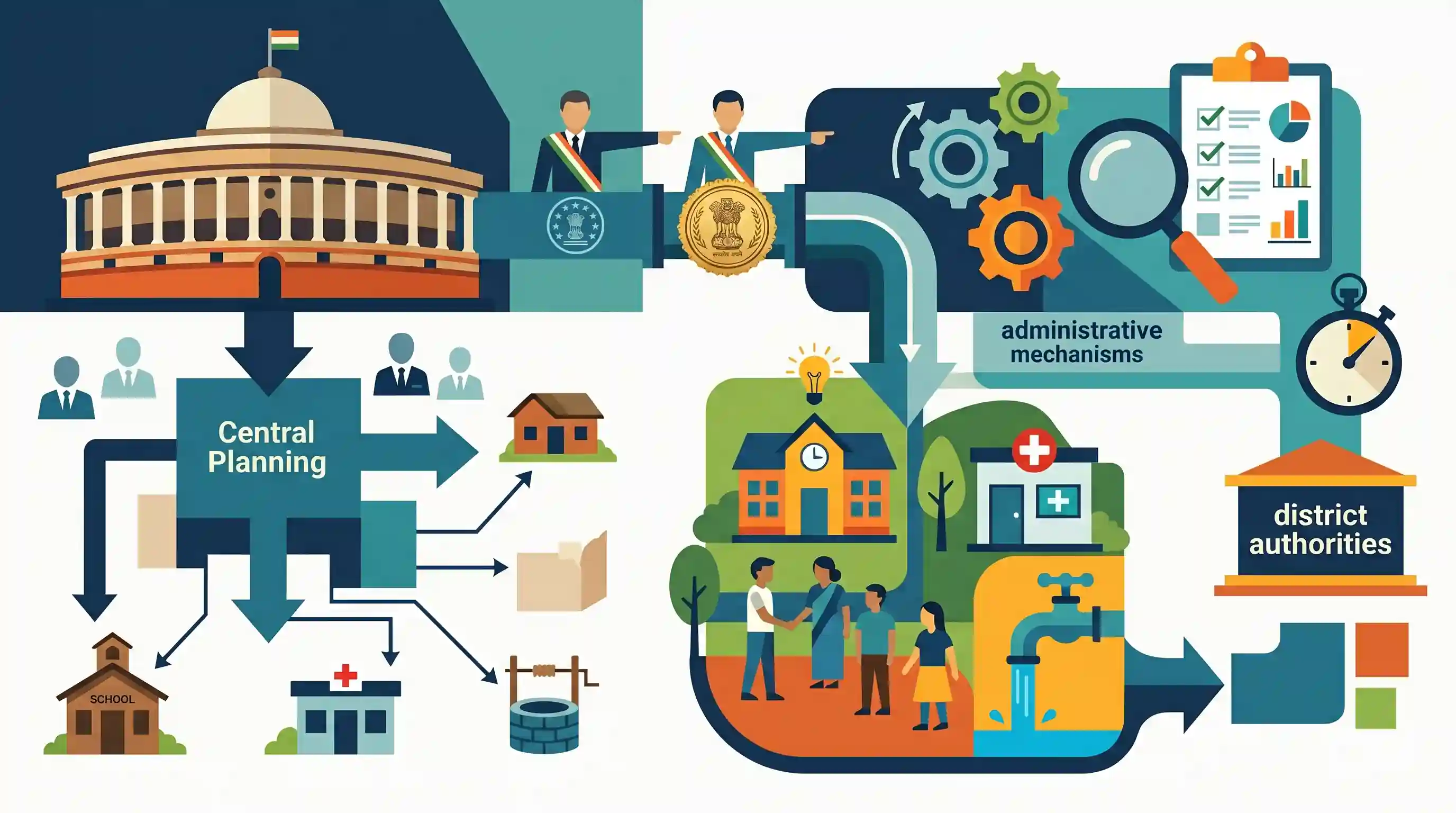
The article defends the retention of the Members of Parliament Local Area Development Scheme (MPLADS) against growing calls for its abolition. While critics argue that the scheme breeds corruption and violates the doctrine of separation of powers by allowing legislators to direct executive funds, the author counters that the Supreme Court has upheld its constitutional validity. The core strength of MPLADS lies in empowering MPs to address immediate, hyper-local community needs—such as basic health, education, and drinking water infrastructure—that centralized planning frequently misses. Rather than scrapping the scheme, the focus should shift toward strengthening administrative mechanisms, ensuring rigorous audits, and improving the timely execution of recommended projects by district authorities.
Key Points
- MPLADS serves a crucial role in addressing micro-level, locally felt developmental needs that broader State or Central schemes often overlook.
- The Supreme Court previously upheld the scheme's constitutional validity (e.g., Bhim Singh v. Union of India, 2010), ruling that it does not violate the separation of powers because MPs merely recommend projects, while execution remains an executive function handled by District Authorities.
- The scheme has successfully facilitated the creation of durable community assets, including critical infrastructure for public health, primary education, and drinking water.
- Instead of scrapping the scheme over concerns of corruption or unspent balances, systemic reforms should focus on stricter auditing, improving administrative capacity at the district level, and enhancing transparency in fund utilization.
Important Terms
Members of Parliament Local Area Development Scheme (MPLADS)

Launched in 1993, this Central Sector Scheme allows MPs to recommend projects creating durable community assets (e.g., water, education) in their constituencies. Funding is currently ₹5 crore annually.
UPSC context
GS-II: Government Policies and Interventions. Tests understanding of legislative roles in grassroots development and decentralized planning.
Separation of Powers
A constitutional principle demarcating functions between the legislature, executive, and judiciary. Critics argue MPLADS blurs this line by giving legislators control over executive spending.
UPSC context
GS-II: Constitutional Comparison and Basic Structure. Essential for discussing checks and balances in Indian governance.
Bhim Singh v. Union of India (2010)
A landmark 2010 Supreme Court ruling that upheld the constitutional validity of MPLADS, stating it does not violate the separation of powers as MPs only have a recommendatory role.
UPSC context
GS-II: Judiciary and Landmark Judgments. Frequently cited in discussions about the constitutionality of legislative-led development.
Article 282
Constitutional provision enabling the Union or States to make grants for any 'public purpose,' serving as the legal basis for MPLADS funding outside regular departmental allocations.
UPSC context
GS-II: Federalism and Financial Relations. Tests knowledge of the Union's spending power beyond its legislative lists.
District Authority
Typically the District Collector or Magistrate, they are the executive arm responsible for technical sanction, project implementation, and monitoring of MP-recommended works at the ground level.
UPSC context
GS-II: Role of Civil Services in Democracy. Highlights the executive's role in implementing legislator-driven projects.
Central Sector Scheme
A scheme 100% funded by the Union Government and implemented by its machinery. MPLADS is classified as such, unlike state-shared Centrally Sponsored Schemes.
UPSC context
Prelims/GS-II: Governance. Tests the ability to distinguish between different types of government funding and implementation models.
Prelims Trap
"MPs manage the execution of MPLADS projects, and any unspent funds lapse at the end of the financial year."
MPs merely recommend projects; District Authorities control fund management and execution. Furthermore, the annual ₹5 crore allocation is strictly non-lapsable.
Static Concepts Connected
What are the mandatory fund allocation rules and geographical limits under MPLADS?
- SC/ST Quotas: At least 15% of funds must be recommended for areas inhabited by SCs, and 7.5% for areas inhabited by STs.
- Non-lapsable Nature: The annual ₹5 crore fund per MP is non-lapsable and carries forward to subsequent financial years.
- Geographical Limits: Lok Sabha MPs recommend within their constituency; Rajya Sabha MPs anywhere in their elected State; Nominated MPs anywhere in India.
How does the Supreme Court view MPLADS under the Separation of Powers doctrine?
- Bhim Singh Case (2010): In Bhim Singh v. Union of India (2010), the SC upheld MPLADS, stating India does not follow a strict, rigid separation of powers.
- Recommendatory Role: The Court held the scheme valid because MPs possess only a recommendatory role, while the actual implementation remains purely an executive function of the District Authority.
Cross-Topic Patterns
MPLADS and the PRI Bypass
Critics argue MPLADS undermines the 73rd and 74th Constitutional Amendments by creating parallel local funding streams outside the control of elected Panchayati Raj Institutions (PRIs) and Urban Local Bodies.
MPLADS Convergence with MGNREGA
MPLADS guidelines explicitly permit convergence with MGNREGA and Khelo India. This allows the pooling of multiple fund sources to create larger, more durable community assets like sports facilities or rural roads.

Expect a 2026 Prelims question testing MPLADS non-lapsability, mandatory SC/ST quotas, and the exact jurisdiction of nominated MPs.
Linked PYQs · 3
Linked PYQs · 3
- 2020PrelimsGS1
With reference to the funds under Members of Parliament Local Area Development Scheme (MPLADS), which of the following statements are correct? 1. MPLADS funds must be used to create durable assets like physical infrastructure for health, education, etc. 2. A specified portion of each MP's fund must benefit SC/ST populations. 3. MPLADS funds are sanctioned on yearly basis and the unused funds cannot be carried forward to the next year. 4. The district authority must inspect at least 10% of all works under implementation every year. Select the correct answer using the code given below:
- 2020MainsGS2
Judicial Legislation is antithetical to the doctrine of separation of powers as envisaged in the Indian Constitution. In this context justify the filing of large number of public interest petitions praying for issuing guidelines to executive authorities.
- 2024MainsGS2
Analyse the role of local bodies in providing good governance at local level and bring out the pros and cons merging the rural local bodies with the urban local bodies.
