Pedagogical concerns arise over early coding education for children
Source:Indian Express ↗
Why It Matters
It highlights a crucial pedagogical debate relevant to the implementation of NEP 2020 and the regulation of the EdTech sector. For UPSC aspirants, it offers critical arguments for GS Paper 2 (Issues related to Education/Human Resources) and provides excellent material for Essay topics on the commercialization of education vs. holistic child development.
Summary
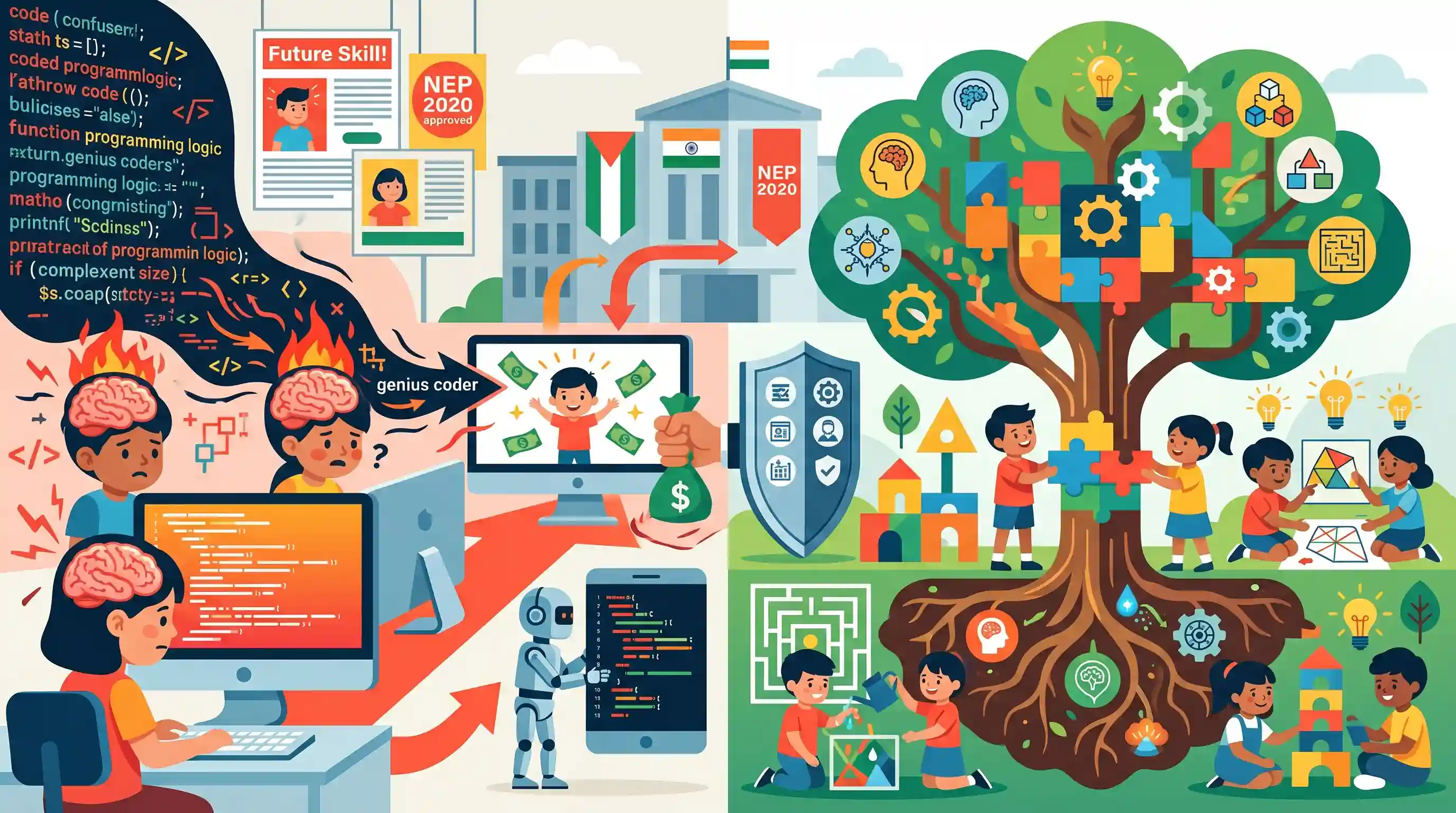
The article critiques the growing trend of teaching coding to young children, a phenomenon fueled by EdTech marketing and interpretations of modern educational frameworks like NEP 2020. It argues that pushing complex syntax onto young minds can cause cognitive overload and often results in rote learning rather than genuine skill acquisition. Instead of premature technical training, early education should focus on foundational logic, problem-solving, and abstract thinking through age-appropriate, play-based methodologies. The piece serves as a caution against prioritizing market-driven vocational trends over scientifically sound pedagogical practices.
Key Points
- Prematurely introducing coding to young children often prioritizes learning specific programming syntax over developing fundamental problem-solving and logical skills.
- The trend is heavily driven by aggressive EdTech marketing that exploits parental anxieties and FOMO (Fear Of Missing Out) regarding future employability.
- Cognitive development in early childhood is better served by play-based learning and unplugged activities that build abstract thinking, rather than complex digital coding.
- While the National Education Policy (NEP) 2020 emphasizes 21st-century skills and digital literacy, its implementation must remain age-appropriate to prevent cognitive overload and rote learning.
Important Terms
National Education Policy (NEP) 2020

A comprehensive 2020 framework to modernize Indian education, prioritizing holistic, multidisciplinary learning and introducing vocational skills like coding from Grade 6 onwards.
UPSC context
GS II: Government Policies. Fundamental for understanding structural reforms in the 5+3+3+4 schooling model.
Foundational Literacy and Numeracy (FLN)
The ability to read with meaning and perform basic math by Grade 3, identified as an 'urgent national mission' under the NIPUN Bharat initiative.
UPSC context
GS II: Social Justice. Essential for discussing 'learning poverty' and the prerequisite for all higher-order learning.
Computational Thinking
A logic-based problem-solving process involving decomposition and pattern recognition, promoted as a cognitive foundation rather than just technical coding syntax.
UPSC context
GS II: Skill Development. Tests the ability to distinguish cognitive foundations from mechanical technical training.
EdTech
The sector leveraging software/hardware for learning; currently under scrutiny in India for aggressive marketing and the absence of a dedicated regulatory framework.
UPSC context
GS III: Economy. Relevant for digital infrastructure, the digital divide, and private sector regulation.
Cognitive Overload
A psychological state where information volume or complexity exceeds working memory capacity, leading to rote learning instead of genuine conceptual understanding.
UPSC context
GS II: Human Resources. Crucial for evaluating age-appropriate curriculum design and pedagogical effectiveness.
Vocational Education
Practical training focused on specific technical skills or trades, which NEP 2020 seeks to integrate into mainstream schooling starting at the middle-school level.
UPSC context
GS II: Human Resources. Key for bridging the education-employability gap and achieving SDG 4.
Prelims Trap
NEP 2020 mandates the integration of coding and digital literacy starting from the Foundational Stage.
NEP 2020 officially mandates the introduction of coding and vocational training from Class 6 (Middle Stage), not early childhood. Early years prioritize play-based foundational literacy.
Static Concepts Connected
What is the pedagogical structure of NEP 2020 regarding vocational skills and coding?
- 5+3+3+4 Structure: Replaces the 10+2 system with Foundational (5 years), Preparatory (3), Middle (3), and Secondary (4) stages.
- Middle Stage Focus: Formally introduces vocational education, internships, and 21st-century skills like coding from Class 6 onwards.
- Foundational Stage: Focuses purely on play-based, activity-based, and discovery-oriented learning for ages 3-8, avoiding complex abstract syntax.
What are the core objectives and features of the NIPUN Bharat Mission?
- Primary Objective: Aims to ensure every child achieves Foundational Literacy and Numeracy (FLN) by Grade 3 (age 9) by 2026-27.
- Pedagogy: Focuses on play, discovery, and activity-based pedagogies rather than rote memorization or early technical skilling.
- Nodal Implementation: Implemented by the Department of School Education and Literacy under the centrally sponsored Samagra Shiksha scheme.
Cross-Topic Patterns
EdTech Marketing & Consumer Protection
Misleading ads by EdTech firms selling 'coding for toddlers' trigger Ministry of Education advisories and attract scrutiny under the Consumer Protection (E-Commerce) Rules, 2020.
Premature Skilling vs Demographic Dividend
Pushing rote technical syntax instead of fundamental logic undermines the genuine capability-building and cognitive development required to sustainably reap India's demographic dividend.

Expect a Prelims question differentiating NEP 2020's stage-wise mandates (like Class 6 coding) vs NIPUN Bharat's foundational goals.
Linked PYQs · 4
Linked PYQs · 4
- 2020MainsGS2
National Education Policy 2020 is in conformity with the Sustainable Development Goal-4 (2030). It intends to restructure and reorient education system in India. Critically examine the statement.
- 2021MainsGS2
“Earn while you learn' scheme needs to be strengthened to make vocational education and skill training meaningful.” Comment.
- 2014MainsGS3
While we flaunt India's demographic dividend, we ignore the dropping rates of employability. What are we missing while doing so? Where will the jobs that India desperately needs come from? Explain.
- 2021MainsGS2
Has digital illiteracy, particularly in rural areas, coupled with lack of Information and Communication Technology (ICT) accessibility hindered socio-economic development? Examine with justification.
