Generative AI Data Scraping Threatens Professional Journalism
Source:The Hindu ↗
Why It Matters
The clash between generative AI and copyright laws is a cutting-edge issue in technology and IPR (GS3). Additionally, the economic sustainability of the free press is essential for democracy (GS2/GS3), making the regulatory oversight of Big Tech and fair compensation models highly relevant for the UPSC Mains examination.
Summary
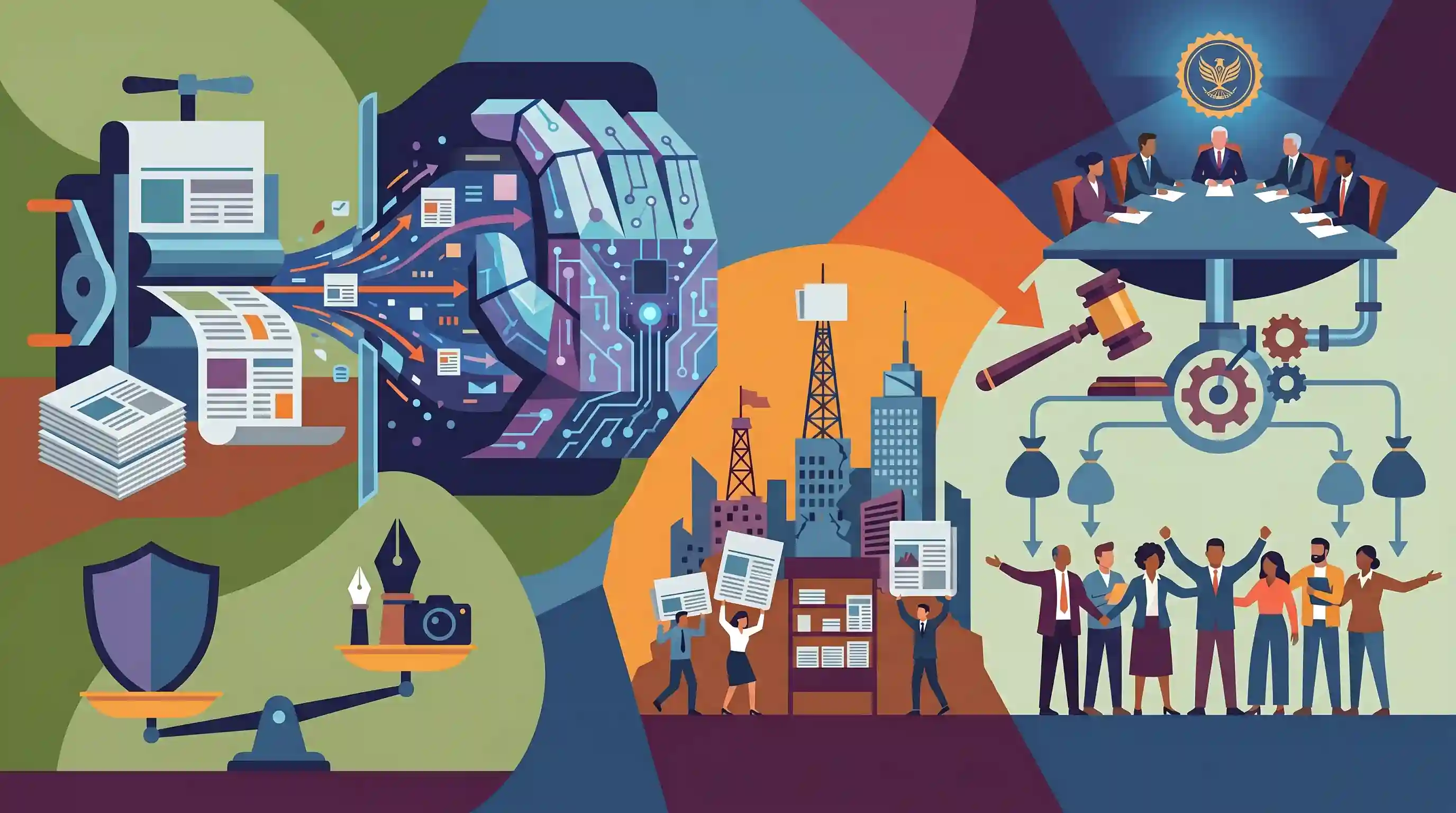
The editorial addresses the growing conflict between news publishers and AI companies over the unauthorized scraping of proprietary content for training generative AI models. It argues that the AI industry's reliance on the 'fair use' doctrine to avoid paying compensation is fundamentally unjust and threatens the survival of professional journalism. Welcoming the formation of a DPIIT committee on copyright and AI in India, the article calls for urgent regulatory interventions and unified action by publishers to secure a fair share of revenues before the news industry is irreversibly damaged.
Key Points
- Artificial Intelligence (AI) models rely extensively on high-quality content, primarily produced by news publishers, for their training data without seeking permission or paying compensation.
- AI firms often invoke the 'fair use' doctrine to justify mass data scraping, which publishers argue is legally and morally flawed since AI outputs directly compete with original news.
- The uncompensated exploitation of news content by generative AI threatens the financial viability of professional journalism, compounding the economic squeeze already caused by search engines and social media.
- The Department for Promotion of Industry and Internal Trade (DPIIT) in India has formed a committee to examine the intersection of copyright law and AI, providing an opportunity to establish fair revenue-sharing frameworks.
- It is crucial for policymakers and the news industry to actively negotiate compensation mechanisms with tech platforms before irreversible damage is done to the media ecosystem.
Important Terms
Fair Use Doctrine

A legal principle allowing limited use of copyrighted material without permission for 'transformative' purposes like research or news reporting, currently a major defense for AI developers.
UPSC context
GS Paper 3 (IPR/AI); tests understanding of legal balances between innovation and creator rights.
Department for Promotion of Industry and Internal Trade (DPIIT)
The nodal agency under the Ministry of Commerce and Industry responsible for IPR, including the administration of the Copyright Act and the Patents Act.
UPSC context
GS Paper 2/3 (Governance/IPR); crucial for understanding India's regulatory architecture for trade and technology.
Copyright Act, 1957
The primary legislation in India protecting original literary, dramatic, and artistic works, now under review to address AI-driven training and data scraping.
UPSC context
GS Paper 3 (IPR); core statutory framework for intellectual property questions in India.
Intellectual Property Rights (IPR)
Legal rights granted to creators for their inventions or creative works (patents, copyrights, trademarks), serving to balance private profit with public access.
UPSC context
GS Paper 3 (Science & Tech); a recurring theme in technological disruption and trade negotiations.
Blanket Licensing
A proposed regulatory framework where AI developers pay a fixed fee to a central fund to legally train models on copyrighted news and media content.
UPSC context
GS Paper 3 (Economy/Tech); represents a potential 'middle path' policy solution for digital revenue sharing.
Generative AI
Artificial intelligence capable of creating new text, images, or media by learning from vast datasets, often via unauthorized 'scraping' of publisher content.
UPSC context
GS Paper 3 (S&T); focuses on the socio-economic and ethical impacts of emerging technologies.
DPIIT Committee on Copyright and AI
A government-constituted panel (2025) tasked with preparing a working paper to recommend amendments to the Copyright Act for the AI era.
UPSC context
GS Paper 2 (Statutory/Regulatory Bodies); relevant for current affairs regarding tech regulation.
Prelims Trap
India's Copyright Act contains explicit exemptions for commercial AI training under its broad fair use provisions.
India follows the restrictive 'fair dealing' doctrine (Section 52), not the broad US 'fair use,' and currently lacks explicit Text and Data Mining (TDM) exceptions for AI.
Static Concepts Connected
What is 'Fair Dealing' under the Indian Copyright Act, 1957?
- Section 52: Enumerates specific exceptions allowing limited use of copyrighted work without permission (e.g., for private research, criticism, or reporting).
- Stricter than US: Unlike the open-ended US "fair use" doctrine, Indian law requires the use to strictly fit within defined, exhaustive categories.
- Human authorship: The Act currently defines an 'author' strictly as a human, leaving AI-generated outputs in a legal gray area.
What is the mandate of the DPIIT regarding Intellectual Property Rights?
- Nodal Agency: It is the nodal department for formulating and implementing the National IPR Policy under the Ministry of Commerce and Industry.
- IP Administration: Directly administers laws concerning Patents, Trademarks, Copyrights, Geographical Indications (GIs), and Industrial Designs in India.
Cross-Topic Patterns
Antitrust disputes in digital markets
The squeeze on publishers by AI models mirrors earlier battles where news outlets approached the Competition Commission of India (CCI) to force search engines to share ad revenues fairly.
Sovereign AI vs. IP protections
India's push for indigenous foundational models under the IndiaAI Mission hinges on balancing creator compensation with affordable data access for domestic AI startups.

Expect a GS3 Mains question evaluating whether India's Copyright Act (1957) and 'fair dealing' doctrine can regulate Generative AI.
Linked PYQs · 2
Linked PYQs · 2
- 2014MainsGS3
In a globalized world, Intellectual Property Rights assume significance and are a source of litigation. Broadly distinguish between the terms-Copyrights, Patents and Trade Secrets.
- 2023MainsGS3
Introduce the concept of Artificial Intelligence (AI). How does Al help clinical diagnosis? Do you perceive any threat to privacy of the individual in the use of Al in healthcare?
