Pharmaceutical Industry Transition from Generics to Innovation
Source:Indian Express ↗
Why It Matters
The pharmaceutical sector is a critical pillar of India's economy and diplomatic soft power. Understanding its structural challenges—specifically the gap between generic manufacturing and original drug discovery—is vital for questions covering industrial growth, self-reliance (Atmanirbhar Bharat), and intellectual property commercialization in GS Paper 3.
Summary
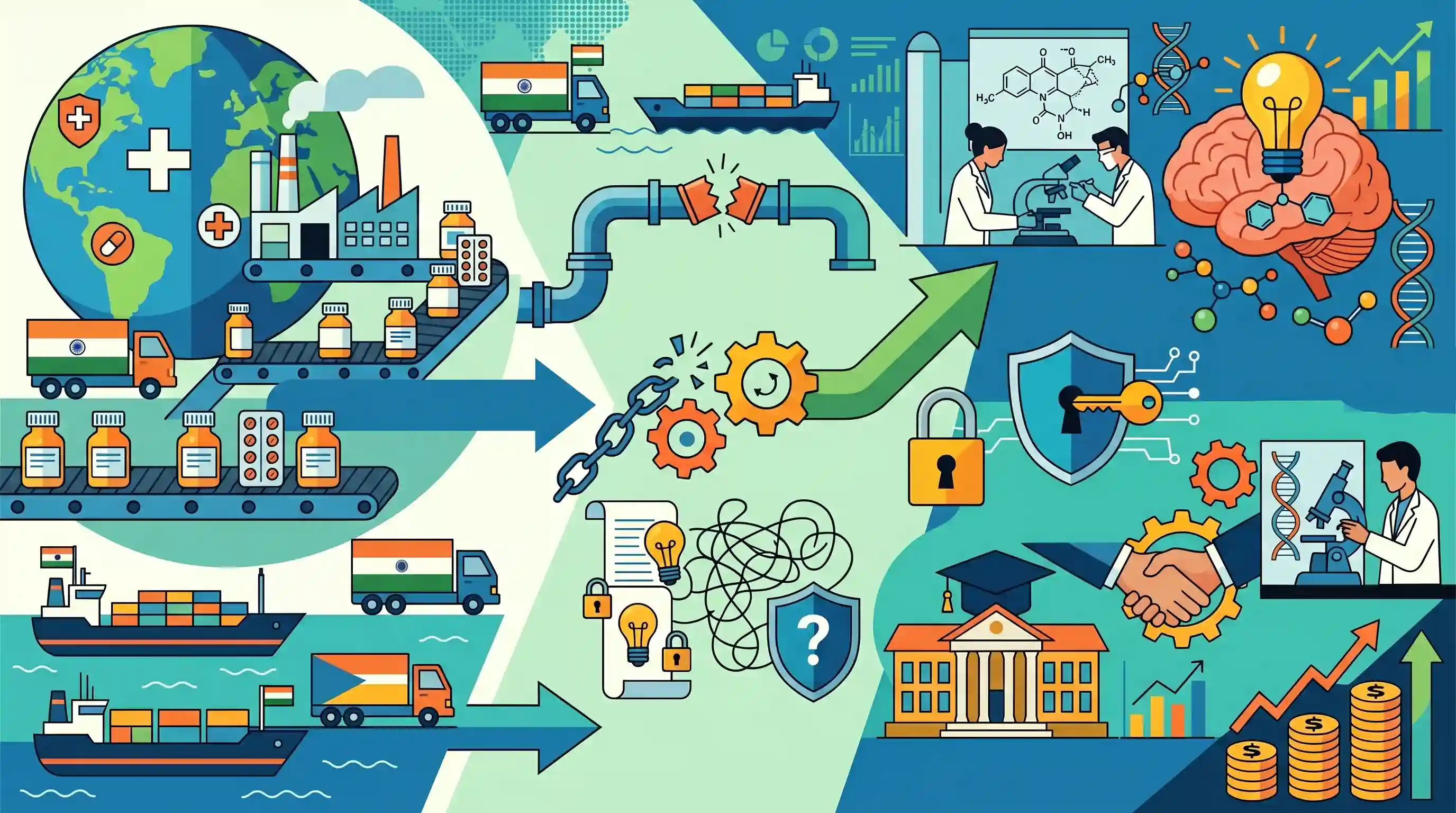
The Indian pharmaceutical industry, widely recognized as the 'Pharmacy of the World' for its dominance in supplying affordable generic drugs globally, faces a critical transition point. The article argues that the sector must pivot from a volume-driven generic manufacturing model to a value-driven innovation model. This shift requires moving beyond reverse-engineering existing drugs to investing heavily in Research and Development (R&D) and new drug discovery. Key challenges include reliance on imported Active Pharmaceutical Ingredients (APIs) and the weak commercialization of intellectual property. To achieve this transition, India must strengthen its Intellectual Property Rights (IPR) ecosystem, foster robust industry-academia collaborations, and secure sustained funding for pharmaceutical innovation.
Key Points
- India dominates the global supply of generic medicines, earning the title 'Pharmacy of the World', but it primarily operates on a low-margin, high-volume model.
- The article emphasizes the urgent need for the Indian pharmaceutical sector to transition toward new drug discovery and R&D to capture higher value in the global market.
- Shrinking profit margins in generic markets and a heavy dependence on imported Active Pharmaceutical Ingredients (APIs) highlight vulnerabilities in the current manufacturing-heavy model.
- Achieving a value-driven ecosystem requires addressing India's low commercialization rate of intellectual property, despite a high volume of patent filings.
- Strengthening the Intellectual Property Rights (IPR) regime, improving industry-academia linkages, and providing financial incentives for innovation are crucial for domestic drug discovery.
Important Terms
TRIPS Agreement

A WTO agreement setting global minimum standards for protecting and enforcing intellectual property rights (IPR), including pharmaceutical patents, while allowing certain public health flexibilities.
UPSC context
GS Paper 2 (International Institutions) and Paper 3 (IPR). Tests understanding of global trade-health balances.
National Intellectual Property Rights (IPR) Policy
A 2016 vision document aimed at creating a vibrant and balanced IPR ecosystem in India to foster innovation, streamline IP administration, and promote commercialization.
UPSC context
GS Paper 3 (Economy/IPR). Essential for questions on India's domestic innovation strategy.
Pharmacy of the World
A tag for India’s dominance in the global generic drug market, supplying approximately 20% of global volume and 60% of the world's vaccines.
UPSC context
GS Paper 2 (Soft Power) and Paper 3 (Industrial Policy). Represents India's pharmaceutical leadership.
Active Pharmaceutical Ingredient (API)
The biologically active component in a drug responsible for the therapeutic effect. India currently faces a high import dependence on China for these critical raw materials.
UPSC context
GS Paper 3 (Economy/S&T). Relevant for 'Atmanirbhar Bharat' and supply chain resilience topics.
New Chemical Entity (NCE)
A unique, novel drug candidate that has not been previously approved. Transitioning to NCE discovery represents the shift from generic manufacturing to high-value innovation.
UPSC context
GS Paper 3 (S&T). Focuses on the technological gap between reverse-engineering and original drug discovery.
Compulsory Licensing
An authorization granted by the government to a third party to manufacture a patented product without the owner's consent, typically during public health emergencies.
UPSC context
GS Paper 2 (Health) and Paper 3 (IPR). A key mechanism for ensuring medicine affordability.
National Policy on R&D and Innovation in Pharma-MedTech 2023
A 2023 policy framework designed to transition India’s pharma sector from cost-based to innovation-driven growth by strengthening industry-academia linkages and incentivizing private R&D.
UPSC context
GS Paper 3 (Industrial Policy). The primary roadmap for achieving the sector’s high-value goals.
Prelims Trap
India leads the world as the largest exporter of pharmaceuticals by value.
India ranks 3rd globally in pharmaceutical production by volume, but only around 14th by value because its exports are heavily skewed toward low-margin, low-cost generics.
Static Concepts Connected
What is 'evergreening' and how does India's patent law address it?
- Evergreening: Extending patent monopolies by making minor, non-therapeutic modifications to existing drugs just before the original patent expires.
- Section 3(d): Prohibits patenting new forms of known substances unless they show significantly enhanced therapeutic efficacy, protecting affordable generics.
- Novartis Case: The landmark SC judgment upheld Section 3(d) as a valid use of TRIPS flexibilities to balance innovation with public health.
What are Active Pharmaceutical Ingredients (APIs)?
- Definition: The biologically active chemical compound in a pharmaceutical drug that produces the intended therapeutic or curative effect.
- Excipients: The chemically inactive substances (e.g., binders, coatings, solvents) combined with the API to form the final consumable pill or liquid.
- Import Dependency: India imports roughly 70% of its APIs and Key Starting Materials (KSMs) from China, prompting PLI scheme interventions.
Cross-Topic Patterns
API Dependency & Geo-economics
India's 70% reliance on Chinese APIs ties national healthcare security to geopolitical risk, a core theme in recent Quad and global supply-chain resilience talks.
R&D Deficit & Higher Education
High patent filings but low commercialization exposes weak industry-academia linkages, echoing the core rationale behind establishing the Anusandhan National Research Foundation (ANRF) to bridge R&D gaps.

Expect a 2026 Prelims multi-statement question linking India's API import dependency, the PRIP scheme, and TRIPS Section 3(d) exceptions.
Linked PYQs · 3
Linked PYQs · 3
- 2024MainsGS3
What is the present world scenario of intellectual property rights with respect to life materials? Although, India is second in the world to file patents, still only a few have been commercialized. Explain the reasons behind this less commercialization.
- 2017PrelimsGS1
With reference to the 'National Intellectual Property Rights Policy', consider the following statements: 1. It reiterates India's commitment to the Doha Development Agenda and the TRIPS Agreement. 2. Department of Industrial Policy and Promotion is the nodal agency for regulating intellectual property rights in India. Which of the above statements is/are correct?
- 2023PrelimsGS1
Consider the investments in the following assets: 1. Brand recognition 2. Inventory 3. Intellectual property 4. Mailing list of clients How many of the above are considered intangible investments?
