Global Geopolitical Flashpoints and Regional Conflicts
Source:Indian Express ↗
Why It Matters
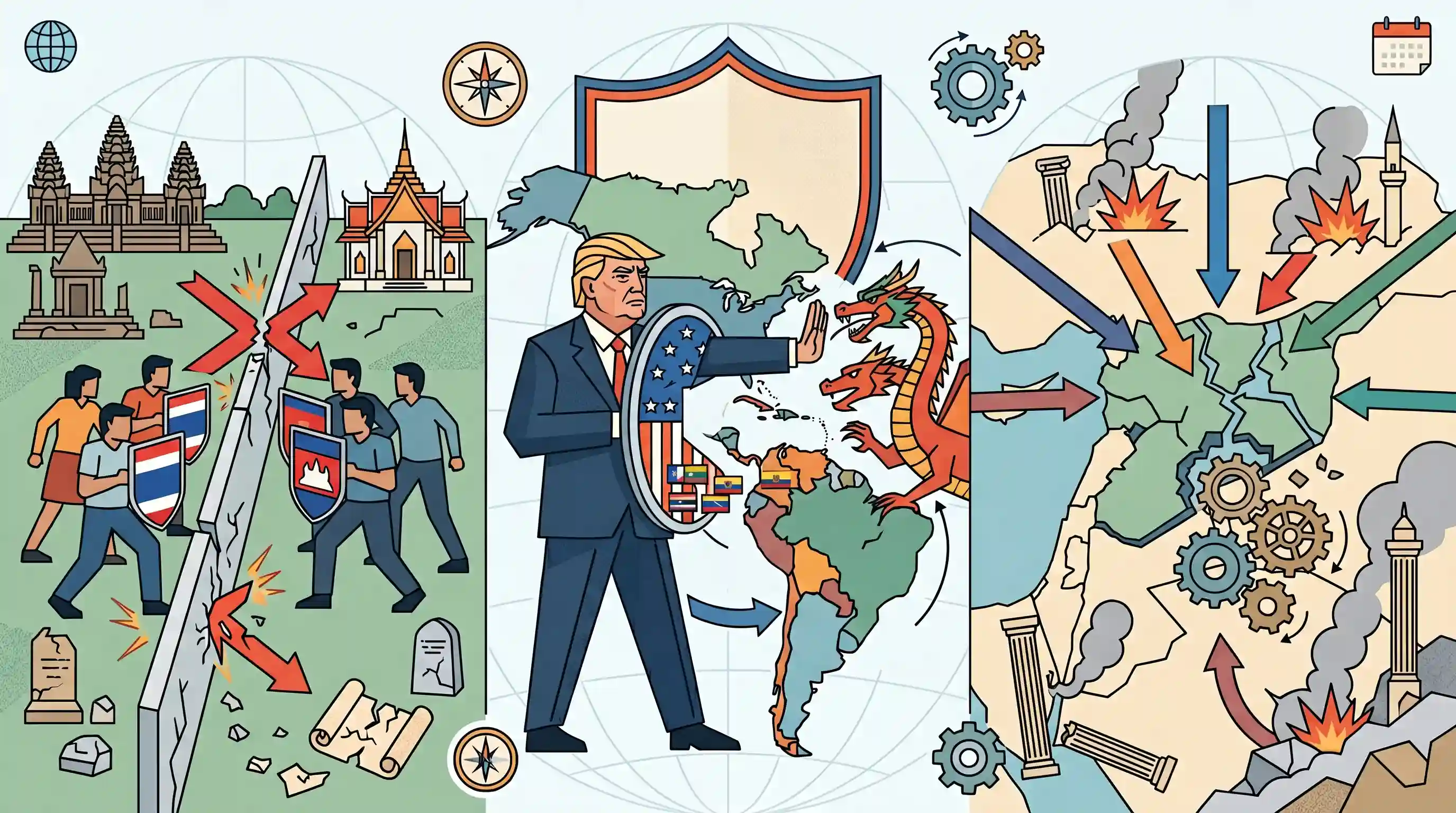
Understanding global flashpoints is crucial for the International Relations segment of GS Paper 2. The Thailand-Cambodia dispute relates to regional groupings like ASEAN, the US Monroe Doctrine connects to global shifts toward sovereign nationalism, and the Syrian crisis impacts Middle Eastern stability and India's extended neighborhood policies.
Summary
A weekly roundup of global geopolitical developments focuses on three major flashpoints. First, border clashes and historical disputes between Thailand and Cambodia threaten regional stability in Southeast Asia. Second, Donald Trump's revival of the Monroe Doctrine underscores a shift towards sovereign nationalism and a renewed US focus on limiting external (especially Chinese) influence in Latin America. Finally, the continuing crisis in Syria remains a critical issue in the Middle East, altering the geopolitical dynamics of the Levant region.
Key Points
- Thailand and Cambodia face renewed geopolitical friction, highlighting historical border disputes such as the conflict over the Preah Vihear temple and testing ASEAN's regional cohesion.
- Donald Trump's invocation of the Monroe Doctrine signals a return to 'America First' sovereign nationalism and a reassertion of US hegemony in Latin America against foreign influence.
- The evolving crisis in Syria continues to reshape the geopolitics of the Middle East, with ongoing instability in the Levant affecting regional security and humanitarian conditions.
Important Terms
Monroe Doctrine

An 1823 US policy opposing European intervention in the Americas, recently revived to assert regional dominance and counter growing Chinese and Russian influence in Latin America.
UPSC context
GS-2/International Relations; tests understanding of historical foreign policy doctrines and their impact on contemporary global power dynamics and regional sovereignty.
ASEAN
A 10-nation regional organization fostering economic and security cooperation in Southeast Asia, currently testing its "non-interference" principle through mediation in the Thailand-Cambodia border dispute.
UPSC context
GS-2/International Relations; essential for India's "Act East Policy" and evaluating the efficacy of regional multilateralism in conflict resolution.
United Nations
The primary global intergovernmental body for peace and security, facilitating humanitarian aid and political negotiations in Syria despite challenges from Security Council vetoes.
UPSC context
GS-2/International Relations; focuses on the role of international institutions and the impact of Great Power politics on global crises.
Preah Vihear Temple
An 11th-century Hindu shrine and UNESCO World Heritage site on the Thailand-Cambodia border; its ownership remains a persistent flashpoint for regional military and nationalist tension.
UPSC context
GS-1/Art and Culture & GS-2/IR; links ancient Khmer architecture to contemporary territorial disputes and colonial-era border demarcation issues.
International Court of_Justice (ICJ)
The principal judicial organ of the UN, which awarded the Preah Vihear Temple to Cambodia in 1962, though territorial claims over the surrounding land remain unresolved.
UPSC context
GS-2/International Relations; tests knowledge of international legal frameworks and their role in the peaceful settlement of interstate territorial conflicts.
Donroe Doctrine
A 21st-century "Trump Corollary" to the Monroe Doctrine, emphasizing US primacy in the Americas while treating migration and Chinese presence as existential security threats.
UPSC context
GS-2/International Relations; highlights shifts in modern US foreign policy toward sovereign nationalism and its implications for hemispheric stability.
Prelims Trap
Preah Vihear is a prominent Buddhist temple complex located in Thailand.
Preah Vihear is actually an 11th-century Hindu shrine dedicated to Lord Shiva situated in Cambodia, though right on the disputed Thai border.
Static Concepts Connected
What countries and regions constitute the historical Levant?
- Geographic boundaries: The region along the eastern shores of the Mediterranean Sea.
- Core modern nations: Encompasses modern-day Syria, Lebanon, Israel, Jordan, and Palestine.
- UPSC mapping focus: Highly prone to prelims questions (e.g., 2022) regarding borders with the Mediterranean Sea.
How did the Roosevelt Corollary alter the Monroe Doctrine?
- Original Doctrine (1823): Warned European powers against future colonization or interference in the Western Hemisphere.
- Roosevelt Corollary (1904): Asserted US right to unilaterally intervene and exercise 'international police power' in Latin America.
Cross-Topic Patterns
Preah Vihear + Cultural Diplomacy
The Hindu roots of Preah Vihear highlight the historical spread of Indic culture to the Khmer Empire, linking Indian Art and Culture with Southeast Asian geopolitics.
ASEAN Way + Bilateral Disputes
Thailand-Cambodia friction exposes the limitations of the consensus-driven 'ASEAN Way,' which struggles to proactively mediate hard security and territorial disputes among member states.

Expect a 2026 prelims mapping question testing the exact nations comprising the Levant, or identifying Southeast Asian Hindu architecture.
Linked PYQs · 5
Linked PYQs · 5
- 2023PrelimsGS1
Consider the following pairs: Area of conflict mentioned in news Country where it is located 1. Donbas : Syria 2. Kachin : Ethiopia 3. Tigray : North Yemen How many of the above pairs are correctly matched?
- 2022PrelimsGS1
The term "Levant" often heard in the news roughly corresponds to which of the following regions?
- 2017PrelimsGS1
Mediterranean Sea is a border of which of the following countries? 1. Jordan 2. Iraq 3. Lebanon 4. Syria Select the correct answer using the code given below:
- 2004PrelimsGS1
The great Asian river Mekong does run through:
- 2015PrelimsGS1
In the Mekong-Ganga Cooperation, an initiative of six countries, which of the following is/are not a participant/participants? 1. Bangladesh 2. Cambodia 3. China 4. Myanmar 5. Thailand Select the correct answer using the code given below.
