India Navigates Global Trade Pressures with Diplomatic Pragmatism
Source:Indian Express ↗
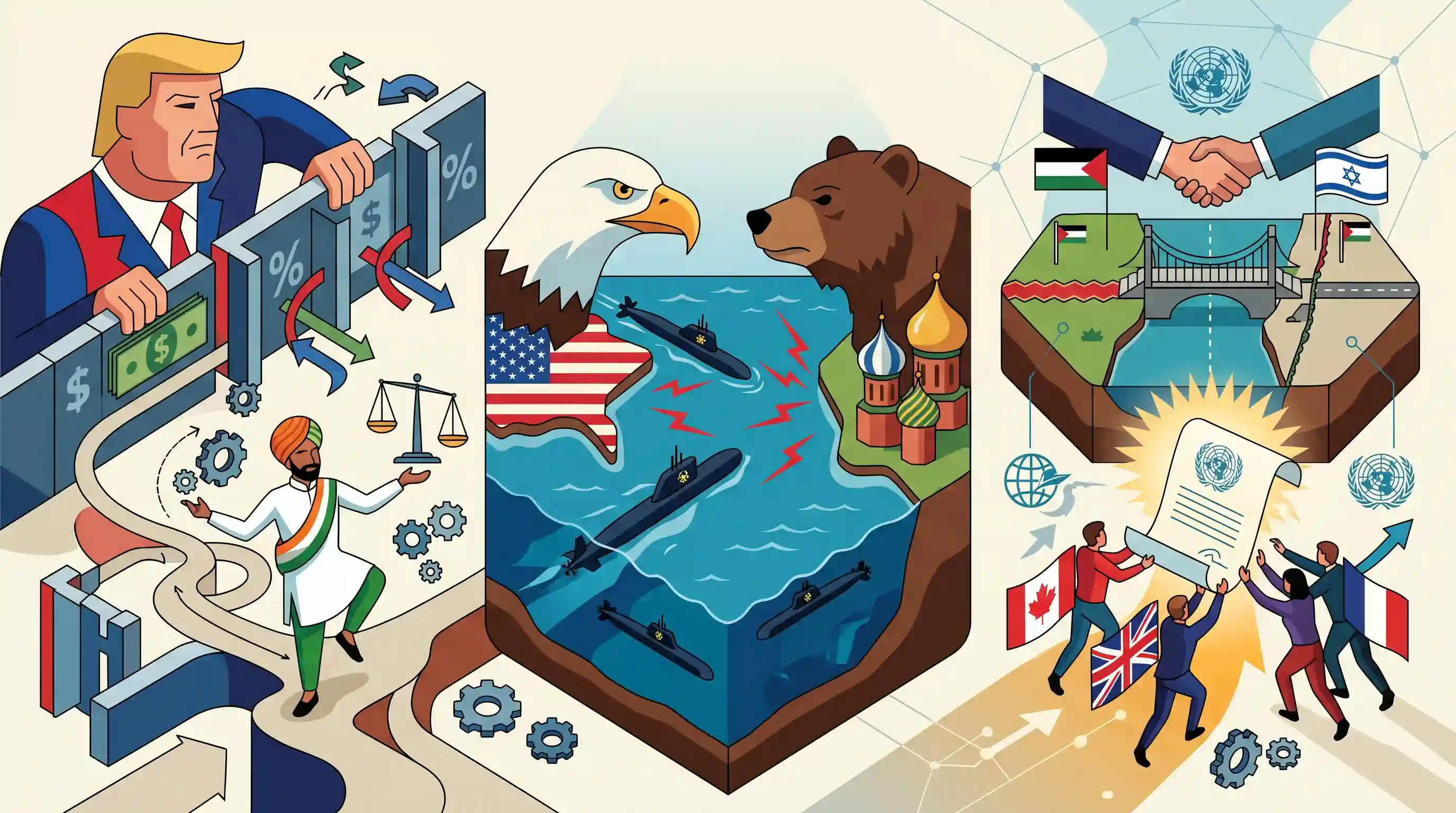
Why It Matters
These events touch upon core UPSC themes, specifically the economic implications of US protectionism on India's growth trajectory, escalating nuclear deterrence strategies between superpowers, and evolving global diplomatic stances on the Israel-Palestine conflict (specifically the two-state solution, a frequent PYQ theme).
Summary
This week's global developments highlight significant shifts in international relations, with India taking a pragmatic stance amid US President-elect Donald Trump's protectionist tariff policies. Geopolitical tensions escalate as the US deploys nuclear-powered submarines nearer to Russia. Concurrently, diplomatic momentum for the two-state solution in the Middle East grows, as Canada joins the UK and France in officially recognising a Palestinian state.
Key Points
- India is adopting a pragmatic diplomatic and economic approach to navigate potential disruptions from the protectionist tariff policies proposed by US President-elect Donald Trump.
- Geopolitical tensions escalate as the US repositions nuclear-powered submarines closer to Russian territory.
- Canada joins the UK and France in formally recognising a Palestinian state, marking significant international momentum for the 'two-state solution' to the Middle East conflict.
Prelims Trap
"All G7 countries have formally recognised the State of Palestine as part of the two-state solution."
While Canada, the UK, and France (G7/Western powers) recently recognized Palestine, the US, Germany, Italy, and Japan have not. A blanket statement about G7 consensus is a trap.
Static Concepts Connected
What is the Most-Favored-Nation (MFN) principle under the WTO?
- Core Principle: WTO members cannot normally discriminate between their trading partners. Granting a trade favor to one country requires granting it to all WTO members.
- Allowed Exceptions: Countries can set up Free Trade Agreements (FTAs) or give special market access to developing nations (Generalized System of Preferences), bypassing strict MFN rules.
- Bound Tariffs: Countries commit to ceiling tariff rates. Imposing arbitrary "reciprocal tariffs" often violates these bound rate commitments unless justified under specific trade remedies.
What role do SSBNs play in strategic nuclear deterrence?
- SSBN Definition: SSBN stands for Ship Submersible Ballistic Nuclear. They are nuclear-powered submarines armed with nuclear-tipped submarine-launched ballistic missiles (SLBMs).
- Second-Strike Capability: Because they are highly stealthy and submerged for months, they can survive a preemptive nuclear first strike, guaranteeing catastrophic retaliation.
- India's Triad: The commissioning of INS Arihant (India's first indigenous SSBN) completed India's nuclear triad, aligning with its "No First Use" doctrine.
Cross-Topic Patterns
Tariff Wars & Currency Dynamics
Rising US protectionism may force exporting nations to allow their currencies to depreciate to maintain export competitiveness, linking trade barriers directly to forex interventions and RBI's monetary policy.
Palestine & India's De-hyphenation
Western recognition of Palestine brings focus back to India's 'de-hyphenation' policy, where it maintains mutually independent and robust diplomatic ties with both Israel and Palestine without linking the two.

Expect a 2026 prelims question mapping G7 policy divergences on Palestine recognition alongside US reciprocal tariff impacts on WTO rules.
Linked PYQs · 3
Linked PYQs · 3
- 2012MainsGS2
Discuss the likely negative impact of the protectionist measures proposed by the US on India's software industry.
- 2018PrelimsGS1
The term "two-state solution" is sometimes mentioned in the news in the context of the affairs of
- 2023PrelimsGS1
Consider the following statements: Statement-I: Israel has established diplomatic relations with some Arab States. Statement-II: The 'Arab Peace Initiative' mediated by Saudi Arabia was signed by Israel and Arab League. Which one of the following is correct in respect of the above statements?
