Global Unrest and Energy Geopolitics Impacting Foreign Policy
Source:Indian Express ↗
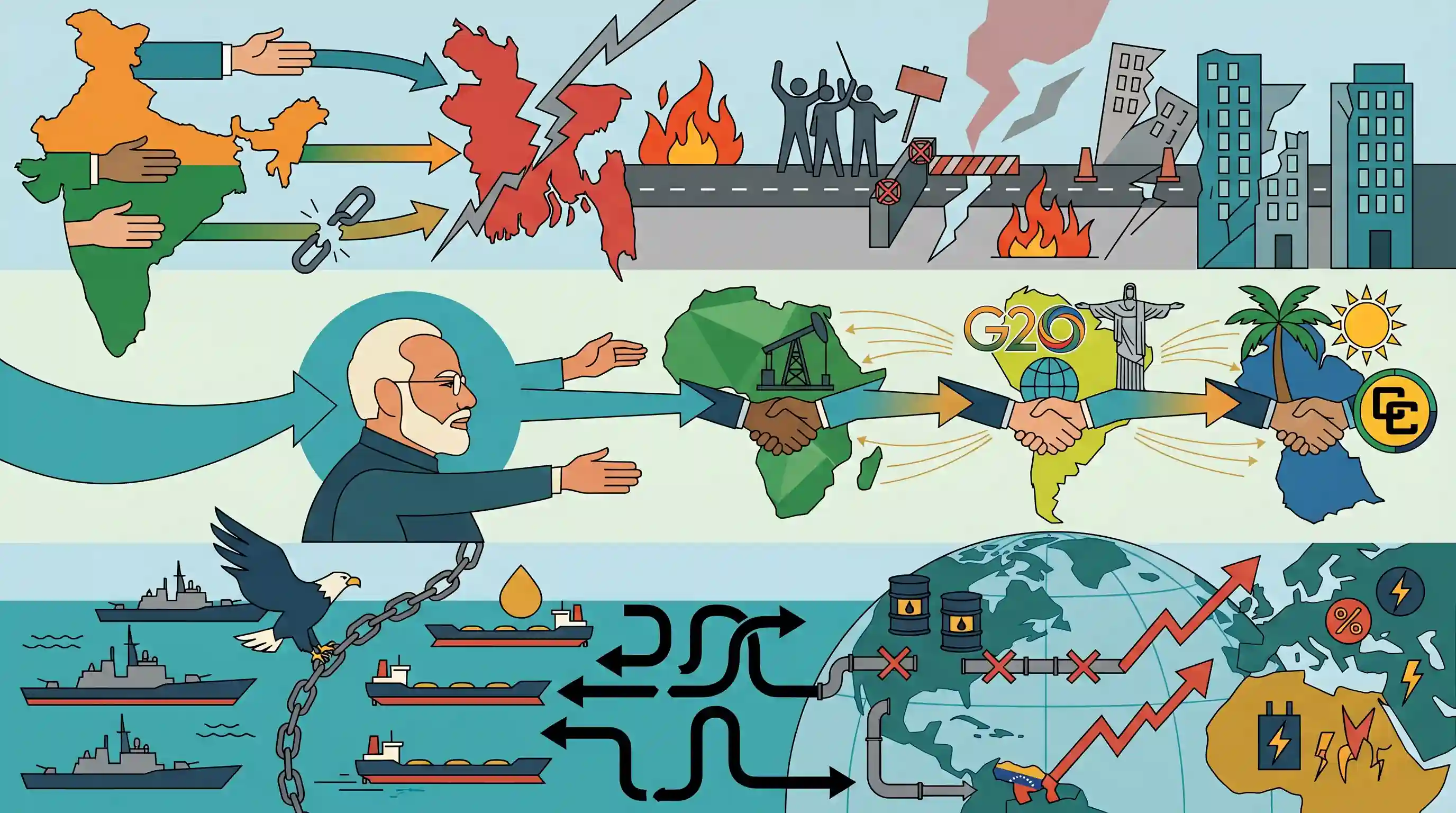
Why It Matters
Understanding these concurrent global events helps aspirants grasp India's multi-aligned foreign policy approach, the economic impact of global sanctions (Venezuela), and the security implications of instability in neighboring countries (Bangladesh).
Summary
The article covers major global geopolitical developments, including the resurgence of political unrest and internal challenges in Bangladesh, posing continuous hurdles for India's 'Neighbourhood First' policy. It highlights Prime Minister Narendra Modi's strategic three-nation tour to Nigeria, Brazil (for the G20 Summit), and Guyana, aimed at strengthening ties with Africa, the Global South, and CARICOM nations. Furthermore, it discusses the US blockade of Venezuelan oil tankers, which reintroduces geopolitical complexities surrounding global energy security and oil supply chains following the reimposition of international sanctions.
Key Points
- Renewed protests and instability in Bangladesh highlight ongoing governance challenges for the interim administration, directly impacting India\'s border and neighborhood security dynamics.
- PM Modi\'s diplomatic visits to Nigeria and Guyana emphasize India\'s expanding footprint in Africa and the Caribbean (CARICOM), reinforcing South-South cooperation.
- India\'s engagement at the G20 Summit in Brazil underlines its ongoing commitment to amplifying the voice of the Global South in multilateral economic governance.
- The US blockade on Venezuelan oil exports restricts global energy supplies, illustrating the geopolitical use of economic sanctions and its impact on international energy security.
- Together, these developments underscore the interconnectedness of regional stability in South Asia, energy geopolitics in Latin America, and India\'s proactive foreign policy outreach.
Important Terms
G20 (Group of Twenty)

An intergovernmental forum of 19 countries, the European Union, and the African Union addressing global economic stability and sustainable development.
UPSC context
GS-II: Global groupings. Tests India's leadership in the Global South and multilateral reforms in governance.
CARICOM (Caribbean Community)
A 15-member Caribbean grouping promoting economic integration, foreign policy coordination, and functional cooperation among its island and mainland states.
UPSC context
GS-II: India’s bilateral relations. Highlights India's strategic energy and developmental outreach to the Caribbean region.
US Oil Blockade on Venezuela
Unilateral maritime enforcement action seizing tankers and imposing a naval quarantine to halt sanctioned Venezuelan oil exports and revenue.
UPSC context
GS-II: Effect of developed countries' policies. Examines energy security, international law, and supply chain disruptions.
Global South
Nations in Africa, Asia, and Latin America characterized by developing economies and histories of colonialism, seeking global governance reform.
UPSC context
GS-II: International Relations. India seeks to lead this bloc in advocating for equitable representation.
Neighbourhood First Policy
India's diplomatic framework prioritizing stable, prosperous relations with immediate neighbors through enhanced connectivity, developmental aid, and security cooperation.
UPSC context
GS-II: India and its Neighborhood-Relations. Critical for understanding regional dynamics and challenges in Bangladesh.
Vishwabandhu
An Indian foreign policy philosophy framing the nation as a 'friend of the world' and a global bridge-builder.
UPSC context
GS-II: Foreign Policy. Reflects India's soft power and its proactive role in resolving international conflicts.
Shadow Fleet
Aging, under-insured tankers using deceptive maritime practices to transport sanctioned oil from nations like Russia, Iran, and Venezuela.
UPSC context
GS-III: Security/Energy Security. Tests knowledge of maritime law enforcement and sanctions evasion risks.
Digital Public Infrastructure (DPI)
Open, interoperable digital platforms like UPI and Aadhaar that enable inclusive public service delivery at a societal scale.
UPSC context
GS-III: Technology. India promotes DPI as a global good and a tool for 'Technology Diplomacy'.
Prelims Trap
"The current G20 Troika includes at least one advanced Western economy to balance developing nation representation."
The current G20 Troika comprises India, Brazil, and South Africa (IBSA)—a historic first where three consecutive Global South nations hold the presidency, completely excluding advanced Western economies.
Static Concepts Connected
What is CARICOM and why is it significant for India's foreign policy?
- Member States: It is a grouping of 15 Caribbean nations focused on economic integration and coordinated foreign policy, forming a significant voting bloc in the UN.
- Strategic Value: India engages CARICOM for energy security, maritime cooperation, and capacity building via ITEC, viewing them as vital partners in its Global South outreach.
Why does Venezuela struggle with oil exports despite having the world's largest reserves?
- Heavy Crude: Its Orinoco Belt produces extra-heavy crude, requiring complex refining and imported diluents to make it commercially viable.
- Sanctions: Aggressive US economic sanctions block access to global financial markets, technology, and key shipping routes, crippling export logistics.
- Infrastructure Decay: State-owned PDVSA has suffered from years of chronic underinvestment, brain drain, and infrastructural decay.
Cross-Topic Patterns
Energy Security + Sanctions Diplomacy
India balances its energy security needs by navigating Western sanctions, seen previously with Russian crude and now highly relevant to Venezuelan oil disruptions and increased reliance on Nigerian imports.
Global South + DPI Export
India leverages Digital Public Infrastructure (DPI) as a primary diplomatic tool for South-South cooperation, prominently visible in its G20 agenda and the proposed CARICOM 7-pillar framework.
Border Security + Regime Instability
Internal political instability in bordering states (like Bangladesh or Myanmar) directly strains India's internal security matrix, compounding risks of illegal migration, cross-border militancy, and infrastructure project stalls.

Expect a multi-statement Prelims question mapping world oil reserves (Orinoco) against trade embargoes and the current G20 IBSA Troika.
Linked PYQs · 4
Linked PYQs · 4
- 2024PrelimsGS1
Consider the following statements : Statement-I : Recently, Venezuela has achieved a rapid recovery from its economic crisis and succeeded in preventing its people from fleeing/emigrating to other countries. Statement-II : Venezuela has the world's largest oil reserves. Which one of the following is correct in respect of the above statements?
- 2025MainsGS2
India-Africa digital partnership is achieving mutual respect, co-development and long-term institutional partnerships. Elaborate.
- 2025MainsGS2
"Energy security constitutes the dominant kingpin of India's foreign policy, and is linked with India's overarching influence in Middle Eastern countries.” How would you integrate energy security with India's foreign policy trajectories in the coming years?
- 2022MainsGS2
India is an age-old friend of Sri Lanka.’ Discuss India's role in the recent crisis in Sri Lanka in the light of the preceding statement.
