Global Shift Toward State Intervention and Protectionist Policies
Source:Indian Express ↗
Why It Matters
Understanding the shift from global free trade to state-led industrial policy and protectionism is crucial for analyzing contemporary international relations, global economic trends, and their direct impact on India's economic strategies and supply chain resilience.
Summary
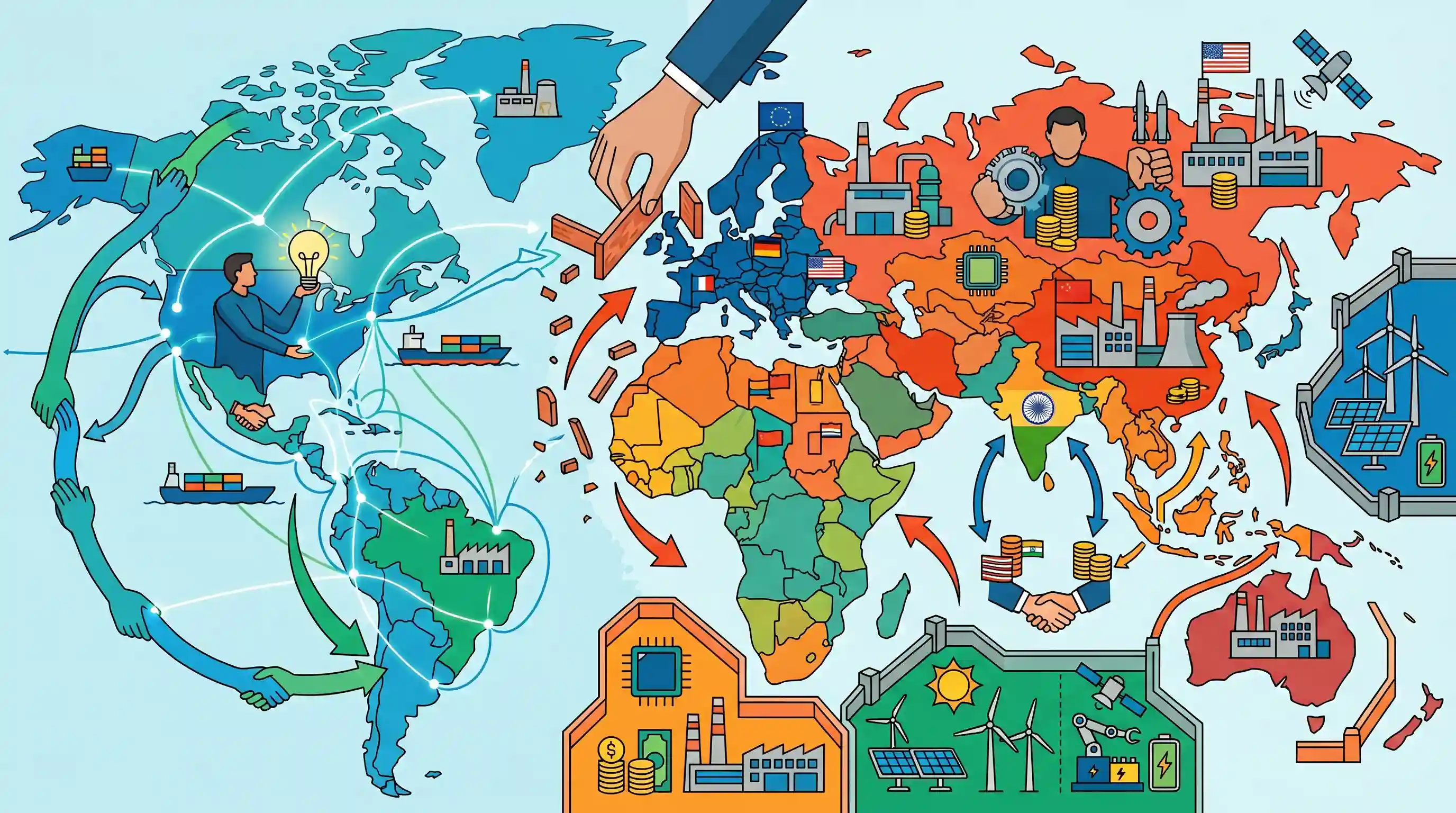
The article highlights a profound shift in global economic governance, arguing that the world is increasingly abandoning the principles of free trade in favor of state intervention, protectionism, and robust industrial policies—a paradigm reminiscent of the 'China model.' As major powers like the US and European nations prioritize national security, supply chain resilience, and strategic autonomy, they are heavily subsidizing domestic industries and adopting protectionist stances. This waning of globalization and multilateralism, accompanied by a rise in sovereign nationalism and geo-economic fragmentation, presents significant challenges and opportunities for emerging economies like India, which must adapt to a world increasingly driven by state capitalism rather than market forces.
Key Points
- The global economic paradigm is shifting away from free trade and laissez-faire economics toward state intervention and industrial policy, resembling the 'China model' of state capitalism.
- Western nations, including the US and European countries, are increasingly adopting protectionist measures, subsidies, and tariffs to protect domestic industries and secure critical supply chains.
- This trend reflects a broader move towards deglobalization, 'sovereign nationalism,' and a decline in multilateralism as countries prioritize strategic autonomy and national security over economic efficiency.
- The shift poses significant challenges for developing countries like India, which must navigate a fragmented global economy characterized by protectionism and bilateralism.
- There is a growing focus on reducing supply chain dependence on China, leading the West to seek alternatives and foster strategic allies in this new geo-economic landscape.
Prelims Trap
"The Washington Consensus recommends strong state intervention and targeted subsidies for rapid economic growth."
The Washington Consensus actually prescribes free-market policies, privatization, and deregulation (neoliberalism), directly opposing the state-directed industrial policies of the 'China/Beijing model'.
Static Concepts Connected
What are the core pillars of the Washington Consensus?
- Fiscal discipline: Strict limits on government borrowing, reduction of fiscal deficits, and minimizing broad government subsidies.
- Market liberalization: Promoting floating exchange rates, free trade, and the removal of barriers to Foreign Direct Investment (FDI).
- Deregulation & Privatization: Transferring state-owned enterprises to the private sector and eliminating rules that restrict competitive market entry.
How do modern economies implement non-tariff protectionism?
- Local content requirements: Mandating that a specific percentage of a product be manufactured domestically to qualify for state incentives (e.g., PLI schemes).
- Regulatory standards: Imposing strict environmental or labor standards (like the EU's Carbon Border Adjustment Mechanism) that implicitly disadvantage developing nation imports.
- State subsidies: Offering massive direct financial grants or tax breaks to domestic industries to ensure they outcompete foreign rivals in critical sectors.
Cross-Topic Patterns
Atmanirbhar Bharat as State Capitalism
India's PLI schemes and recent import restrictions mirror global industrial policies, signaling a shift from post-1991 liberalization toward strategic, state-backed manufacturing and self-reliance.
Friendshoring & China+1 strategy
The decline of WTO multilateralism pushes nations toward bilateralism and alliances like the Minerals Security Partnership, prioritizing geopolitical trust over sheer economic efficiency.

Deglobalisation, Washington vs Beijing Consensus, and 'friendshoring' concepts will likely combine into a multi-statement Prelims question.
Linked PYQs · 3
Linked PYQs · 3
- 2025MainsGS3
What are the challenges before the Indian economy when the world is moving away from free trade and multilateralism to protectionism and bilateralism? How can these challenges be met?
- 2025MainsGS2
"With the waning of globalization, post-Cold War world is becoming a site of sovereign nationalism.” Elucidate.
- 2024MainsGS2
‘The West is fostering India as an alternative to reduce dependence on China's supply chain and as a strategic ally to counter China's political and economic dominance.’ Explain this statement with examples.
