Deepak Dhar Contribution to Statistical Physics and ICTP Dirac Medal
Source:The Hindu ↗
কেন এটি গুরুত্বপূর্ণ
Deepak Dhar's recognition is a hallmark of Indian excellence in foundational theoretical sciences. For UPSC candidates, understanding basic scientific concepts like Self-Organized Criticality, fractals, and the interdisciplinary applications of statistical mechanics (like neural networks and AI modeling) is critical for Science & Technology sections in both Prelims and GS Paper 3.
সারসংক্ষেপ
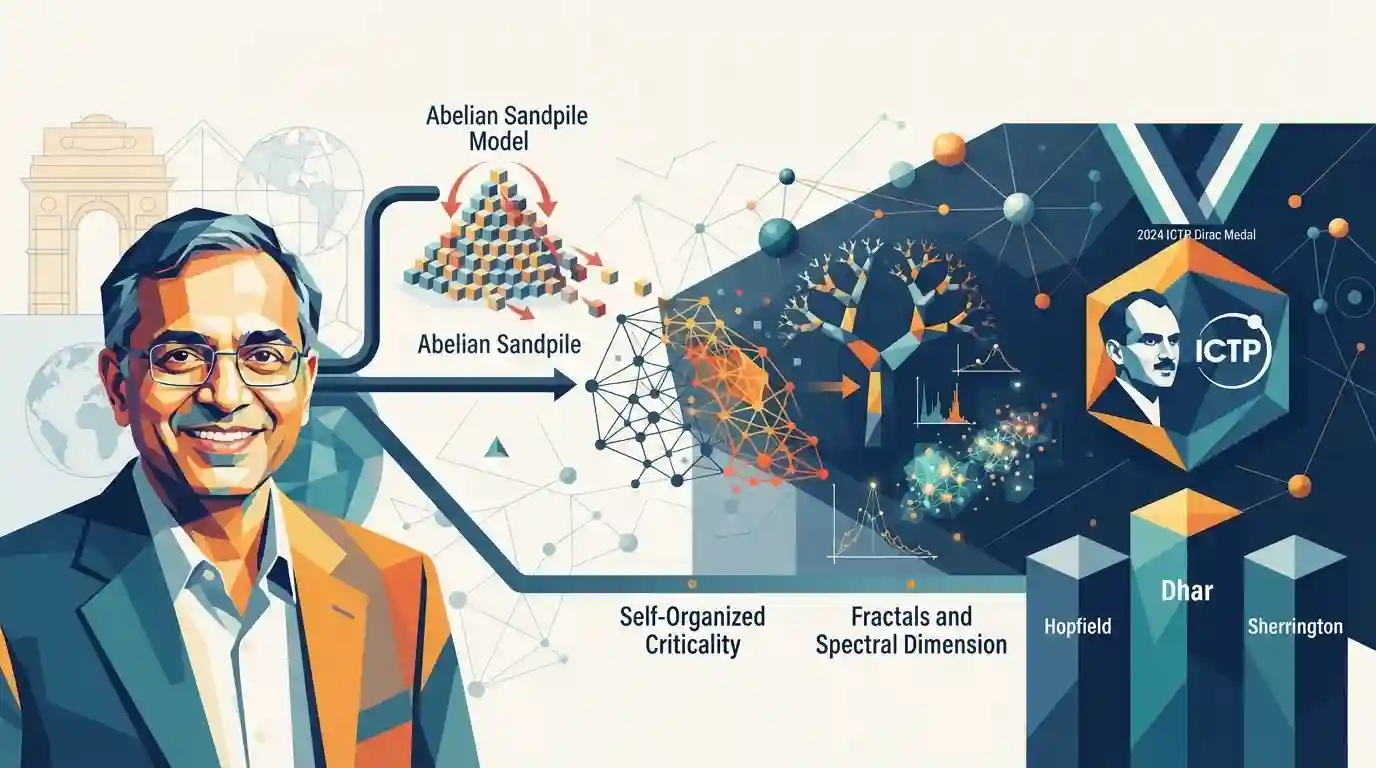
The article explains the pioneering scientific work that earned Indian theoretical physicist Deepak Dhar the prestigious 2024 ICTP Dirac Medal. Sharing the award with renowned physicists John J. Hopfield and David Sherrington, Dhar was recognized for his monumental contributions to statistical physics, particularly in studying out-of-equilibrium systems. His most famous work involves the Abelian Sandpile Model, which provides the mathematical underpinning for Self-Organized Criticality (SOC)—a phenomenon explaining how complex dynamical systems naturally reach a tipping point where even minor disturbances cause avalanches (like earthquakes or forest fires). Dhar also advanced the understanding of 'fractals' and 'spectral dimension'. Awarded by the Abdus Salam International Centre for Theoretical Physics (ICTP), this accolade underscores the pivotal role statistical physics plays in modern interdisciplinary science, while highlighting India's formidable capabilities in fundamental theoretical research.
মূল বিষয়
- Indian theoretical physicist Deepak Dhar was awarded the prestigious 2024 ICTP Dirac Medal, sharing it with John J. Hopfield and David Sherrington.
- The Dirac Medal, awarded annually by the Abdus Salam International Centre for Theoretical Physics (ICTP) in Trieste, honors significant contributions to theoretical physics.
- Deepak Dhar was recognized for his seminal contributions to statistical physics, specifically focusing on out-of-equilibrium systems which are highly complex compared to equilibrium states.
- His major theoretical achievements include the exact mathematical solution of the Abelian Sandpile Model—a structural model explaining Self-Organized Criticality (SOC), where complex systems naturally evolve to a critical, avalanche-prone state.
- Dhar also made pioneering contributions to the understanding of fractals and defining the 'spectral dimension', which dictates how diffusing particles move on geometrically self-similar fractal surfaces.
- The triad of 2024 winners demonstrated how statistical physics could revolutionize other disciplines, such as computer science (neural networks via Hopfield and Sherrington's work) and biological systems.
- Dhar's consistent international recognition (including the 2022 Boltzmann Medal) highlights the strong global standing of India's foundational research in theoretical physics.
গুরুত্বপূর্ণ শব্দ
Dirac Medal

A prestigious international award presented annually by the ICTP to honor significant contributions to theoretical physics, awarded to Indian physicist Deepak Dhar in 2026.
UPSC context
GS Paper III: Science & Technology; tests awareness of premier global scientific honors and Indian achievements in theoretical physics.
Boltzmann Medal
The highest global accolade in statistical physics, awarded triennially by IUPAP for outstanding achievements, won by Deepak Dhar in 2022 as its first Indian recipient.
UPSC context
GS Paper III: Science & Technology; tests knowledge of landmark global recognitions and pioneering Indian contributors to basic sciences.
Self-Organized Criticality (SOC)
A concept in complex systems theory where non-equilibrium dynamical systems naturally evolve toward a critical state (tipping point), allowing small local disturbances to trigger massive cascades.
UPSC context
GS Paper III: Basic Sciences; tests comprehension of theoretical physics models applicable to natural disaster forecasting and complex systems.
Abelian Sandpile Model
A foundational mathematical cellular automaton model where Deepak Dhar proved the "Abelian" property, demonstrating that the final stable state is independent of the order of perturbations.
UPSC context
GS Paper III: Science & Technology; tests awareness of major Indian contributions to mathematical physics and modeling.
Tata Institute of Fundamental Research (TIFR)
A premier public research institution in India, founded in 1945 by Dr. Homi J. Bhabha under the Department of Atomic Energy, dedicated to advanced basic sciences.
UPSC context
GS Paper III: Scientific Institutions; tests knowledge of premier national organizations spearheading post-independence scientific research.
Abdus Salam International Centre for Theoretical Physics (ICTP)
An international research institute based in Trieste, Italy, that fosters advanced physical and mathematical sciences, particularly targeting scientific capacity-building in developing nations.
UPSC context
GS Paper III: International Institutions; tests familiarity with international scientific bodies driving global academic collaboration.
প্রিলিমস ফাঁদ
The ICTP Dirac Medal is awarded by the Royal Swedish Academy of Sciences or is associated with the Nobel Prize committee.
Aspirants often mistake elite theoretical physics honors like the Dirac or Boltzmann Medals for Nobel-affiliated awards; the Dirac Medal is uniquely awarded by the ICTP in Trieste, Italy.
সংযুক্ত স্থির ধারণা
What is Self-Organized Criticality (SOC) in complex systems?
- Core Definition: Refers to dynamical systems naturally evolving toward a critical state (tipping point) without external fine-tuning or intervention.
- Avalanche Dynamics: A minor disturbance can trigger events of any size, following a power-law distribution where tiny events are frequent and catastrophic ones are rare.
- Real-World Utility: Crucial for modeling natural phenomena such as tectonic fault movements, solar flares, economic market crashes, and neural network signaling.
What are Fractals and Spectral Dimensions in physics?
- Fractals: Geometrical shapes that exhibit self-similarity across different scales, meaning smaller parts resemble the whole structure.
- Spectral Dimension: A mathematical index determining how physical processes, like diffusion or heat conduction, propagate through highly complex fractal networks.
আন্তঃবিষয় প্যাটার্ন
Statistical Physics + Disaster Risk Reduction
Deepak Dhar’s mathematical work on Self-Organized Criticality provides the foundational framework used by geophysicists to model unpredictable disasters like earthquakes, landslides, and forest fires.
Theoretical Physics + Artificial Intelligence
The award’s focus on non-equilibrium systems connects statistical mechanics to theoretical neuroscience, specifically how spin-glass models underpin the architecture of modern artificial neural networks.

Deepak Dhar's dual Boltzmann-Dirac honors likely to feature in UPSC as a conceptual statement on Self-Organized Criticality and fractal models.
সংযুক্ত PYQ · 2
সংযুক্ত PYQ · 2
- 2017PrelimsGS1
The terms 'Event Horizon', 'Singularity', 'String Theory' and 'Standard Model' are sometimes seen in the news in the context of
- 2016MainsGS3
Discuss India's achievements in the field of Space Science and Technology. How the application of this technology has helped India in its socio-economic development?
