Western Ghats Ecologically Sensitive Area Conservation Policy
Source:orfonline ↗
Why It Matters
The article examines the perennial friction between environmental protection and developmental politics in India's biodiversity hotspots, which is a frequent theme in MPSC geography and environment sections.
Summary
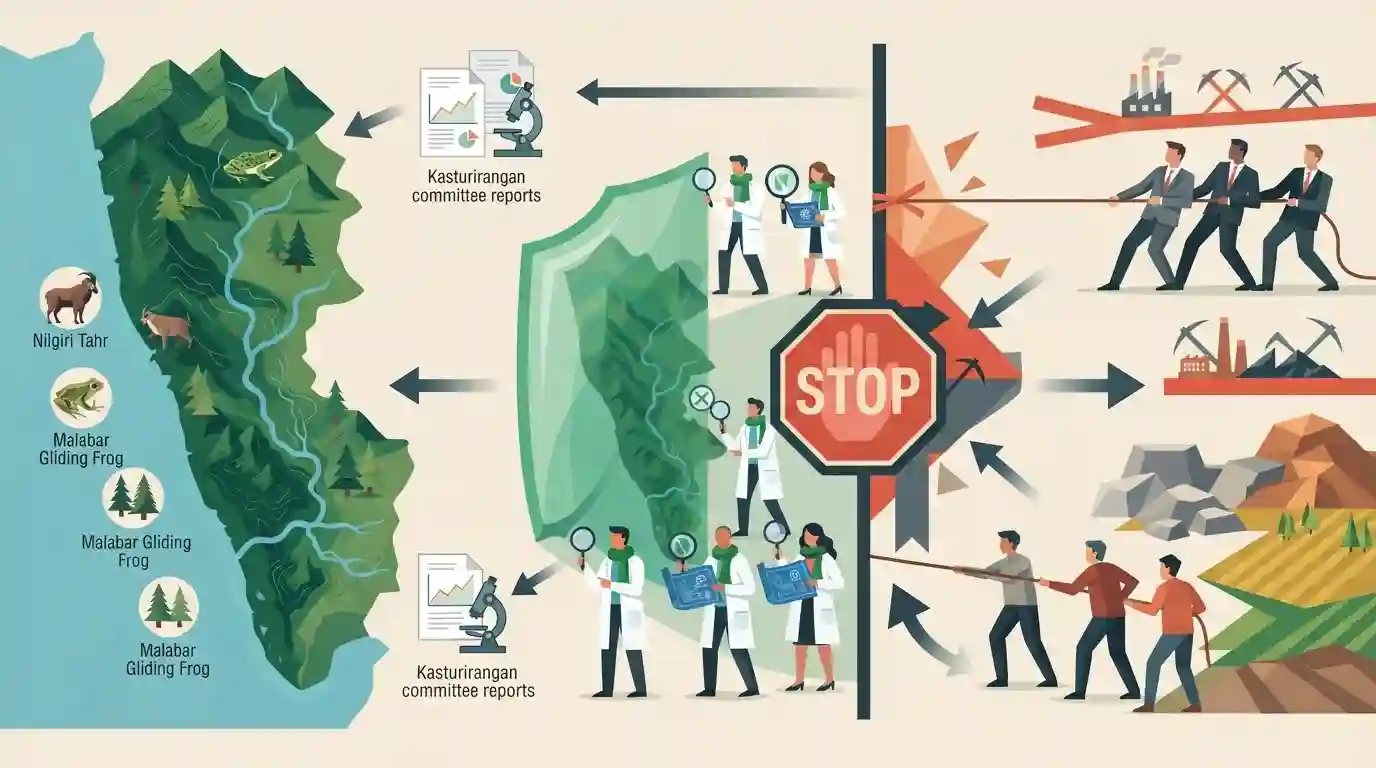
This article explores the ongoing political deadlock surrounding the notification of the Western Ghats as an Ecologically Sensitive Area (ESA). Despite clear scientific consensus recommendations from expert bodies like the Gadgil and Kasturirangan committees regarding the critical need to preserve the fragile biodiversity hotspot, implementation has stalled due to local economic concerns, political resistance, and developmental pressures across the affected states.
Key Points
- The Western Ghats span six states along the western coast of India and are recognized globally as a major biodiversity hotspot.
- Two key committees, the Madhav Gadgil Committee (WGEEP) and the Kasturirangan Committee, have provided frameworks for protecting the Western Ghats as an Ecologically Sensitive Area (ESA).
- Scientific consensus on environmental conservation frequently clashes with political deadlock, local socio-economic anxieties, resistance to developmental restrictions, and fears of displacement or livelihood loss.
- Draft notifications regarding the ESA designation face repeated delays and resistance from state governments and local communities across the Western Ghats region.
Important Terms
Ecologically Sensitive Area (ESA) notification

A designation assigned by the government under the Environment Protection Act, 1986, to regions requiring special protection due to fragile ecosystems, high biodiversity, and vulnerability to anthropogenic threats.
UPSC context
Important for MPSC/UPSC Environment and Biodiversity Conservation; tests policy mechanisms for balancing developmental needs with ecological preservation in sensitive zones.
Madhav Gadgil Committee
The Western Ghats Ecology Expert Panel (2011) led by Madhav Gadgil, which recommended classifying the entire Western Ghats as an ESA with strict bans on industrial and mining activities.
UPSC context
Crucial for MPSC Environment and Geography topics; evaluates expert committee recommendations on biodiversity conservation and sustainable regional development.
Kasturirangan Committee
A High-Level Working Group (2013) chaired by K. Kasturirangan that adopted a developmental-conservation balance by limiting the Western Ghats ESA to 37 percent while protecting human settlements.
UPSC context
Essential for MPSC Environment and Governance; tests policy trade-offs between environmental protection and regional economic growth in fragile ecosystems.
Ministry of Environment, Forest and Climate Change (MoEFCC)
The nodal central ministry responsible for formulating and implementing environmental, forestry, and wildlife protection policies, laws, and notifications across India.
UPSC context
Core MPSC Polity and Administration topic; tests institutional frameworks and executive authority regarding environmental regulation and notifications.
Prelims Trap
Both the Madhav Gadgil and Kasturirangan committees recommended declaring 100% of the Western Ghats as an Ecologically Sensitive Area.
Aspirants often confuse the two reports, assuming both recommended a complete ban across the entire Western Ghats region, whereas Kasturirangan limited ESA to 37%.
Static Concepts Connected
What are the key differences between the Gadgil and Kasturirangan committees on the Western Ghats?
- Gadgil Report: WGEEP (2010) recommended declaring the entire Western Ghats as an Ecologically Sensitive Area (ESA) with three zones and bottom-up local governance.
- Kasturirangan Report: HLWG (2013) recommended designating only 37% of the Western Ghats as an ESA, focusing primarily on natural landscapes while excluding inhabited areas.
- Common Bans: Both committees recommended strict bans on mining, quarrying, and red-category polluting industries within their respective designated zones.
Cross-Topic Patterns
Western Ghats ESA + PESA Act Linkages
The debate over ESA notifications in the Western Ghats directly intersects with the Panchayats (Extension to Scheduled Areas) Act (PESA) and tribal rights in forested regions of Maharashtra.
Biodiversity Conservation vs. Federal Development Corridors
Conservation economics in fragile biodiversity zones often clashes with the state's push for infrastructure corridors and industrial mining under federal policies.

Expect a statement-based MPSC question comparing Gadgil (entire region, bottom-up) and Kasturirangan (37%, selective) committee recommendations.
Linked PYQs · 2
Linked PYQs · 2
- 2017MPSC_PRELIMSGS1
Which of the following mountains are considered as one of the top biodiversity hot spots ?
- 2022MPSC_PRELIMSGS1
In India, which of the following has become a hot-spot with reference to threats to biodiversity ?
