Palk Strait Fishing Rights and Katchatheevu Maritime Disputes
Source:The Hindu ↗
Why It Matters
Highlights the intersection of domestic politics (federalism) and foreign policy, the ecological aspects of maritime disputes, and the strategic importance of stable India-Sri Lanka relations under the Neighbourhood First policy.
Summary
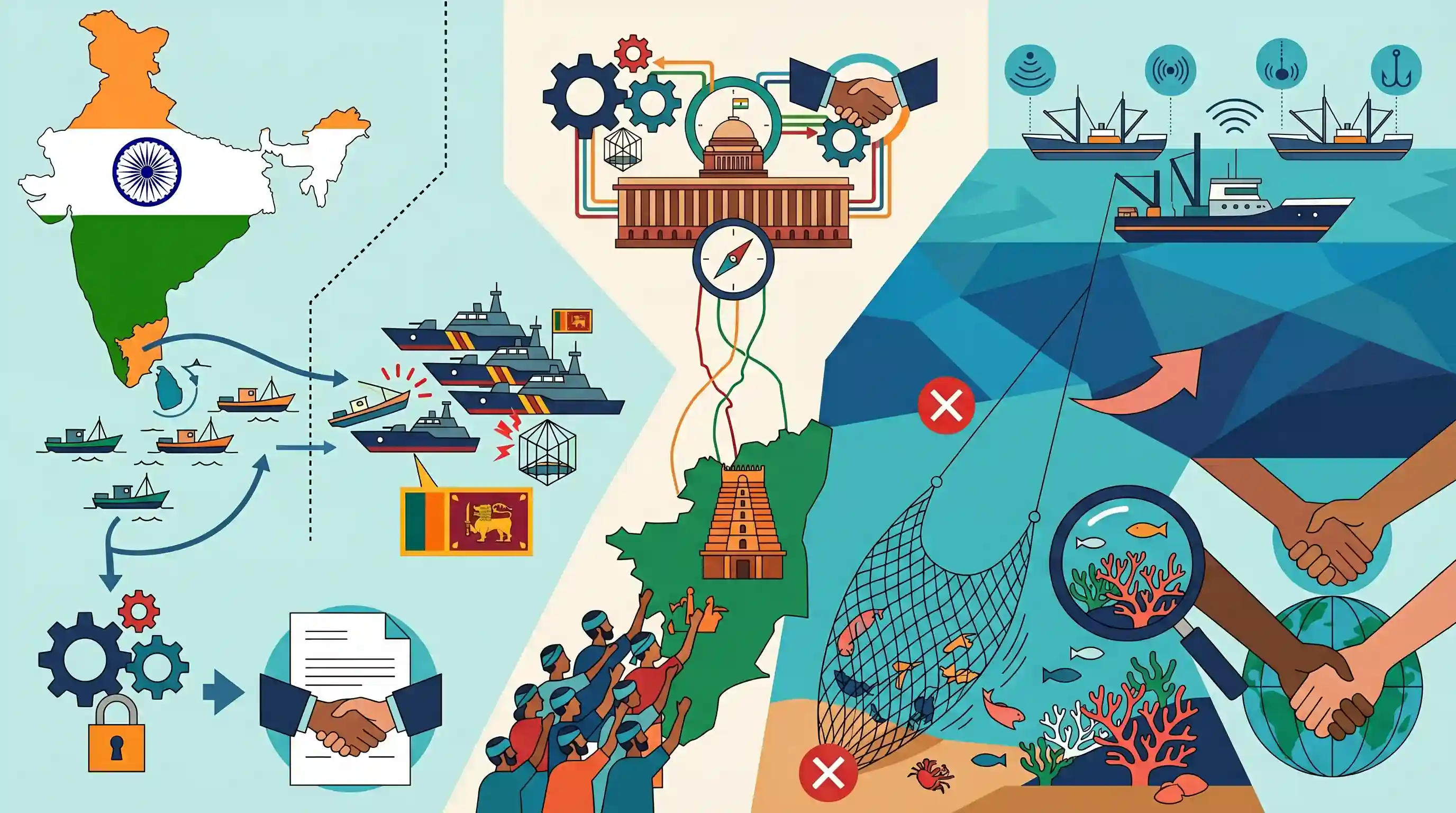
The Katchatheevu and Palk Strait disputes remain persistent irritants in India-Sri Lanka relations, primarily driven by the livelihoods of Tamil Nadu fishermen and ecological concerns in the Palk Bay. While the 1974 and 1976 maritime agreements settled the territorial status of Katchatheevu, frequent transgressions of the International Maritime Boundary Line (IMBL) by Indian trawlers lead to clashes and arrests by the Sri Lankan Navy. The long-term solution lies in phasing out destructive bottom trawling, incentivizing deep-sea fishing, establishing joint bilateral mechanisms for marine conservation, and addressing the issue as a humanitarian and ecological challenge. Navigating this dispute carefully is crucial for maintaining India's broader strategic interests and its 'Neighbourhood First' policy.
Key Points
- The Katchatheevu island dispute is frequently triggered by the arrest of Indian fishermen from Tamil Nadu by the Sri Lankan Navy in the Palk Strait.
- Katchatheevu was officially recognized as Sri Lankan territory under the 1974 and 1976 bilateral maritime boundary agreements.
- The ongoing conflict is primarily ecological and economic; Indian fishermen engage in bottom trawling, which depletes marine resources and violates Sri Lankan laws.
- A sustainable solution requires transitioning Indian fishermen to deep-sea fishing, promoting joint marine conservation efforts, and managing arrests with a humanitarian approach.
- Politicizing the Katchatheevu issue for domestic gains risks undermining India's broader strategic and diplomatic relationship with Sri Lanka.
Important Terms
1974 and 1976 Maritime Boundary Agreements

Bilateral treaties that delineated the maritime boundary in the Palk Strait, Gulf of Mannar, and Bay of Bengal, settling the status of Katchatheevu and the Wadge Bank.
UPSC context
GS-II (International Relations); important for understanding the legal basis of territorial settlements and maritime disputes with India's neighbors.
Katchatheevu
A 285-acre uninhabited island in the Palk Strait, ceded to Sri Lanka by India in 1974; it remains a flashpoint for disputes over traditional fishing rights and Indian federalism.
UPSC context
GS-II/Prelims; tests knowledge of historical bilateral agreements and the tension between State interests and Union foreign policy.
Bottom Trawling
An ecologically destructive fishing method involving dragging weighted nets along the seafloor, which depletes marine stocks and damages coral reefs, fueling conflict between Indian and Sri Lankan fishermen.
UPSC context
GS-III (Environment/Conservation); relevant for questions on unsustainable resource extraction and its impact on regional blue economy and diplomacy.
UNCLOS
An international treaty providing a comprehensive legal framework for ocean governance, including the delimitation of territorial waters and Exclusive Economic Zones (EEZ).
UPSC context
GS-II/Prelims; foundational for understanding international maritime law and India's role in the rules-based order of the Indian Ocean.
International Maritime Boundary Line (IMBL)
The official maritime border between India and Sri Lanka established by bilateral treaties; frequent transgressions by Indian trawlers lead to arrests by the Sri Lankan Navy.
UPSC context
GS-II (Bilateral Relations); central to the 'Fishermen Issue' and practical challenges in managing shared maritime spaces.
Wadge Bank
A nutrient-rich fishing ground near Kanyakumari over which India gained sovereign rights through the 1976 agreement, often viewed as a strategic trade-off for Katchatheevu.
UPSC context
GS-II/Prelims; highlights the strategic dimension of maritime negotiations and resource management in India's southern waters.
Prelims Trap
"The 1974 agreement secured traditional fishing rights for Indian fishermen around Katchatheevu island."
The 1974 pact only allowed resting, drying nets, and attending the Catholic shrine. The 1976 agreement strictly prohibited fishing in each other’s Exclusive Economic Zones.
Static Concepts Connected
Does settling a boundary dispute require a Constitutional Amendment Act?
- Executive Action: Settling a genuine boundary dispute does not require a CAA and can be done by executive action (Maganbhai Ishwarbhai Patel case 1969).
- Ceding Territory: Ceding undisputed Indian territory to a foreign state strictly requires a Constitutional Amendment under Article 368 (Berubari Union Case 1960).
Why is 'bottom trawling' environmentally destructive?
- Habitat Destruction: Dragging weighted nets across the seafloor destroys the benthic zone, crushing fragile coral reefs, sponges, and seagrass beds.
- High Bycatch: It indiscriminately catches non-target species and juvenile fish, preventing the natural replenishment of commercial marine stocks.
Cross-Topic Patterns
Federalism in Foreign Policy
Tamil Nadu's legal challenge to Katchatheevu mirrors West Bengal’s opposition to Teesta water sharing, highlighting how border states directly complicate India's 'Neighbourhood First' diplomacy.
Blue Economy + Bilateral IR
The Palk Bay Scheme addresses a diplomatic crisis via domestic ecological intervention: subsidizing fishermen to shift from destructive shallow-water trawlers to sustainable deep-sea vessels.

Expect a linked Prelims question mapping Katchatheevu's legal status to polity (Berubari Union/Article 368) and UNCLOS boundary principles.
Linked PYQs · 1
Linked PYQs · 1
- 2022MainsGS2
India is an age-old friend of Sri Lanka.’ Discuss India's role in the recent crisis in Sri Lanka in the light of the preceding statement.
