Public Health Risks of E Cigarettes and the Vaping Ban in India
Source:Indian Express ↗
Why It Matters
Highlights the intersection of public health policy and emerging commercial health threats, crucial for GS Paper 2 (Health, Governance). It provides context for evaluating the efficacy of statutory bans (like PECA 2019) versus regulation in combating youth addiction and non-communicable diseases.
Summary
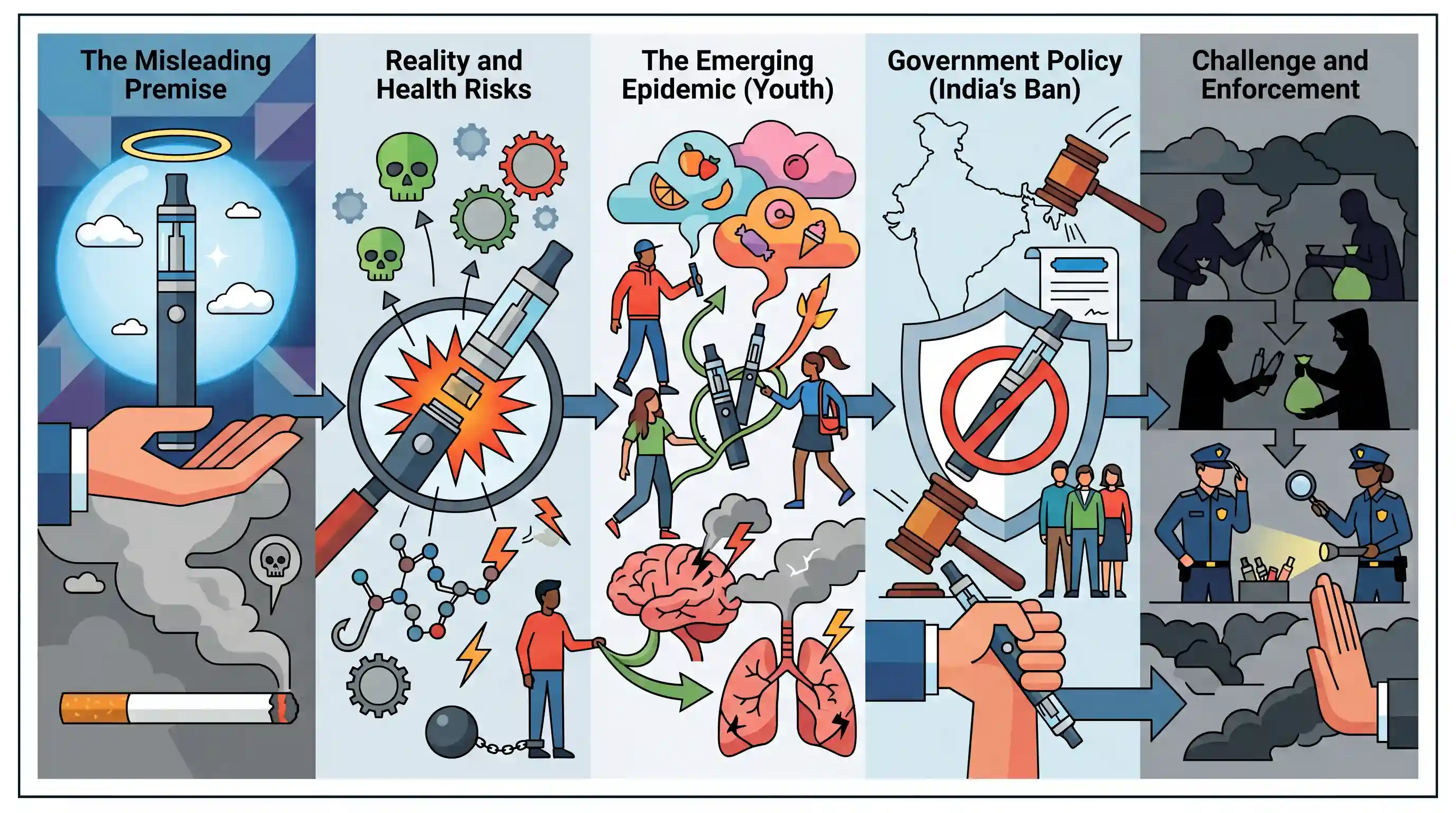
The article critically examines the scientific evidence surrounding e-cigarettes (vaping), dismantling the narrative that they are a safe alternative to traditional combustible tobacco. It highlights the serious health risks associated with vaping, including exposure to toxic chemicals, heavy metals, and highly addictive nicotine, which particularly targets youth. The piece underscores the importance of India's proactive ban under the Prohibition of Electronic Cigarettes Act (PECA), 2019, while calling for stricter enforcement to combat the illicit market and protect public health from this emerging epidemic.
Key Points
- E-cigarettes, often marketed as safe alternatives or smoking cessation tools, are scientifically proven to contain harmful substances such as volatile organic compounds, heavy metals, and ultrafine particles.
- Vaping poses severe health risks, including lung injuries (such as EVALI), cardiovascular issues, and intense nicotine addiction that adversely affects adolescent brain development.
- The vaping industry deliberately targets youth using flavored products and aggressive marketing, threatening to create a new generation of nicotine-dependent individuals.
- India proactively implemented the Prohibition of Electronic Cigarettes Act (PECA) in 2019 to completely ban the production, import, sale, and advertisement of e-cigarettes.
- Despite the ban, addressing the flourishing black market requires stringent law enforcement, continuous public health surveillance, and robust youth awareness campaigns.
Important Terms
Prohibition of Electronic Cigarettes Act (PECA), 2019

Indian legislation enacted to completely ban the production, manufacture, import, export, sale, and advertisement of e-cigarettes. It aims to protect citizens, especially youth, from nicotine addiction and emerging public health risks.
UPSC context
GS Paper II (Government Policies) and Paper III (Public Health). Tests regulatory mechanisms against modern health threats.
WHO Framework Convention on Tobacco Control (FCTC)
The first international public health treaty negotiated under the WHO. It provides a legal framework for global tobacco control, focusing on reducing demand, supply, and cross-border advertising to combat the tobacco epidemic.
UPSC context
GS Paper II (International Treaties) and Paper III (Health). Relevant for global governance and India’s international commitments.
Indian Council of Medical Research (ICMR)
India's apex body for the formulation and promotion of biomedical research. It provided the critical scientific basis for the e-cigarette ban through a white paper detailing the harmful effects of nicotine delivery systems.
UPSC context
GS Paper II (Statutory/Regulatory Bodies) and Paper III (Science & Tech). Tests institutional roles in evidence-based policy.
World Health Organization (WHO)
A specialized United Nations agency responsible for international public health. It sets global health standards, coordinates international responses to epidemics, and advocates for policies like the FCTC to reduce tobacco-related mortality.
UPSC context
GS Paper II (International Institutions). Tests knowledge of global health oversight and multilateral health cooperation.
Electronic Nicotine Delivery Systems (ENDS)
A category of battery-powered devices, such as e-cigarettes and vapes, that deliver nicotine via an inhalable aerosol. They are banned in India due to risks like cardiovascular disease and youth addiction.
UPSC context
GS Paper III (Science & Tech/Public Health). Tests awareness of emerging health threats and the scientific basis for regulation.
Prelims Trap
"PECA 2019 explicitly criminalizes the personal consumption and use of e-cigarettes in India."
PECA 2019 bans production, sale, import, transport, and storage of e-cigarettes. However, the Act notably does not explicitly criminalize the act of personal consumption.
Static Concepts Connected
What is the WHO Framework Convention on Tobacco Control (FCTC)?
- Nature & Origin: It is the first global public health treaty negotiated under the WHO (adopted in 2003) to tackle the global tobacco epidemic.
- Core Mandate: Provides a framework for both demand reduction (taxation, packaging) and supply reduction (illicit trade) of tobacco.
- India's Stance: India is a signatory and ratified it in 2004, driving domestic actions like COTPA and PECA 2019 to meet treaty obligations.
What makes e-cigarette aerosols harmful to human health?
- Toxic Aerosols: They do not emit water vapour; they generate aerosols containing Volatile Organic Compounds (VOCs) and ultrafine particles.
- Chemical Additives: Users inhale heavy metals like lead, chromium, and nickel, along with additives like diacetyl which causes bronchiolitis obliterans ("popcorn lung").
- Neurotoxic Nicotine: Contains highly addictive nicotine which acts as a neurotoxin, severely impairing adolescent brain development, memory, and learning.
Cross-Topic Patterns
E-waste hazards from disposable e-cigarettes
Discarded single-use vapes contain lithium-ion batteries and toxic chemical residues, bridging public health (PECA) with E-Waste Management Rules and hazardous waste management.
NCDs, SDGs, and Tobacco Control
Nicotine regulation ties directly to UN SDG Target 3.4 (reducing premature mortality from NCDs), connecting national legislation like PECA 2019 to India's global health commitments.

Expect a Science & Tech question contrasting chemical emissions of traditional tobacco vs. e-cigarettes, focusing on heavy metals & EVALI.
Linked PYQs · 3
Linked PYQs · 3
- 2025PrelimsGS1
Consider the following: I. Cigarette butts II. Eyeglass lenses III. Car tyres How many of them contain plastic?
- 2020MainsGS2
In order to enhance the prospects of social development, sound and adequate health care policies are needed particularly in the fields of geriatric and maternal health care. Discuss.
- 2021PrelimsGS1
'Triclosan', considered harmful when exposed to high levels for a long time, is most likely present in which of the following?
