Role of economic diplomacy in shaping bilateral trade agreements
Source:The Hindu ↗
Why It Matters
Understanding the nuances of economic diplomacy and bilateral trade deals is crucial for analyzing India's foreign policy and economic resilience, particularly in the context of shifting global trade paradigms from multilateralism (WTO) to bilateralism. This forms a core component of GS2 (International Relations) and GS3 (Economy).
Summary
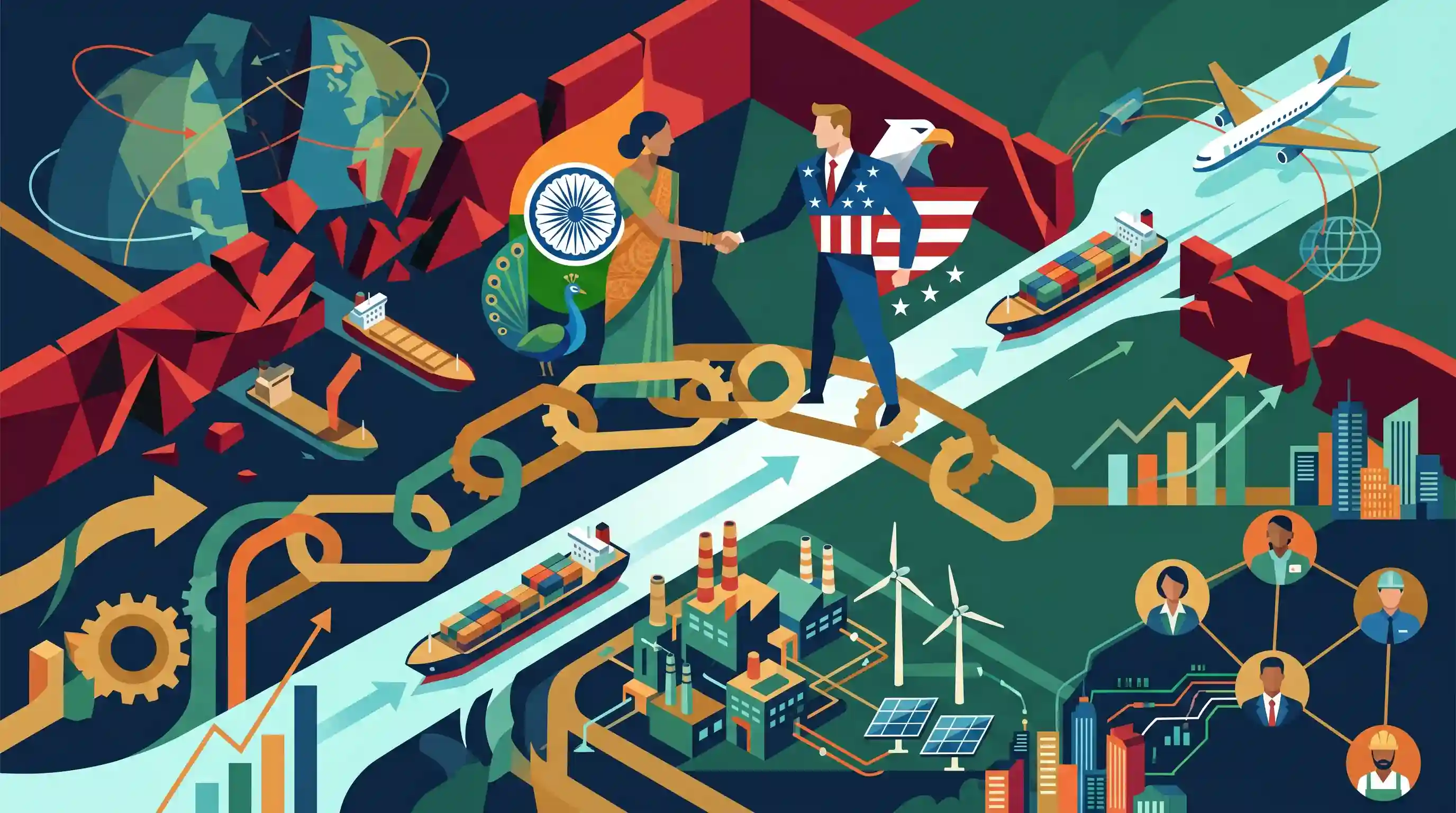
The article analyzes the recent trade agreement between India and the United States, highlighting the critical role of economic diplomacy. By effectively navigating trade disputes, protectionist tendencies, and market access issues, both nations have bolstered their economic integration. This trade deal not only mitigates the challenges posed by the shift from multilateralism to bilateralism but also fortifies the overarching India-U.S. strategic partnership, ensuring enhanced supply chain resilience and mutual economic growth in a contested global economy.
Key Points
- The recent U.S. trade deal with India exemplifies the successful application of economic diplomacy to resolve bilateral trade disputes and tariff barriers.
- Robust economic ties are increasingly recognized as a foundational pillar for strengthening the broader strategic and security partnership between the two democracies.
- The agreement reflects a global trend where nations are pivoting from multilateral WTO negotiations toward strategic bilateral trade pacts.
- The deal enhances supply chain resilience, secures market access, and mitigates the adverse impacts of rising global protectionism.
Important Terms
India-U.S. Interim Trade Agreement (2026)

A 2026 pact where the U.S. lowered tariffs on Indian goods from 50% to 18% in exchange for India's energy pivot from Russia and 'Buy American' commitments.
UPSC context
GS Paper 2 (IR); tests understanding of bilateral trade de-escalation, strategic autonomy, and 'transactional diplomacy' under different U.S. administrations.
Economic Diplomacy
The strategic use of a nation's economic resources—such as trade, investment, and aid—to achieve its foreign policy goals and national interests.
UPSC context
GS Paper 2/3; central theme in India’s 'Viksit Bharat' 2047 goals and its shift from defensive to proactive global economic engagement.
Comprehensive Global Strategic Partnership
The highest level of diplomatic ties between India and the U.S., encompassing defense, technology (iCET/TRUST), and a shared vision for a 'Free and Open Indo-Pacific.'
UPSC context
GS Paper 2; basic framework for UPSC questions on India-U.S. cooperation vs. friction points like data localization or trade tariffs.
Reciprocal Tariffs
A trade policy where a country matches the import duties of another; used as leverage to force tariff reductions or correct trade imbalances.
UPSC context
GS Paper 3 (Economy); relevant for questions on 'Protectionism' and the impact of developed countries' trade policies on the Indian economy.
COMPACT Initiative
An initiative launched in 2025 (Catalyzing Opportunities for Military Partnership, Accelerated Commerce and Technology) to deepen defense co-production and high-tech trade.
UPSC context
GS Paper 2; tests knowledge of specific newer defense-trade frameworks like Javelin co-production and the 'Mission 500' trade target.
World Trade Organization (WTO)
The intergovernmental organization regulating international trade; it serves as a forum for resolving bilateral disputes, such as the seven major India-U.S. cases settled by 2023.
UPSC context
GS Paper 2/3; tests understanding of 'rules-based world order' and the role of the WTO Dispute Settlement Body.
Free Trade Agreement (FTA)
A comprehensive agreement between countries to eliminate trade barriers; while India and the U.S. lack a full FTA, they pursue sectoral 'interim' deals.
UPSC context
GS Paper 3; tests awareness of India’s trade diversification strategy (e.g., FTAs with UAE, Australia, UK) vs. sectoral deals with the U.S.
Prelims Trap
India and the United States have signed a comprehensive Free Trade Agreement (FTA).
Aspirants confuse targeted bilateral trade resolutions (often out-of-court WTO settlements) with a full-fledged FTA. India and the U.S. do not currently have a comprehensive FTA.
Static Concepts Connected
What are the key differences between trade agreement types?
- PTA: Reduces tariffs on a specific "positive list" of agreed-upon products.
- FTA: Eliminates tariffs on a vast majority of goods, maintaining a limited "negative list".
- CECA / CEPA: Comprehensive pacts covering goods, services, investment, intellectual property, and regulatory cooperation.
How does the WTO Dispute Settlement mechanism function?
- Consultation phase: Initial 60-day period for parties to resolve trade disputes bilaterally before formal litigation.
- Panel stage: Adjudication by an independent panel if bilateral consultations fail to reach a mutually agreed solution.
- Appellate Body: Reviews appeals. Currently paralyzed due to the U.S. blocking judge appointments, driving nations toward bilateral settlements.
Cross-Topic Patterns
Trade pacts & Supply Chain Resilience
Links GS-2 Bilateral Relations with GS-3 initiatives like the Indo-Pacific Economic Framework (IPEF) and the Supply Chain Resilience Initiative (SCRI) to secure critical inputs amidst geopolitical fragmentation.
Economic diplomacy & Quad evolution
Reflects a broader pattern where strategic partnerships (like Quad or iCET) are increasingly anchored by targeted economic and technology-sharing mechanisms rather than just traditional defense ties.

Mains 2026 could ask to evaluate India's shift from multilateral WTO frameworks to strategic bilateral pacts for economic security.
Linked PYQs · 4
Linked PYQs · 4
- 2025MainsGS3
What are the challenges before the Indian economy when the world is moving away from free trade and multilateralism to protectionism and bilateralism? How can these challenges be met?
- 2018MainsGS2
What are the key areas of reform if the WTO has to survive in the present context of "Trade War', especially keeping in mind the interest of India?
- 2022MainsGS2
How will I2U2 (India, Israel, UAE and USA) grouping transform India's position in global politics?
- 2016MainsGS2
The broader aims and objectives of WTO are to manage and promote international trade in the era of globalization. But the Doha round of negotiations seem doomed due to differences between the developed and the developing countries." Discuss in the Indian perspective.
