US economic sanctions and the resilience of Cuban biotechnology
Source:The Hindu ↗
Why It Matters
It provides a critical case study on how international economic sanctions directly impact global health, scientific collaboration, and human rights. Furthermore, Cuba's indigenous biotechnology achievements offer an alternative model of self-reliance and public-health-oriented research for developing nations.
Summary
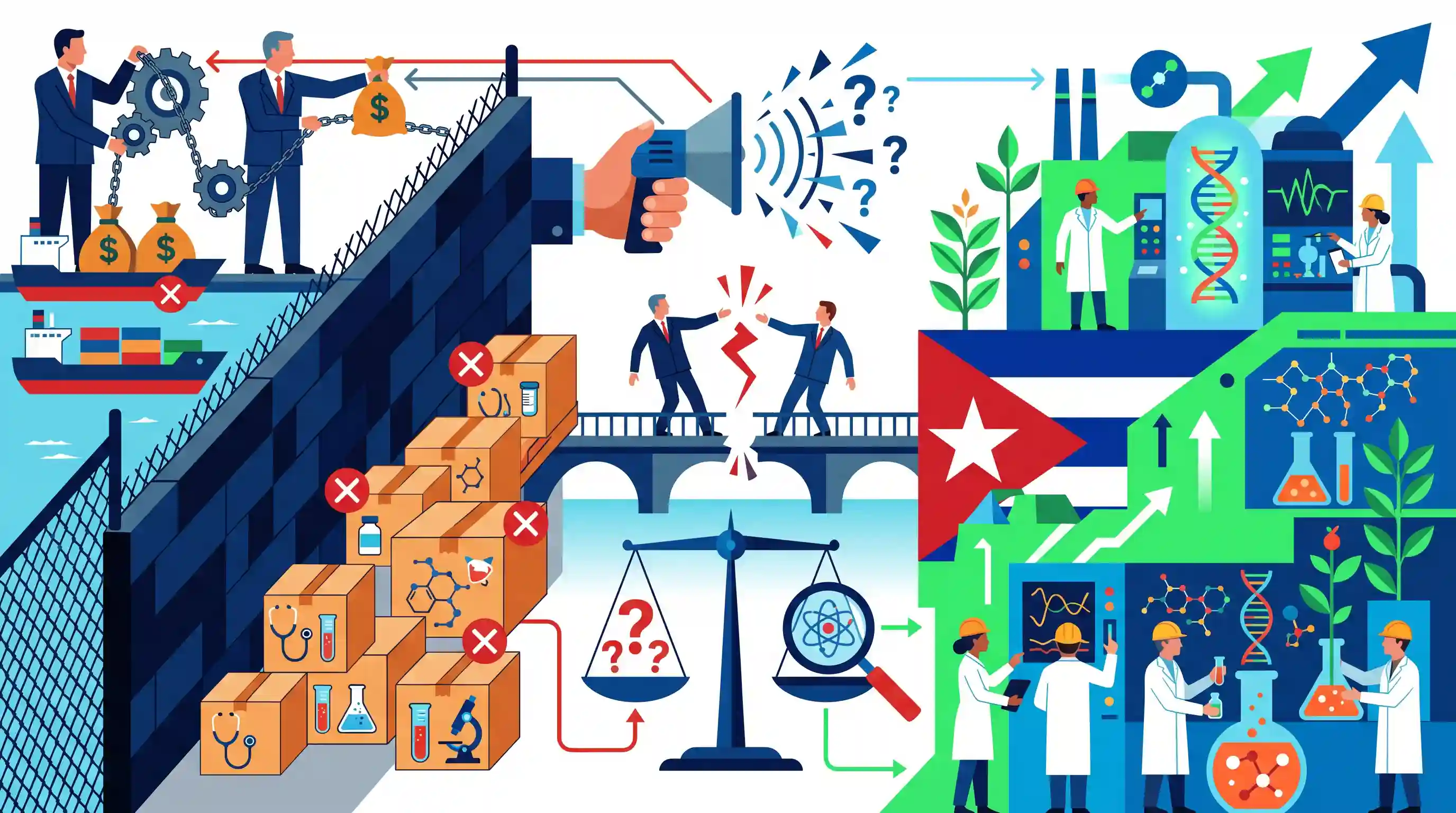
The article highlights the perspectives of Dr. Mitchell Valdes-Sosa, Director of the Cuban Neuroscience Center, on the debilitating effects of the U.S. economic blockade on Cuba's science and healthcare sectors. Valdes-Sosa argues that the U.S. policy systematically aims to cut off all sources of income to Cuba, severely hindering the import of vital medical supplies, reagents, and research equipment. Despite these crippling geopolitical sanctions, Cuba has demonstrated significant resilience by developing a robust, state-led biotechnology industry capable of producing indigenous vaccines and therapeutics. The discourse also emphasizes the politicization of science, referencing the 'Havana Syndrome' allegations as an example of unproven claims being weaponized to strain international diplomacy.
Key Points
- The U.S. economic blockade deliberately restricts Cuba's access to essential medical supplies, cutting-edge research technologies, and international scientific collaboration.
- U.S. policy towards Cuba functions as a systematic effort to cut off income sources, frequently prioritizing geopolitical objectives over global health and humanitarian concerns.
- Despite severe sanctions, Cuba has cultivated a resilient, state-sponsored biotechnology sector that successfully produces indigenous vaccines and advanced medical treatments.
- The intersection of diplomacy and science is evident in issues like the 'Havana Syndrome,' where Cuban scientists played a key role in investigating and challenging allegations of 'sonic attacks' by the U.S.
Important Terms
US embargo against Cuba

A long-standing set of economic, commercial, and financial sanctions imposed by the U.S. since 1960 to pressure the Cuban government toward democratic reforms.
UPSC context
GS Paper II: Effect of policies of developed and developing countries on India’s interests; International Relations history.
Havana Syndrome
A mysterious set of neurological symptoms (e.g., dizziness, headaches) first reported by U.S. diplomats in Havana in 2016, allegedly linked to directed-energy weapons.
UPSC context
GS Paper II & III: International security, diplomatic health incidents, and emerging non-traditional warfare technologies.
Medical Diplomacy
Cuba's foreign policy strategy of sending medical brigades and providing healthcare assistance globally to build international goodwill, soft power, and diplomatic ties.
UPSC context
GS Paper II: Global health governance, South-South cooperation, and soft power strategies in foreign policy.
BioCubaFarma
The Cuban state business group (including CNEURO) that manages the country's biotechnology and pharmaceutical industries, focusing on non-profit, state-led innovation and indigenous production.
UPSC context
GS Paper III: Science and Technology—Indigenization of technology and developing new technology; healthcare infrastructure.
Cuban Neuroscience Center (CNEURO)
A prominent Cuban research institute specializing in brain mapping, neuroinformatics, and medical device development; it is a key component of Cuba's high-tech healthcare sector.
UPSC context
GS Paper III: Achievements of scientists in science & technology; development of indigenous medical technologies.
Helms-Burton Act
The 1996 U.S. federal law that strengthened the embargo against Cuba by allowing sanctions against foreign companies doing business with the island.
UPSC context
GS Paper II: Effect of foreign legislation on international trade and the sovereignty of other nations.
Prelims Trap
The economic blockade against Cuba is enforced by a binding United Nations Security Council (UNSC) resolution.
The US embargo is unilateral, not multilateral. In fact, the UN General Assembly overwhelmingly votes every year to condemn the US economic blockade against Cuba.
Static Concepts Connected
How do unilateral secondary sanctions function in international relations?
- Primary Sanctions: Restrict citizens and companies of the sanctioning country from engaging in trade or financial transactions with the target state.
- Secondary Sanctions: Penalize third-party nations, foreign entities, or banks for doing business with the sanctioned country, cutting them off from the sanctioner's financial system.
- International Legality: Only UN Security Council sanctions are universally binding. Unilateral secondary sanctions (like the US Helms-Burton Act for Cuba) rely on domestic law applied extraterritorially.
What is the scientific basis of Cuba's indigenous protein subunit vaccines (like Abdala)?
- Protein Subunit Mechanism: They use harmless, purified fragments (proteins) of the pathogen (e.g., the spike protein's receptor-binding domain) to trigger an immune response without causing disease.
- Storage Advantage: Unlike mRNA vaccines, subunit vaccines are highly stable at standard refrigerator temperatures (2-8°C), making them highly suitable for low-resource settings.
- Recombinant Yeast: Cuba relies on recombinant DNA technology, inserting the viral gene into yeast (Pichia pastoris) to mass-produce the target proteins.
Cross-Topic Patterns
Vaccine Equity vs. Intellectual Property
Cuba's state-owned BioCubaFarma model contrasts sharply with IP-heavy Western pharma. This feeds directly into GS2/GS3 debates on WTO TRIPS waivers, patent monopolies, and vaccine equity for the Global South.
Havana Syndrome & Directed Energy Weapons
The 'Havana Syndrome' allegations frequently spark discussions on Directed Energy Weapons (DEWs) and acoustic/microwave technologies, intersecting GS3 defense tech with GS2 diplomatic security protocols.

Expect a Prelims science pairing question matching syndromes (e.g., Havana Syndrome) with their alleged electromagnetic/technological origins.
Linked PYQs · 2
Linked PYQs · 2
- 2012MainsGS2
How have the US sanctions against Iran affected India's bilateral relations with Iran?
- 2021MainsGS3
What are the research and developmental achievements in applied biotechnology? How will these achievements help to uplift the poorer sections of the society?
