Urban Fire Safety and Building Code Compliance
Source:The Hindu ↗
কেন এটি গুরুত্বপূর্ণ
Urban fire safety sits at the intersection of GS1 (Urbanization), GS2 (Governance/ULBs), and GS3 (Disaster Management). Frequent fire tragedies expose systemic regulatory failures and corruption. For UPSC aspirants, understanding the National Building Code, the role of municipal governance in disaster mitigation, and the necessity of proactive safety audits is critical for writing holistic answers on urban resilience and disaster preparedness.
সারসংক্ষেপ
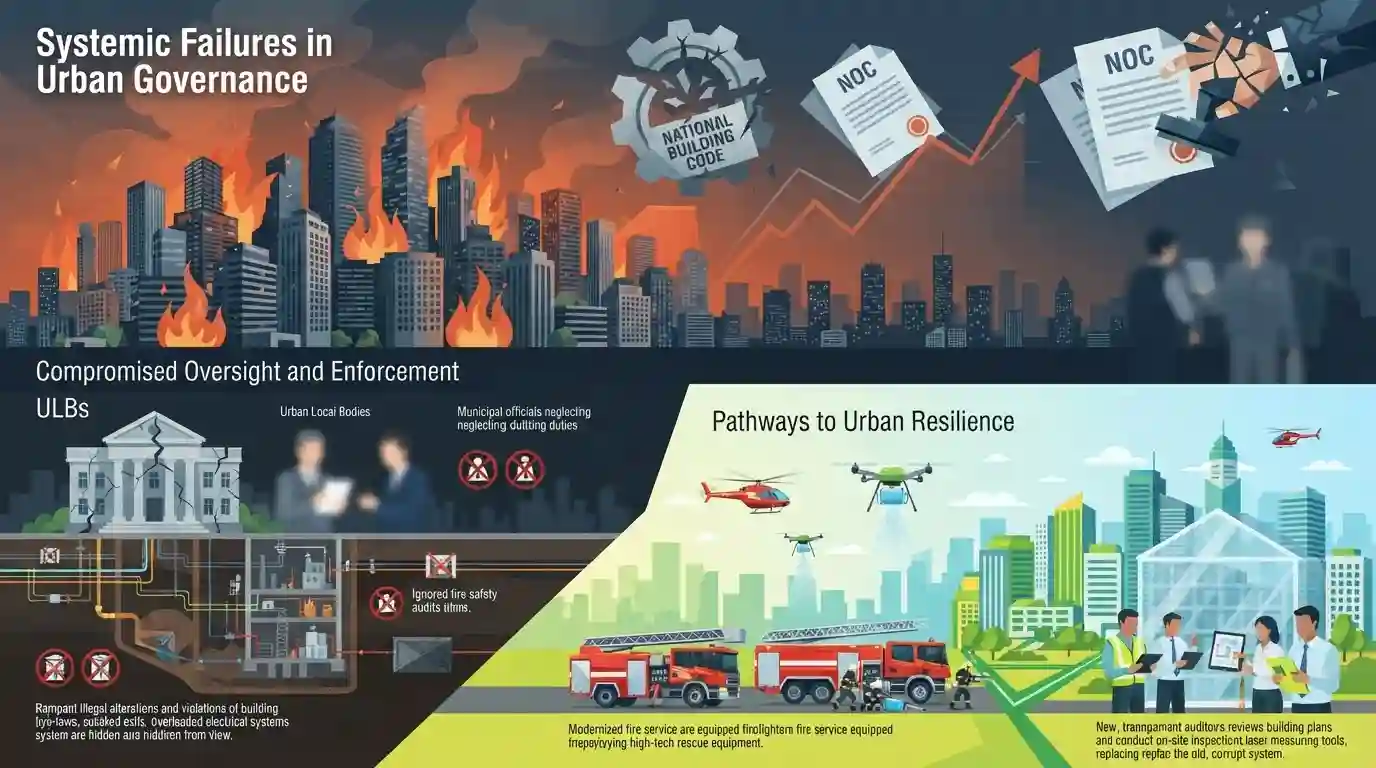
The article addresses the escalating frequency of devastating urban fires in India, framing them as systemic governance and planning failures rather than mere accidents. Tragedies such as those in Rajkot and Delhi highlight rampant violations of the National Building Code, compromised municipal oversight, and a systemic lack of regular fire safety audits. The author argues that urban local bodies must move beyond the perfunctory issuance of NOCs and strictly enforce building bye-laws. Furthermore, there is an urgent need to modernize fire services, mandate independent compliance audits, and treat urban fire hazards as a critical component of national disaster management and urban resilience strategies.
মূল বিষয়
- Urban fires in India have evolved from isolated accidents into systemic disasters, driven by chaotic urbanization, regulatory apathy, and blatant violations of safety norms.
- The National Building Code (NBC), specifically Part 4 (Fire and Life Safety) drafted by BIS, remains largely recommendatory, resulting in piecemeal adoption and lax enforcement by States and urban local bodies.
- Systemic failures include corruption in the issuance of 'No Objection Certificates' (NOCs), ad-hoc commercialization of residential zones, and a lack of regular, independent fire safety audits.
- India's urban fire infrastructure is woefully under-equipped and under-staffed, struggling to manage complex emergencies in high-rise buildings and densely packed informal settlements.
- Mitigation requires transitioning from a reactive response model to proactive disaster preparedness, making NBC compliance mandatory, enforcing strict penalties for violations, and heavily investing in the capacity building of municipal fire services.
গুরুত্বপূর্ণ শব্দ
National Building Code of India (NBC)

A comprehensive national instrument published by the Bureau of Indian Standards (BIS) that provides guidelines for regulating building construction, structural design, and fire safety requirements across India.
UPSC context
GS Paper III (Disaster Management) and GS Paper I (Urbanization); tests knowledge of urban safety standards and hazard resilience frameworks.
Model Building Bye-laws
A regulatory framework issued by the Ministry of Housing and Urban Affairs (TCPO) to guide states and urban local bodies in drafting regional building regulations for orderly, safe, and sustainable construction.
UPSC context
GS Paper I (Urbanization) and GS Paper II (ULBs); tests administrative and regulatory mechanisms for ensuring safe structural development in cities.
National Disaster Management Authority (NDMA)
The apex statutory body in India, established under the Disaster Management Act, 2005, and chaired by the Prime Minister, responsible for framing policies, plans, and guidelines for disaster response and mitigation.
UPSC context
GS Paper III (Disaster Management); tests knowledge of institutional frameworks, hazard mitigation policies, and crisis response mechanisms in India.
Bureau of Indian Standards (BIS)
The national standards body of India, established under the BIS Act, 2016, responsible for the harmonious development of standardization, product certification, and quality assurance of goods and services.
UPSC context
GS Paper III (Economy and Safety); tests understanding of regulatory bodies, consumer protection, and standard-setting frameworks for public safety.
Municipal Corporations
Urban local government bodies responsible for the administration and governance of larger urban areas, implementing municipal functions devolved by state legislatures under the 74th Constitutional Amendment Act.
UPSC context
GS Paper II (Polity and Governance); tests comprehension of decentralized local self-governance, urban administration, and constitutional provisions under Part IXA.
Fire Services
A state subject in India listed under the Twelfth Schedule (Article 243W), tasked with fire prevention, firefighting, and emergency rescue, organized primarily by state governments and Urban Local Bodies.
UPSC context
GS Paper III (Disaster Management) and GS Paper II (Federal Structure); tests understanding of local hazard mitigation and governance of emergency services.
প্রিলিমস ফাঁদ
The National Building Code (NBC) is a legally binding parliamentary statute that automatically overrides local municipal building bye-laws.
The NBC, published by the BIS, is purely recommendatory. It only gains legal force when state governments formally incorporate it into their local building bye-laws.
সংযুক্ত স্থির ধারণা
What is the constitutional and administrative status of Fire Services in India?
- Seventh Schedule status: Fire Services is a State subject, placing the primary legislative responsibility on state governments.
- Twelfth Schedule entry: Article 243W lists 'Fire Services' as a municipal function to be devolved to Urban Local Bodies (ULBs).
- Devolution challenges: In practice, many states bypass devolution, keeping fire departments under state-level home departments rather than local bodies.
How does the Model Fire Services Bill of 2019 reform urban fire governance?
- Multi-hazard mandate: It transitions traditional fire services into comprehensive, modern disaster-response forces capable of handling multiple hazards.
- Financial sustainability: The bill mandates creating a dedicated 'Fire Prevention and Life Safety Fund' funded through local safety levies.
- Incentivized modernization: States must adopt these legal reforms to access the ₹5,000 crore modernization fund under the NDRF window.
আন্তঃবিষয় প্যাটার্ন
Fiscal Federalism + Disaster Reforms
The Union's ₹5,000 crore modernization fund uses financial leverage to push states toward legislative updates, showing cooperative federalism in disaster management.
Micro-climates + Urban Infrastructure
Urban heat island effects compound electrical failures in dense, unauthorized colonies, converting municipal regulatory lapses into severe climate-exacerbated disasters.

Prelims 2026 may test the recommendatory nature of NBC Part 4 and the 12th Schedule status of Fire Services within urban governance.
সংযুক্ত PYQ · 4
সংযুক্ত PYQ · 4
- 2019MainsGS3
Disaster preparedness is the first step in any disaster management process. Explain how hazard zonation mapping will help disaster mitigation in the case of landslides.
- 2024MainsGS3
Flooding in urban areas is an emerging climate-induced disaster. Discuss the causes of this disaster. Mention the features of two such major floods in the last two decades in India. Describe the policies and frameworks in India that aim at tackling such floods.
- 2024MainsGS2
Analyse the role of local bodies in providing good governance at local level and bring out the pros and cons merging the rural local bodies with the urban local bodies.
- 2006PrelimsGS1
What is the Universal Product Code (UPC) adopted for?
