Shifting Geopolitical Dynamics of Kashmir Issue
Source:The Hindu ↗
ఇది ఎందుకు ముఖ్యం
Understanding the shifting dynamics of the Kashmir issue and India-Pakistan relations is crucial for UPSC aspirants, as it frequently features in GS Paper 2 (International Relations) and GS Paper 3 (Internal Security). It highlights India's diplomatic successes in isolating state-sponsored terrorism and managing border security challenges.
సారాంశం
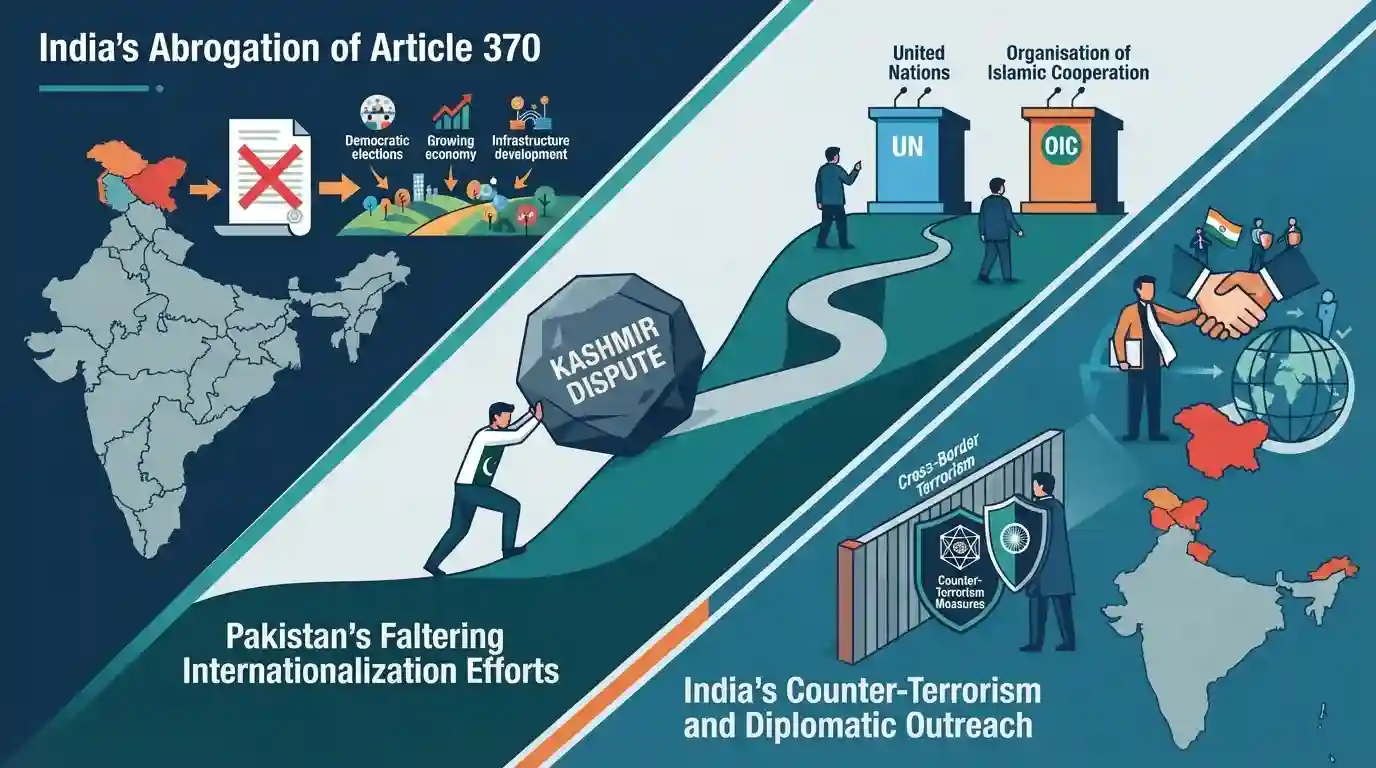
The article examines the gradual unraveling of Pakistan's long-standing narrative on the Kashmir issue. Following India's decisive move to abrogate Article 370 and the subsequent restoration of political processes in Jammu and Kashmir, Pakistan's efforts to internationalize the dispute have faltered. Multilateral platforms such as the UN and the OIC have shown minimal support for Pakistan's stance, highlighting its diplomatic isolation. Furthermore, India's effective counter-terrorism measures and strong diplomatic outreach have neutralized Pakistan's strategy of cross-border terrorism, leading the global community to increasingly accept Kashmir as an internal matter of India.
ముఖ్య అంశాలు
- Pakistan\'s traditional geopolitical narrative on Kashmir has progressively lost traction on the global stage.
- The abrogation of Article 370 and the successful conduct of democratic processes in Jammu & Kashmir have reinforced India\'s internal stabilization efforts.
- Pakistan\'s repeated attempts to internationalize the Kashmir dispute at multilateral forums like the UN and OIC have largely failed, indicating its growing diplomatic isolation.
- India\'s robust diplomatic posture and consistent framing of cross-border terrorism have successfully countered Pakistan\'s proxy war strategy.
- The international community increasingly perceives the Kashmir issue as India\'s internal matter, reflecting a significant shift in regional geopolitics.
ముఖ్యమైన పదాలు
Article 370

A temporary provision of the Indian Constitution that previously granted special autonomous status to Jammu and Kashmir, restricting the Indian Parliament's legislative powers over the region.
UPSC context
GS Paper 2 (Polity); tests understanding of federalism, asymmetric integration, and constitutional evolution.
Organisation of Islamic Cooperation (OIC)
An international intergovernmental organization of 57 member states, acting as the collective voice of the Muslim world to safeguard its political, social, and economic interests.
UPSC context
GS Paper 2 (International Relations); tests knowledge of major global groupings and India's multilateral diplomacy.
Cross-border Terrorism
An irregular security threat where a country's territory is used to sponsor, facilitate, or launch terrorist attacks against neighboring states to achieve strategic or political goals.
UPSC context
GS Paper 3 (Internal Security); tests comprehension of border management, asymmetric threats, and external security challenges.
Proxy War
An indirect conflict where opposing nation-states support, fund, and arm third-party actors (like insurgent groups or militias) to achieve strategic goals without engaging in direct warfare.
UPSC context
GS Paper 3 (Internal Security); tests understanding of state-sponsored security threats and national defense doctrines.
Instrument of Accession
A legal document signed by the rulers of princely states in 1947 to accede to India or Pakistan, ceding authority over defense, external affairs, and communications.
UPSC context
GS Paper 2 (Indian Polity/History); tests knowledge of post-independence integration and historical underpinnings of the constitution.
ప్రిలిమ్స్ ఉచ్చు
The Simla Agreement of 1972 officially terminated the UN mandate and presence of the United Nations Military Observer Group (UNMOGIP).
While India maintains UNMOGIP's mandate lapsed after the 1972 Simla Agreement (which established the LoC), the UN has not officially terminated it, as dissolution requires a UNSC resolution.
అనుసంధానమైన స్థిర భావనలు
What are the core mechanisms of UN Security Council Resolution 47 (1948)?
- Sequential Mandate: Establishes a strict three-step sequential process: first, Pakistan must withdraw all Pakistani nationals/tribesmen; second, India progressively reduces forces; third, a plebiscite is conducted.
- Non-trigger of Plebiscite: Because Pakistan failed to execute Step 1 (withdrawal of forces), the subsequent steps—including the plebiscite—were never legally triggered or operationalized.
- Chapter VI Status: Adopted under Chapter VI of the UN Charter, making its recommendations non-binding, unlike enforcement measures mandated under Chapter VII.
How did the Simla Agreement (1972) formalize bilateralism?
- Bilateral Framework: Article 1(ii) binds both nations to settle their differences through bilateral negotiations, preventing unilateral escalation or third-party international mediation.
- LoC Conversion: Converted the 1949 UN-supervised Ceasefire Line into the mutually agreed Line of Control (LoC), altering the legal landscape of territorial monitoring.
అంతర-అంశ నమూనాలు
FATF scrutiny + Proxy war deterrence
Demonstrates how international financial watchdogs (FATF Grey Listing) serve as non-military deterrence tools, effectively constraining a state's cross-border asymmetric warfare capabilities.
Asymmetric federalism + External sovereignty
The Supreme Court's 2023 ruling establishes that asymmetric federal arrangements under the Indian Constitution do not confer distinct internal sovereignty, strengthening India's international diplomatic posturing.

Mains 2026 may analyze how the constitutional closure of Article 370 permanently alters the geopolitical utility of bilateral pacts like Simla.
అనుసంధాన PYQలు · 5
అనుసంధాన PYQలు · 5
- 2016MainsGS2
To what extent is Article 370 of the Indian Constitution, bearing marginal note "Temporary provision with respect to the State of Jammu and Kashmir", temporary? Discuss the future prospects of this provision in the context of Indian polity.
- 2015MainsGS2
Terrorist activities and mutual distrust have clouded India-Pakistan relations. To what extent the use of soft power like sports and cultural exchanges could help generate goodwill between the two countries? Discuss with suitable examples.
- 2016MainsGS2
Increasing cross-border terrorist attacks in India and growing interference in the internal affairs of several member-states by Pakistan are not conducive for the future of SAARC (South Asian Association for Regional Cooperation)." Explain with suitable examples.
- 2020MainsGS3
Analyze internal security threats and transborder crimes along Myanmar, Bangladesh and Pakistan borders including Line of Control (LoC). Also discuss the role played by various security forces in this regard.
- 2024MainsGS3
India has a long and troubled border with China and Pakistan fraught with contentious issues. Examine the conflicting issues and security challenges along the border. Also give out the development being undertaken in these areas under the Border Area Development Programme (BADP) and Border Infrastructure and Management (BIM) Scheme.
