Urban Accessibility Deficits and Rights of Disabled Persons
Source:The Hindu ↗
কেন এটি গুরুত্বপূর্ণ
It addresses a crucial social justice and governance issue concerning the fundamental rights, mobility, and safety of persons with disabilities (PwDs) in urban spaces, linking directly with statutory mandates like the RPwD Act, 2016 and Accessible India Campaign.
সারসংক্ষেপ
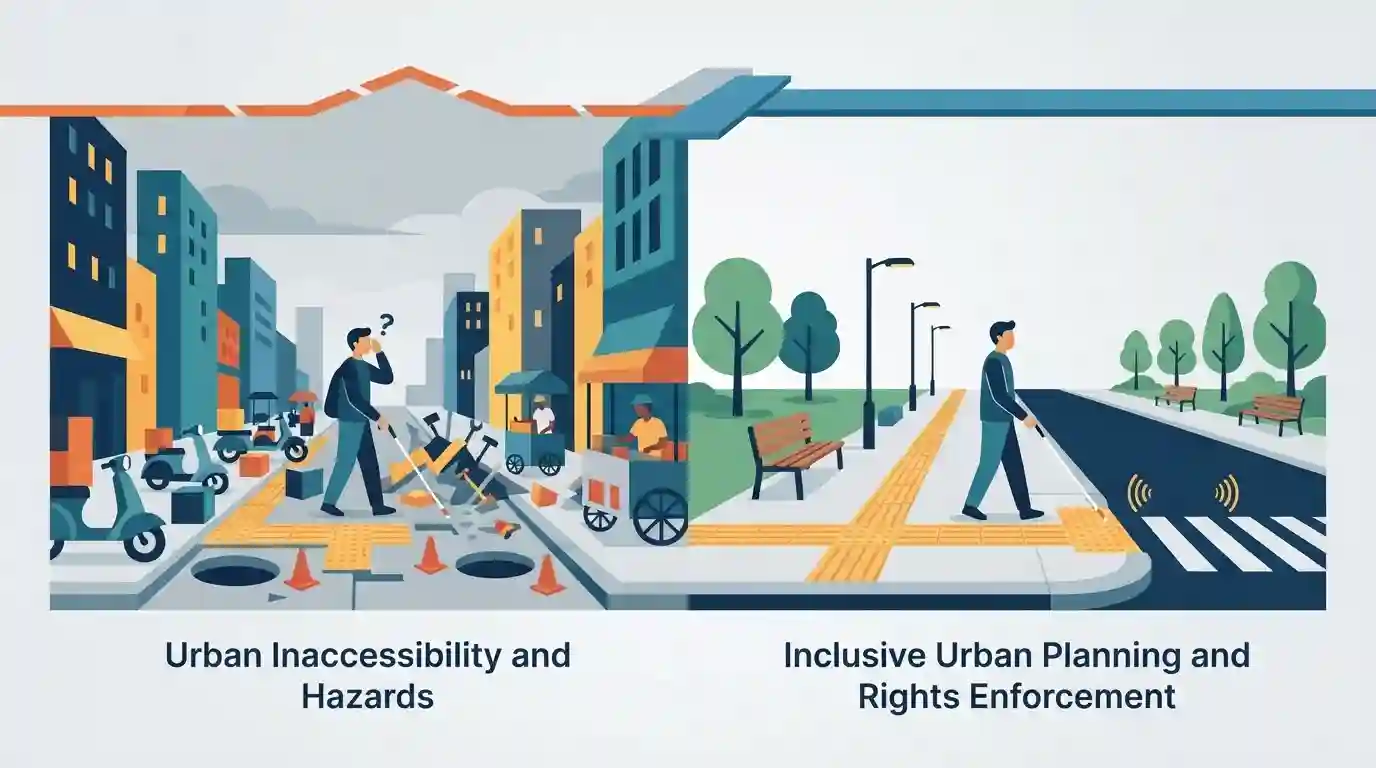
The article highlights the systemic urban infrastructural hazards and lack of accessibility faced by white cane users in India. Despite legal mandates under the RPwD Act, 2016 and the Accessible India Campaign, public spaces remain hostile and hazardous for visually impaired individuals, underscoring the urgent need for inclusive urban planning, proper tactile paving maintenance, and effective enforcement of rights.
মূল বিষয়
- White cane users face severe infrastructural hurdles, urban hazards, and lack of accessibility in public spaces across Indian cities.
- Despite the Rights of Persons with Disabilities (RPwD) Act, 2016, and campaigns like Sugamya Bharat Abhiyan, ground-level implementation of barrier-free infrastructure remains deficient.
- Poor urban planning, unscientific tactile paving, and obstructions on footpaths endanger the mobility, safety, and independence of visually impaired persons.
- Inclusive development requires shifting from charity-based models to rights-based accessibility compliance, sensitisation, and strict accountability in urban governance.
গুরুত্বপূর্ণ শব্দ
Rights of Persons with Disabilities Act, 2016

A landmark legislation enacted to protect and promote the rights and dignity of persons with disabilities, expanding recognized disability categories from 7 to 21 and emphasizing a rights-based approach.
UPSC context
GS Paper II (Social Justice - Vulnerable Sections); tests legal frameworks, entitlements, and welfare mechanisms for persons with disabilities in India.
Accessible India Campaign (Sugamya Bharat Abhiyan)
A nationwide flagship campaign launched by the Ministry of Social Justice and Empowerment to create a barrier-free and accessible environment for persons with disabilities across built, transport, and ICT verticals.
UPSC context
GS Paper II (Governance / Inclusive Development); evaluates government initiatives and infrastructural accessibility for marginalized sections.
প্রিলিমস ফাঁদ
Accessible India Campaign is a statutory mechanism enacted under Section 40 of the RPwD Act.
The Accessible India Campaign is often mistaken as a statutory enactment, whereas it is a nationwide flagship campaign launched by the Ministry of Social Justice and Empowerment.
সংযুক্ত স্থির ধারণা
What are the key statutory provisions and verticals under the Rights of Persons with Disabilities Act, 2016?
- Disability Scope: Expanded recognized disabilities from 7 to 21 categories, aligning Indian law with the UNCRPD framework.
- Accessibility Mandate: Mandates time-bound accessibility compliance in public buildings, transport systems, and ICT under Sections 40 to 46.
- Penal Provisions: Provides penal provisions for offenses against persons with disabilities, ensuring a shift to rights-based enforcement.
আন্তঃবিষয় প্যাটার্ন
Smart Cities vs. Disability Inclusive Urbanism
Tactile paving and barrier-free audits intersect with Smart Cities Mission mandates and urban local body decentralization under the 74th Constitutional Amendment Act.

RPwD Act 2016 provisions and UNCRPD obligations will likely be paired in a multi-statement Prelims question on rights-based models.
সংযুক্ত PYQ · 3
সংযুক্ত PYQ · 3
- 2017MainsGS2
Does the Rights of Persons with Disabilities Act, 2016 ensure effective mechanism for empowerment and inclusion of the intended beneficiaries in the society? Discuss.
- 2026PrelimsGS1
Which of the following statements with regard to the persons with disabilities in India is/are correct ? 1. The Rights of Persons with Disabilities Act, an Act passed by the Parliament of India in 2018, mandates reservation in education and employment, places a legal duty on Governments to ensure accessibility and non-discrimination. 2. The Sugamya Bharat Abhiyan focuses on achieving universal accessibility for Persons with Disabilities across three key domains — built infrastructure, transport systems and information and communication technology. 3. The National Divyangjan Finance and Development Corporation (NDFDC) is a public sector organisation set up by the Ministry of Corporate Affairs as a not-for-profit company to promote entrepreneurship among Persons with Disabilities (PwDs). Select the answer using the code given below :
- 2011PrelimsGS1
India is home to lakhs of persons with disabilities. What are the benefits available to them under the law? 1. Free schooling till the age of 18 years in government-run schools. 2. Preferential allotment of land for setting up business. 3. Ramps in public buildings. Which of the statements given above is/are correct?
