Environmental and Economic Balance Sheets in E Waste Management
Source:The Hindu ↗
কেন এটি গুরুত্বপূর্ণ
Crucial for understanding policy frameworks surrounding e-waste management, circular economy models, and the implementation of Extended Producer Responsibility (EPR) in India.
সারসংক্ষেপ
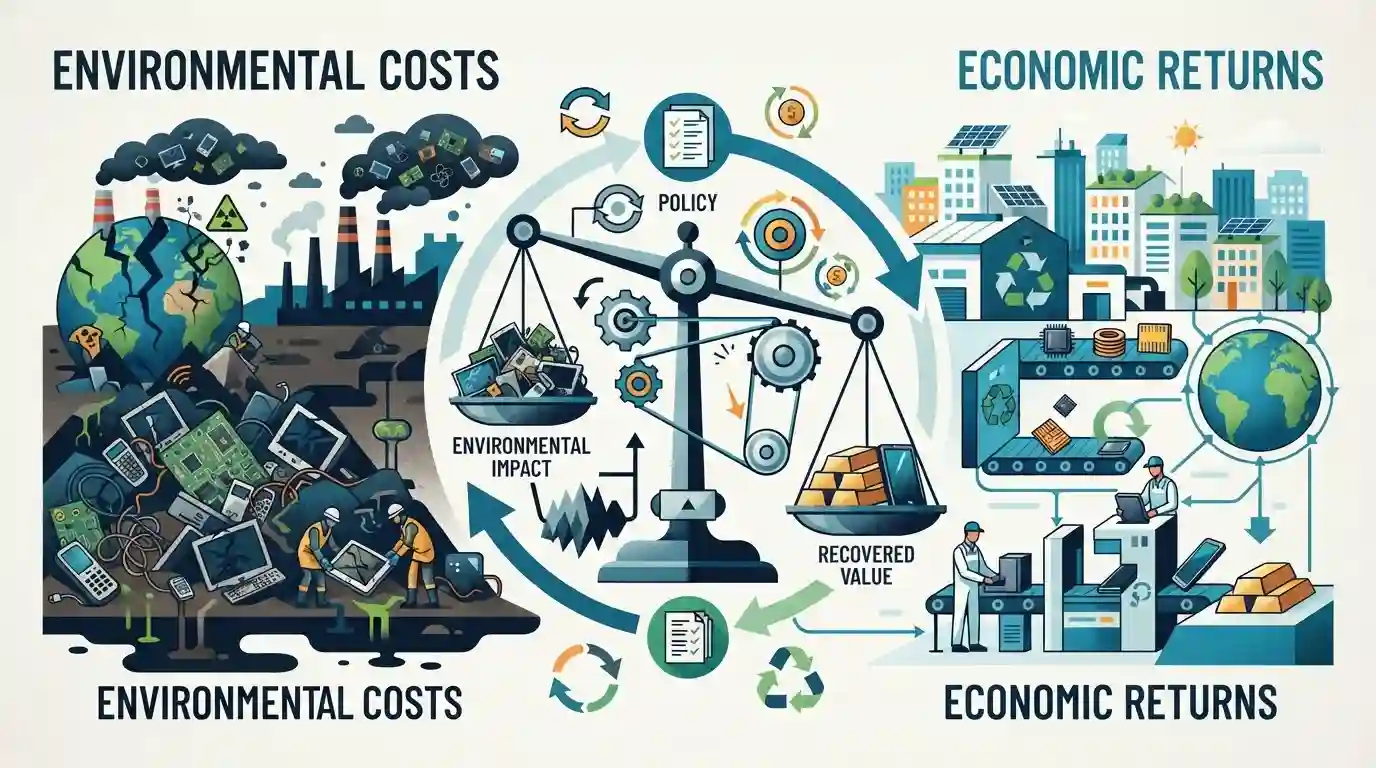
The article discusses the complex dual balance sheets—environmental costs and economic returns—involved in managing electronic waste, analyzing how policy mechanisms like Extended Producer Responsibility (EPR) must navigate these economic and ecological realities.
মূল বিষয়
- E-waste decisions involve balancing environmental/health costs against economic/recycling revenues.
- Extended Producer Responsibility (EPR) framework requires better tracking of material balance sheets.
- Informal sector dominance creates severe ecological hazards and resource leakage.
- Policy formulation needs to integrate formal recycling standards with economic viability.
গুরুত্বপূর্ণ শব্দ
E-Waste (Management) Rules

India's regulatory framework governing electronic waste, built on Extended Producer Responsibility (EPR), mandating registered tracking, recycling targets, and centralized CPCB portal reporting for electrical and electronic equipment.
UPSC context
Important for GS Paper III (Environment, Conservation, and Pollution Control); tests understanding of statutory waste management frameworks and circular economy policies.
Extended Producer Responsibility (EPR)
An environmental policy approach making producers financially and physically accountable for the entire lifecycle of their products, particularly post-consumer collection, recycling, and safe disposal.
UPSC context
Crucial for GS Paper III (Environment and Sustainable Development); tests policy instruments used to internalize ecological costs in manufacturing sectors.
Ministry of Environment, Forest and Climate Change
The nodal ministry in the central government responsible for planning, promoting, and implementing environmental and forestry policies, including waste management regulations and pollution standards.
UPSC context
Relevant for GS Paper II (Governance and Institutional Frameworks) and GS Paper III (Environment); tests knowledge of key environmental governance authorities.
সংযুক্ত স্থির ধারণা
What are the key provisions and enforcement mechanisms of India's E-Waste Management Rules?
- Producer Responsibility: Shifts the financial and physical responsibility of end-of-life management from local bodies to producers.
- Digital Portal: Replaced traditional authorization with a centralized online portal managed by the Central Pollution Control Board (CPCB).
- Certificates Regime: Producers must meet yearly recycling quotas and purchase digital certificates to prove compliance.
- Environmental Compensation: Imposes penalties on entities that fail to meet targets through environmental compensation funds.
আন্তঃবিষয় প্যাটার্ন
EPR Regimes + Market-Based Environmental Instruments
India's digital EPR certificate trading regime exemplifies market-based environmental governance, paralleling carbon credit mechanisms and renewable energy certificates (RECs) under energy policy.
Informal E-Waste + Basel Convention Obligations
Crude acid leaching and open burning in informal e-waste hubs directly violate international Basel Convention guidelines on transboundary movement and hazardous waste management.

Expect a multi-statement prelims question pairing EPR mandate shifts (CPCB enforcement vs municipality role) with Basel Convention definitions.
সংযুক্ত PYQ · 2
সংযুক্ত PYQ · 2
- 2019PrelimsGS1
In India, 'extended producer responsibility' was introduced as an important feature in which of the following?
- 2021PrelimsGS1
'R2 Code of Practices' constitutes a tool available for promoting the adoption of
