Turnberry System and Emerging US Global Economic Order
Source:Indian Express ↗
Why It Matters
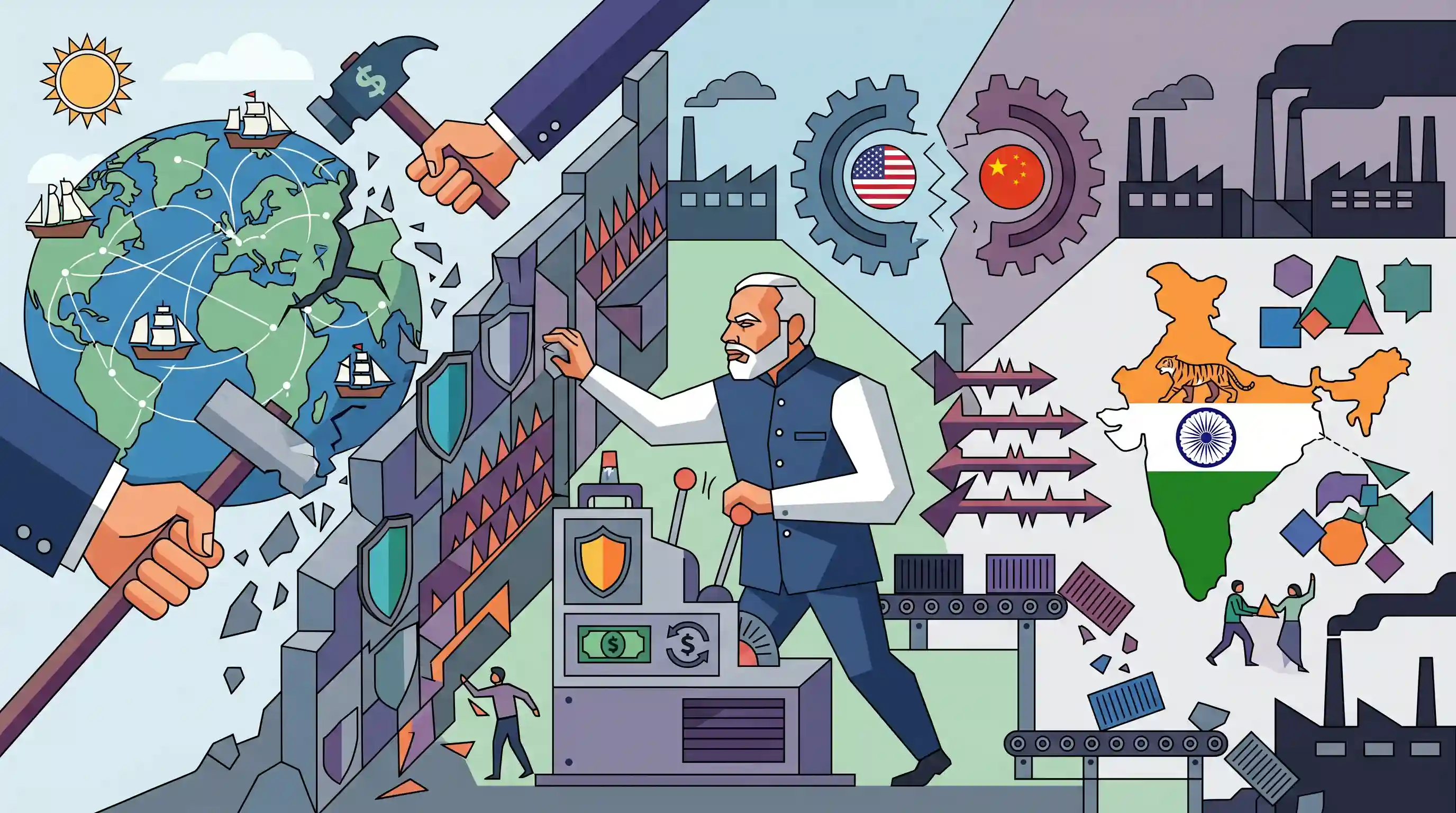
The shift from the Bretton Woods liberal economic order to a protectionist, bilateral 'Turnberry system' is a critical macroeconomic and geopolitical development. It directly impacts global trade dynamics, foreign policy strategies, and India's economic stability, making it highly relevant for GS2 (International Relations) and GS3 (Economy - Trade and Protectionism).
Summary
The article discusses the emergence of a new global economic order, colloquially termed the 'Turnberry system', which signifies a stark departure from the multilateral, free-trade architecture established at Bretton Woods. Driven by US economic policies—particularly those associated with Donald Trump—this new paradigm is characterized by heightened protectionism, the use of universal tariffs, transactional bilateral trade deals, and the weaponization of the US dollar. As globalization wanes in favor of 'sovereign nationalism' and strategic decoupling from China, developing economies like India face critical challenges in navigating supply chain disruptions, protectionist trade barriers, and a fragmented global trade environment.
Key Points
- The 'Turnberry system' is a conceptual moniker for the new, increasingly protectionist global economic order driven by US policies under Donald Trump, contrasting sharply with the post-WWII multilateral Bretton Woods system.
- This new order is characterized by a shift away from free trade and multilateral institutions (like the WTO) towards aggressive bilateralism, transactional diplomacy, and universal or targeted tariff barriers.
- Economic nationalism and the weaponization of economic tools (such as the US dollar, sanctions, and tariffs) are increasingly utilized to decouple from adversaries like China and force concessions from allies.
- For India and other developing nations, this transition poses significant macroeconomic challenges, as increased global protectionism disrupts global supply chains, trade predictability, and export-led growth models.
- The global landscape is moving toward fragmented economic blocs, emphasizing self-reliance, near-shoring, and 'sovereign nationalism' over integrated globalization.
Important Terms
Turnberry system

A transactional economic order prioritizing bilateral deals and reciprocal tariffs over multilateralism, named after a 2025 U.S.-EU framework signed at the Trump Turnberry resort.
UPSC context
GS Paper 2 & 3: Tests understanding of shifts in global trade architecture and effects of U.S. policies on India's interests.
Bretton Woods System
The 1944 framework that established the IMF and World Bank to ensure post-WWII economic stability, originally based on fixed exchange rates and international cooperation.
UPSC context
GS Paper 3: Fundamental to the history of global finance; tests knowledge of the architecture being challenged by modern protectionism.
World Trade Organization (WTO)
The global body governing international trade rules, facilitating negotiations, and resolving disputes; it succeeded GATT in 1995 following the Uruguay Round.
UPSC context
GS Paper 3: Focuses on trade liberalization, the Appellate Body crisis, and India's stance on agricultural subsidies and MSMEs.
International Monetary Fund (IMF)
A Bretton Woods institution providing financial assistance and policy advice to member countries facing balance-of-payments crises to ensure global monetary stability.
UPSC context
GS Paper 2: Important for "International Institutions" and discussions on global debt sustainability and quota reforms.
Protectionism
Economic policy restricting imports via tariffs or quotas to favor domestic industries; a core feature of 'sovereign nationalism' and the 'America First' agenda.
UPSC context
GS Paper 3: Vital for analyzing deglobalization, trade wars, and their impact on Indian exports and "Make in India."
World Bank
An international financial body providing loans and grants to low and middle-income countries for development projects, part of the Bretton Woods twins.
UPSC context
GS Paper 2 & 3: Key to topics on infrastructure financing, poverty reduction, and sustainable development goals.
Prelims Trap
The 'Turnberry system' is a new official multilateral trade agreement replacing the Bretton Woods system.
It is not an official treaty. It is a colloquial term for the unilateral, protectionist economic policies driven by the US, contrasting sharply with formal multilateralism.
Static Concepts Connected
What are the foundational pillars of the Bretton Woods system?
- IMF and World Bank: Established the International Monetary Fund (IMF) for balance-of-payments support and the World Bank for post-war reconstruction.
- GATT and WTO: Birthed the General Agreement on Tariffs and Trade (now WTO) to promote free trade by reducing global tariff barriers.
- Pegged Exchange Rates: Originally pegged global currencies to the US dollar (pegged to gold), ensuring trade predictability until the 1971 Nixon Shock.
How do WTO-compliant trade remedies differ from unilateral tariffs?
- Evidence-based Remedies: WTO permits Antidumping, Countervailing, and Safeguard duties only after formal investigations prove material injury to domestic industries.
- Non-discrimination (MFN): The Most-Favoured-Nation (MFN) principle prevents countries from arbitrarily slapping universal or targeted tariffs on specific members without WTO authorization.
Cross-Topic Patterns
Weaponization of the US Dollar
Aggressive US sanctions and tariffs accelerate pushbacks like BRICS currency mechanisms and India's rupee-trade settlements to bypass dollar dependency.
Turnberry vs. Minilateral Supply Chains
As the US pushes near-shoring and sovereign nationalism, India must lean into minilateral frameworks like IPEF and the Supply Chain Resilience Initiative (SCRI).

Expect a 2026 Mains question contrasting the 'Turnberry system' with Bretton Woods, focusing on WTO marginalization and India's trade.
Linked PYQs · 4
Linked PYQs · 4
- 2025MainsGS3
What are the challenges before the Indian economy when the world is moving away from free trade and multilateralism to protectionism and bilateralism? How can these challenges be met?
- 2018MainsGS3
How would the recent phenomena of protectionism and currency manipulations in world trade affect macroeconomic stability of India?
- 2025MainsGS2
"With the waning of globalization, post-Cold War world is becoming a site of sovereign nationalism.” Elucidate.
- 2016MainsGS2
The broader aims and objectives of WTO are to manage and promote international trade in the era of globalization. But the Doha round of negotiations seem doomed due to differences between the developed and the developing countries." Discuss in the Indian perspective.
