Chronic political instability in Nepal challenges regional stability
Source:The Hindu ↗
Why It Matters
Nepal acts as a crucial strategic buffer for India. Frequent political changes in Kathmandu impact bilateral projects, border security, and India's 'Neighbourhood First' policy, particularly in the context of China's growing regional influence.
Summary
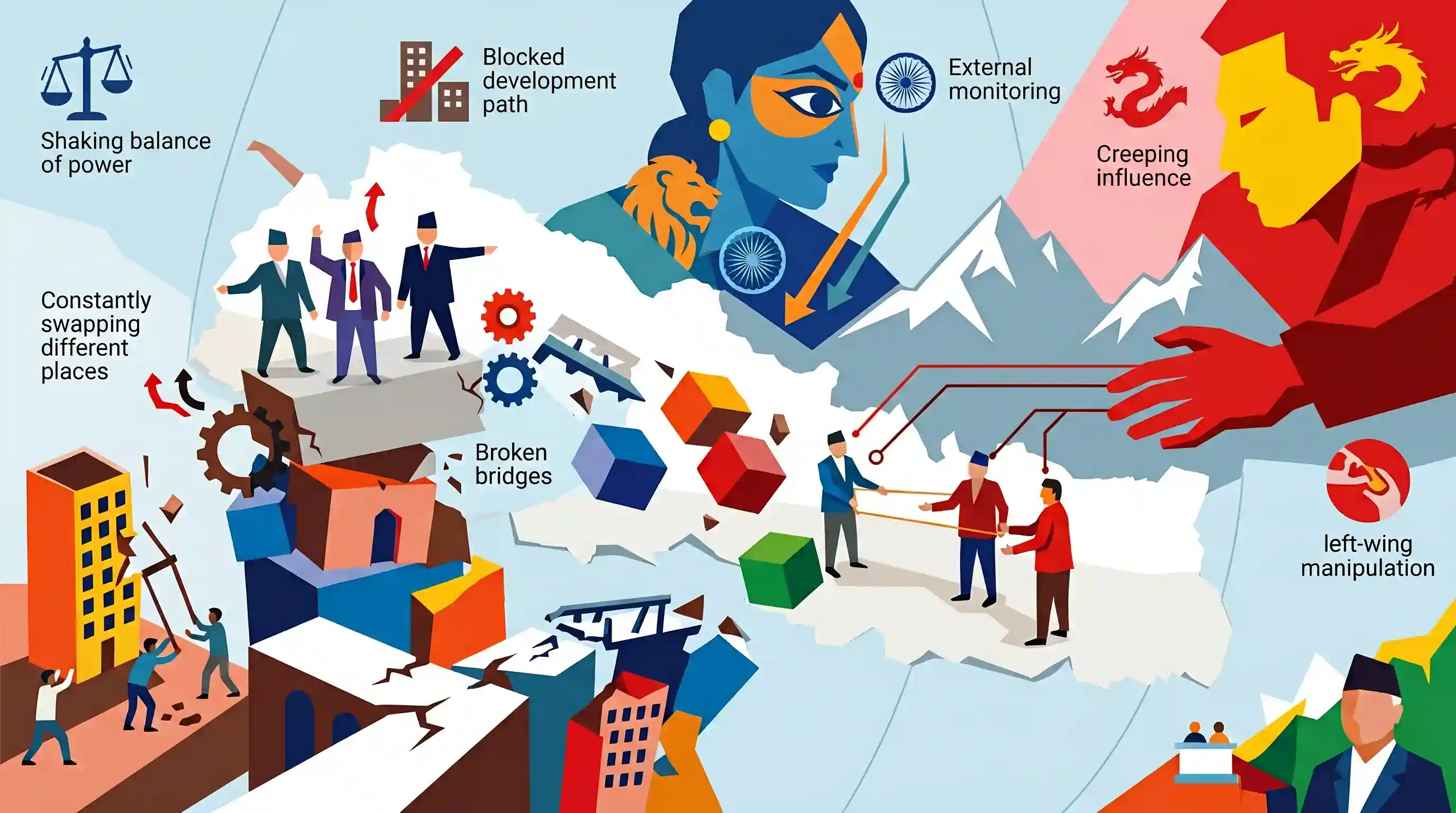
The article examines the chronic political instability in Nepal, driven by constantly shifting alliances among major factions such as the Nepali Congress, CPN (UML), and CPN (Maoist Centre). This continuous turmoil in Kathmandu severely hampers effective governance and economic progress. From a geopolitical perspective, Nepal's internal instability is closely monitored by New Delhi under its 'Neighbourhood First' policy, especially given China's growing footprint and efforts to influence left-wing unity in the Himalayan nation. For Nepal, achieving a stable political framework is essential to secure its democratic institutions and foster development, which in turn is critical for regional security.
Key Points
- Nepal experiences chronic political instability due to fragile coalition governments and frequent shifts in alliances among its primary political parties.
- This ongoing turmoil undermines governance, impedes long-term economic planning, and erodes institutional credibility.
- India views the instability with strategic concern due to the open border, historical ties, and its 'Neighbourhood First' policy.
- China's increasing diplomatic and economic footprint, alongside efforts to unite left-wing factions in Nepal, adds a complex geopolitical dimension for New Delhi.
- The road ahead for Nepal necessitates building institutional resilience and forging a consensus on governance to ensure democratic consolidation and stable economic growth.
Important Terms
Neighbourhood First Policy

A core pillar of India's foreign policy prioritizing regional stability, connectivity, and development partnership with its immediate neighbors to secure its strategic interests and foster a peaceful periphery.
UPSC context
GS II (International Relations). Tests understanding of India’s regional strategy and the evolution of its diplomatic engagement with South Asian neighbors.
1950 Indo-Nepal Treaty of Peace and Friendship
The foundational agreement establishing a 'special relationship' between India and Nepal, characterized by open borders, reciprocal treatment of citizens, and consultation on security matters.
UPSC context
GS II (IR). Critical for analyzing the historical and legal basis of bilateral ties and modern calls for its revision.
Nepali Congress
The oldest and largest democratic-socialist party in Nepal; it played a key role in democratic transitions and traditionally favors balanced, friendly relations with India.
UPSC context
GS II (IR). Relevant for understanding the political factions that shape Nepal's governance and its foreign policy orientation toward India.
CPN (UML)
A major center-left communist party in Nepal that follows 'People’s Multiparty Democracy' and often adopts a nationalist stance, sometimes associated with closer ties to China.
UPSC context
GS II (IR). Essential for analyzing internal political shifts in Nepal and the impact of 'left-wing unity' on regional security.
CPN (Maoist Centre)
The party of former Maoist insurgents, led by Pushpa Kamal Dahal (Prachanda), which transitioned from armed struggle to mainstream politics, becoming a pivotal force in Nepal’s coalition governments.
UPSC context
GS II (IR). Important for understanding Nepal’s transition to a republic and the volatile political alliances affecting regional stability.
Prelims Trap
India is the sole country providing transit access for landlocked Nepal's third-country trade.
While India handles the vast majority of Nepal's transit trade, Nepal signed a Transit Transport Agreement with China in 2016, ending India's legal monopoly.
Static Concepts Connected
What are the core provisions of the 1950 Indo-Nepal Treaty of Peace and Friendship?
- Reciprocal Treatment: Provides national treatment to citizens of both countries regarding residence, property, employment, and trade.
- Open Border: Facilitates unrestricted movement of people across the 1,751 km shared border, anchoring the 'Roti-Beti' relationship.
- Security Consultation: Mandates both nations to inform each other of any serious friction with a neighboring state affecting bilateral ties.
Which major river treaties form the basis of India-Nepal hydro-diplomacy?
- Mahakali Treaty: Signed in 1996 for the integrated development of the Mahakali River, conceptualizing the delayed Pancheshwar Multipurpose Project.
- Kosi Agreement: Signed in 1954 (and revised in 1966) to manage flood control, irrigation, and power generation on the Kosi river.
- Gandak Agreement: Signed in 1959 to construct a barrage for mutual irrigation and hydroelectric power benefits.
Cross-Topic Patterns
Open borders and Internal Security
Guarded by the SSB, the porous 1,751 km border poses internal security challenges like smuggling and counterfeit currency, which worsen during Kathmandu's political vacuums.
Geopolitical hedging via China's BRI
Kathmandu leverages Chinese infrastructure funding (BRI) and communist-party ties to balance Indian influence, reflecting a broader neighborhood pattern also seen in Maldives and Sri Lanka.

Expect a Mains GS2 question linking chronic political instability in India’s immediate neighborhood to border management challenges and infra delays.
Linked PYQs · 1
Linked PYQs · 1
- 2012MainsGS2
Discuss the contentious issues that have caused the prolonged constitutional logjam in Nepal.
