Godavari inter-state water disputes and basin management challenges
Source:The Hindu ↗
Why It Matters
Inter-state river water disputes test the limits of India's cooperative federalism and dispute redressal mechanisms (Article 262). The Godavari case exemplifies how legacy legal frameworks must evolve to address contemporary water stress, climate change, and the need for Integrated River Basin Management (IRBM), making it highly relevant for GS1 (Geography/Water Resources) and GS2 (Federalism/Polity).
Summary
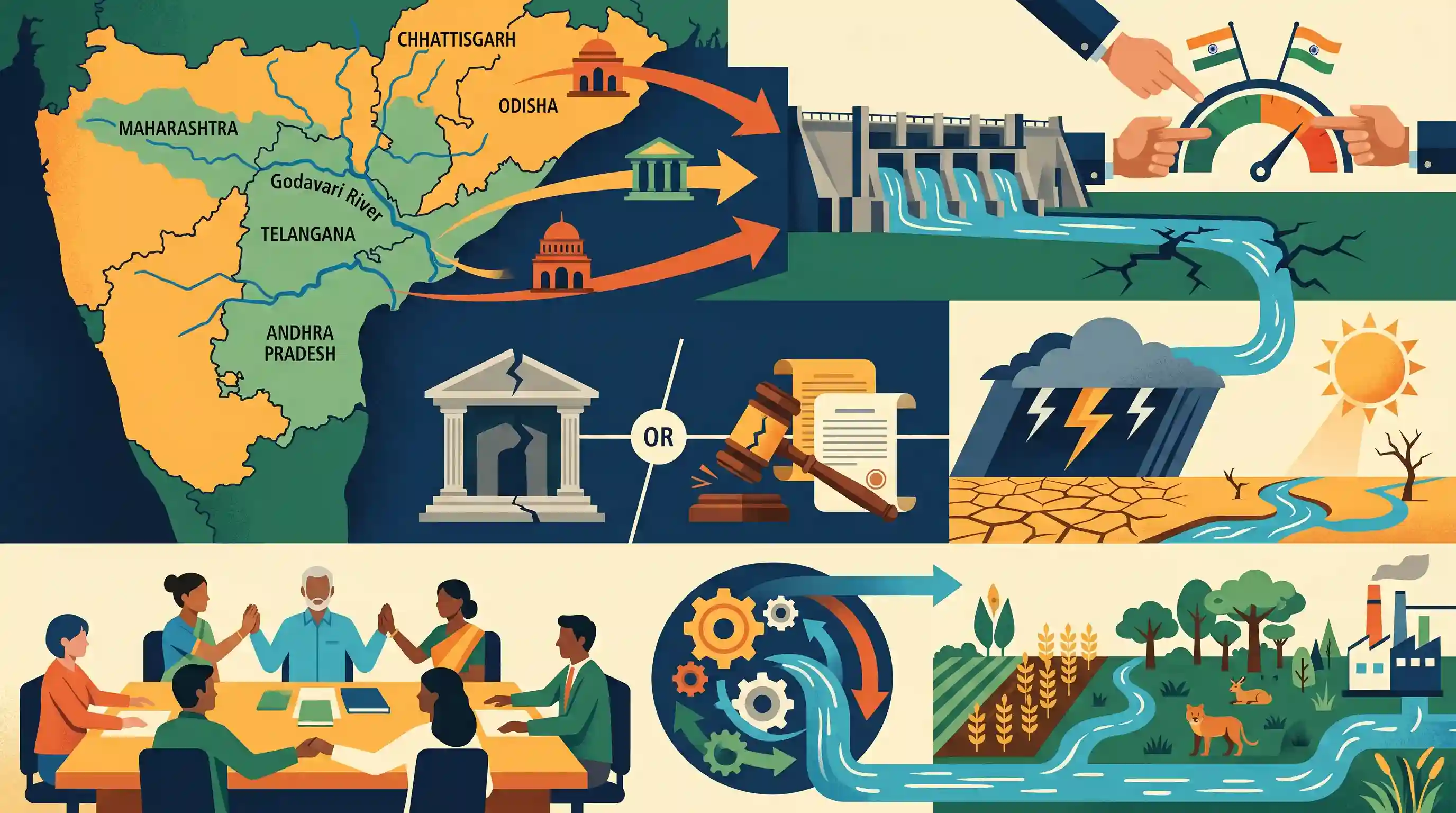
The article explores the escalating inter-state disputes over the Godavari River, India's largest peninsular river system. Competing developmental demands among riparian states—namely Maharashtra, Telangana, Andhra Pradesh, Chhattisgarh, and Odisha—have intensified friction over water sharing. Mega-projects like Polavaram and Kaleshwaram are flashpoints, raising concerns over downstream water availability and ecological degradation. The piece underscores the limitations of legacy tribunal awards under the Inter-State River Water Disputes Act, arguing that they fail to account for climate change and shifting hydrological patterns. It advocates for a paradigm shift toward integrated, basin-level water management that prioritizes sustainability and cooperative federalism over rigid state allocations.
Key Points
- The Godavari river faces escalating inter-state conflicts driven by competing regional demands for irrigation, industrial, and domestic water usage among its riparian states.
- Large-scale water diversion and storage infrastructure, such as the Polavaram and Kaleshwaram projects, frequently trigger downstream anxieties over ecological flows and water security.
- Existing tribunal mechanisms (like the historical GWDT awards) are struggling to cope with modern realities, including altered hydrology due to climate change and erratic rainfall patterns.
- There is a critical need to transition from rigid, state-wise volumetric quotas toward Integrated River Basin Management (IRBM), prioritizing real-time data sharing and ecological preservation.
Important Terms
Inter-State River Water Disputes Act, 1956

Enacted under Article 262, this law allows the Union to establish ad-hoc tribunals for binding adjudication of inter-state river water conflicts when negotiations fail.
UPSC context
GS Paper II: Federalism and Statutory Bodies. Tests understanding of legal mechanisms for resolving state-level resource conflicts.
Godavari Water Disputes Tribunal (GWDT)
An ad-hoc body constituted in 1969 under Justice R.S. Bachawat; its 1980 award allocated Godavari waters among Maharashtra, Andhra Pradesh, Madhya Pradesh, Odisha, and Karnataka.
UPSC context
GS Paper I: Indian Geography. Tests knowledge of historic water-sharing agreements and riparian state rights.
Central Water Commission (CWC)
A premier technical organization under the Ministry of Jal Shakti responsible for coordinating schemes for flood control, irrigation, and hydropower development across India.
UPSC context
GS Paper II & III: Governance and Infrastructure. Tests the role of technical advisory bodies in water resource management.
Polavaram Project
A multi-purpose irrigation project on the Godavari in Andhra Pradesh, accorded 'National Project' status in 2014, intended for irrigation, hydropower, and inter-basin water transfer.
UPSC context
GS Paper III: Economic Development/Infrastructure. Highlights issues of displacement, inter-state submergence, and national-priority projects.
Kaleshwaram Lift Irrigation Project (KLIP)
Telangana's multi-stage lift irrigation scheme on the Godavari; it is the world's largest such project, designed to irrigate arid uplands via massive pump houses.
UPSC context
GS Paper III: Infrastructure/Technology. Evaluates mega-engineering feats versus their environmental and fiscal sustainability.
Integrated River Basin Management (IRBM)
A holistic approach treating a river basin as a single ecosystem to coordinate conservation, management, and development of water resources equitably among stakeholders.
UPSC context
GS Paper III: Environment/Geography. Tests modern sustainable alternatives to traditional rigid water-sharing awards.
Article 262 of the Constitution
The constitutional provision empowering Parliament to legislate on the adjudication of disputes relating to waters of inter-state rivers and river valleys.
UPSC context
GS Paper II: Indian Constitution. Fundamental to questions on the division of powers and judicial exclusion in water disputes.
Prelims Trap
The Supreme Court has no jurisdiction whatsoever over inter-state river water disputes due to Article 262.
Parliament barred the SC's original jurisdiction via the 1956 Act, but the SC still hears appeals against tribunal awards under Article 136 (Special Leave Petition).
Static Concepts Connected
What is the geographical extent and tributary system of the Godavari?
- Basin States: The basin spans Maharashtra, Telangana, Andhra Pradesh, Chhattisgarh, Odisha, Madhya Pradesh, Karnataka, and Puducherry (Yanam).
- Left-bank tributaries: Penganga, Wardha, Wainganga (which combine to form Pranahita), Indravati, and Sabari.
- Right-bank tributaries: Pravara, Manjira, and Maner.
What are the constitutional provisions for inter-state river water disputes?
- Article 262: Empowers Parliament to adjudicate disputes regarding use, distribution, or control of inter-state rivers, and to explicitly exclude Supreme Court jurisdiction over such matters.
- ISRWD Act, 1956: Enacted under Art 262 to set up ad-hoc tribunals. Under a 2002 amendment, their awards are published in the Official Gazette and carry the weight of a Supreme Court decree.
Cross-Topic Patterns
Climate Change vs. Static Tribunal Awards
Links GS1 (altered hydrology) with GS2 (inter-state relations). Fixed volumetric water allocations fail when erratic monsoons reduce overall basin yield, causing states to breach statutory quotas.
River Interlinking & Ecological Flows
Polavaram's Godavari-Krishna link parallels the Ken-Betwa project (GS3). Mega lift-irrigation (Kaleshwaram) raises ongoing cost-benefit and ecological flow debates in Environmental Impact Assessments.

A 2026 Prelims question mapping Godavari tributaries coupled with Article 262 vs. Article 136 Supreme Court jurisdiction is highly likely.
Linked PYQs · 3
Linked PYQs · 3
- 2015PrelimsGS1
Consider the following rivers: 1. Vamsadhara 2. Indravati 3. Pranahita 4. Pennar Which of the above are tributaries of Godavari?
- 2020MainsGS1
The interlinking of rivers can provide viable solutions to the multi-dimensional inter-related problems of droughts, floods and interrupted navigation. Critically examine.
- 2019MainsGS1
What is water stress? How and why does it differ regionally in India?
