Evolution of Digital Governance and Challenges of the Modern Internet
Source:Indian Express ↗
Why It Matters
The dual nature of the internet—as both a catalyst for progress and a source of societal disruption—is a recurring theme in UPSC Mains. It forms the core of Essay topics on technology and society, as well as GS3 questions on cybersecurity, social media's role in internal security, and digital governance.
Summary
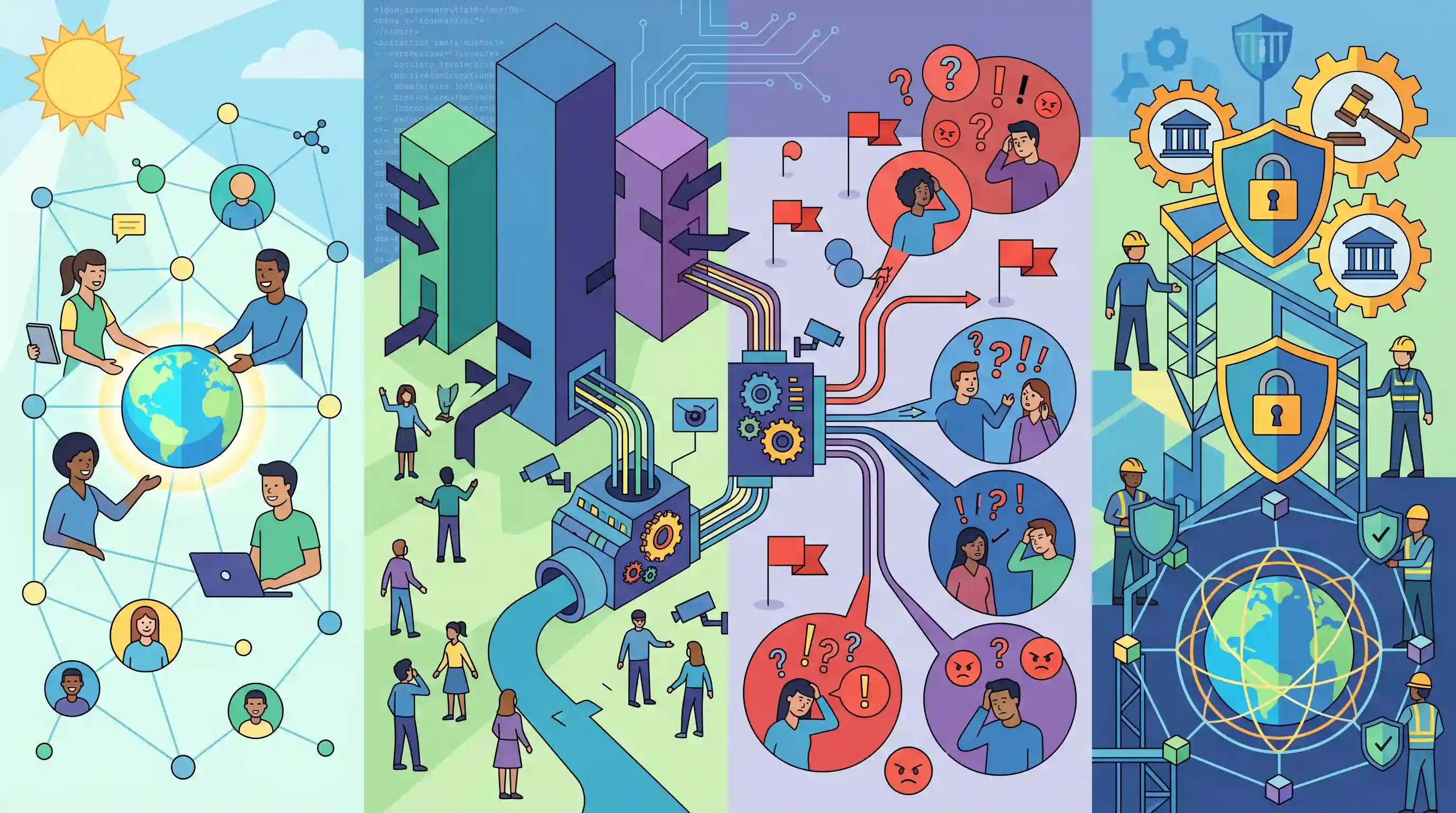
The editorial reflects on the evolutionary trajectory of the internet, contrasting its initial utopian promise with contemporary realities. Originally envisioned as a democratizing force for free speech and global connectivity, the internet is now heavily influenced by Big Tech monopolies, surveillance capitalism, and algorithmic polarization. The piece underscores how social media platforms often breed echo chambers, misinformation, and mental health challenges. It highlights the pressing need for comprehensive digital governance, data privacy frameworks, and cybersecurity measures to reclaim the internet's constructive potential while mitigating its disruptive societal impacts.
Key Points
- The internet initially offered a utopian vision of decentralized information, open communication, and the democratization of knowledge.
- Over time, the digital ecosystem has centralized around Big Tech monopolies, leading to concerns over data privacy and surveillance capitalism.
- Social media algorithms have inadvertently exacerbated societal polarization, echo chambers, and the spread of misinformation or fake news.
- The misuse of cyberspace by malicious actors and non-state entities highlights the critical need for robust cybersecurity measures and global digital governance.
- The contrast between the internet's early promise and its current reality serves as a crucial lesson for regulating emerging technologies like Artificial Intelligence.
Important Terms
Big Tech

A group of dominant global technology companies (e.g., Google, Amazon, Meta) with significant market power and influence over the digital economy and information flow.
UPSC context
GS-III (Economy/IT): Relates to antitrust issues, market monopolies, and the regulation of systemically important digital intermediaries.
Surveillance Capitalism
An economic system centered on the harvesting and commodification of personal data to predict and influence human behavior for corporate profit.
UPSC context
GS-III/IV (Ethics/Security): Tests awareness of the ethical implications of data-driven business models and privacy rights.
Algorithmic Polarization
The process where automated content curation by social media reinforces user biases, leading to heightened social fragmentation and political division.
UPSC context
GS-III (Internal Security): Tests understanding of how social media tools can incite communal disharmony or radicalization.
Echo Chambers
Digital environments where users encounter only information that reinforces their existing beliefs, often created by engagement-focused social media algorithms.
UPSC context
GS-III (Internal Security): Crucial for understanding the role of networking sites in internal security challenges like misinformation.
Digital Governance
The framework of rules, norms, and practices used to manage a digital ecosystem, ensuring accountability, transparency, and the protection of digital rights.
UPSC context
GS-II (E-Governance): Concerns the institutional and regulatory mechanisms required to manage a country's digital infrastructure and citizen interactions.
Data Privacy Frameworks
Legal and regulatory structures, such as India's DPDP Act, 2023, designed to protect personal information from unauthorized use while enabling lawful data processing.
UPSC context
GS-II/III (Polity/Security): Tests knowledge of legal safeguards for fundamental rights (Privacy) in the digital age.
Prelims Trap
"India is a signatory to the Budapest Convention on Cybercrime to combat transnational digital threats."
India is NOT a signatory to the Budapest Convention. It abstained from joining, citing national sovereignty concerns over cross-border data sharing with foreign law enforcement agencies.
Static Concepts Connected
What is the statutory framework governing digital monopolies and Big Tech in India?
- Competition Act 2002: Empowers the Competition Commission of India (CCI) to penalize the abuse of dominant market positions, such as anti-competitive app store policies.
- Draft Digital Competition Bill: Proposes an 'ex-ante' framework to proactively regulate Systemically Significant Digital Enterprises (SSDEs) before market monopolies solidify.
How does India legally counter digital misinformation and cyber threats?
- Section 69A (IT Act): Allows the government to block digital content threatening India's sovereignty, defense, or public order.
- IT Rules 2021: Mandates significant social media intermediaries to appoint compliance officers and enable traceability of the first originator of malicious information.
- CERT-In: The statutory national nodal agency under the Ministry of Electronics and IT for responding to computer security incidents.
Cross-Topic Patterns
Data Privacy vs. Surveillance Capitalism
The shift towards surveillance capitalism directly tests the Puttaswamy Right to Privacy, making the enforcement of the Digital Personal Data Protection (DPDP) Act a critical governance theme.
Algorithmic Radicalization & Internal Security
Echo chambers created by engagement-driven algorithms are leveraged by non-state actors for lone-wolf radicalization, morphing tech design into a core internal security threat.
Internet Monopolies to AI Governance
The failure to regulate early internet monopolies is the primary driver behind calls for proactive, ex-ante global frameworks (like the Global Digital Compact) for Artificial Intelligence.

Surveillance capitalism and algorithmic bias will likely merge in a 2026 GS3 Mains question on digital monopolies and DPDP Act.
Linked PYQs · 4
Linked PYQs · 4
- 2016MainsEssay
Cyberspace and Internet : Blessing or curse to the human civilization in the long run
- 2016MainsGS3
Use of Internet and social media by non-state actors for subversive activities is a major security concern. How have these been misused in the recent past? Suggest effective guidelines to curb the above threat.
- 2024MainsEssay
Social media is triggering 'Fear of Missing Out' amongst the youth, precipitating depression and loneliness.
- 2020MainsEssay
Technology as the silent factor in international relations
