Exclusion Errors and Technocratic Challenges in Welfare Delivery
Source:The Hindu ↗
Why It Matters
The debate between technological efficiency and welfare equity is a core component of GS Paper 2 (e-governance limitations, welfare schemes) and GS Paper 3 (subsidies, DBT). Aspirants must understand how systemic biases in digital infrastructure can inadvertently cause exclusion errors, a recurring critique relevant for Main exam answers.
Summary
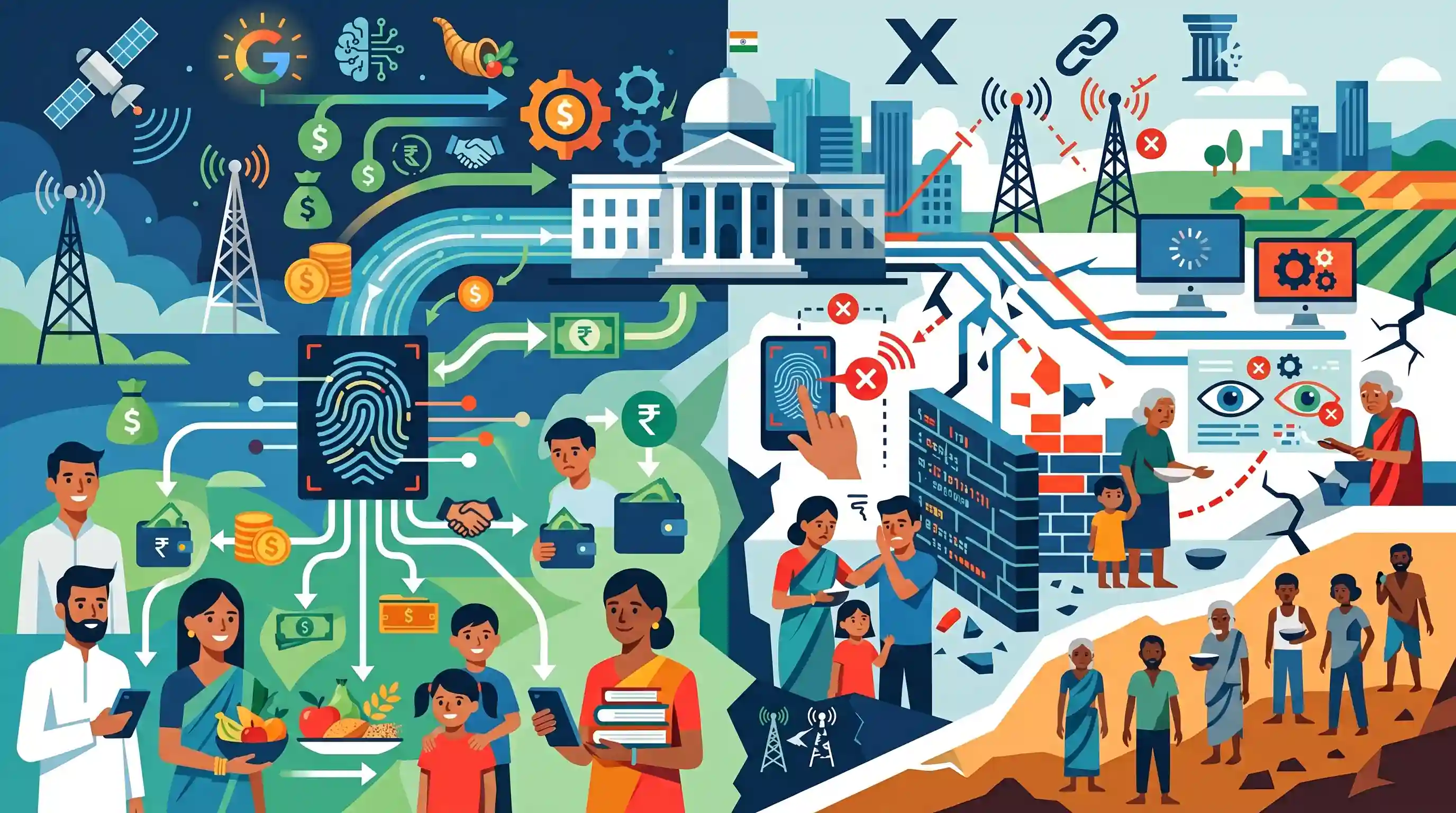
The article critically examines the increasing reliance on a 'technocratic calculus'—driven by digital tools like Aadhaar and Direct Benefit Transfers (DBT)—in the delivery of India's welfare schemes. It highlights the tension between administrative goals of efficiency and leakage reduction, and the lived realities of the poor who frequently face exclusion errors due to technological failures, biometric mismatches, and connectivity issues. Ultimately, it argues that an overemphasis on digital integration risks marginalizing the most vulnerable citizens, necessitating a more user-centric, inclusive approach to e-governance and social welfare.
Key Points
- The transition of India's welfare state towards a technocratic model heavily relies on digital infrastructure, including Aadhaar, DBT, and the JAM trinity.
- While e-governance initiatives aim to streamline delivery, reduce leakages, and identify ghost beneficiaries, they often inherently prioritize backend technological integration over user-centric accessibility.
- There is a persistent issue of 'exclusion errors', where genuine beneficiaries are denied essential rations or wages due to biometric authentication failures, poor internet connectivity, or digital illiteracy.
- The article underscores the necessity of balancing technocratic efficiency with human rights, arguing for grievance redressal mechanisms and offline fallbacks to prevent the marginalization of vulnerable populations.
Important Terms
Aadhaar

A 12-digit unique identity number issued by UIDAI, based on biometric and demographic data, serving as a foundational digital identity for welfare delivery and authentication.
UPSC context
GS Paper II/III: Tests understanding of e-governance, digital infrastructure, and challenges of exclusion in social welfare delivery.
Direct Benefit Transfer (DBT)
A governance reform transferring subsidies directly into beneficiaries' bank accounts, designed to bypass intermediaries, reduce leakages, and improve fiscal efficiency.
UPSC context
GS Paper II/III: Evaluates government policies, subsidy rationalization, and the effectiveness of technology in public service delivery.
JAM Trinity
The integration of Jan Dhan bank accounts, Aadhaar, and Mobile connectivity, forming the technical backbone for India’s digital welfare and financial inclusion landscape.
UPSC context
GS Paper II/III: Central to discussions on financial inclusion, e-governance models, and the 'technocratic calculus' of modern welfare.
MGNREGA
A rights-based social security scheme guaranteeing 100 days of manual work to rural households, now heavily reliant on Aadhaar-linked payment systems.
UPSC context
GS Paper II: Key for topics on welfare schemes for vulnerable sections and rural development challenges.
Public Distribution System (PDS)
A food security system distributing subsidized food grains through a network of Fair Price Shops, increasingly utilizing biometric authentication to verify beneficiaries.
UPSC context
GS Paper III: Directly addresses food security, farm subsidies, and deficiencies in the government's food management system.
Unique Identification Authority of India (UIDAI)
The statutory authority established under the Aadhaar Act 2016 responsible for Aadhaar enrollment, authentication, and managing the Central Identities Data Repository.
UPSC context
GS Paper II: Tests knowledge of statutory/regulatory bodies and the institutional framework governing digital identity.
Prelims Trap
"Biometric authentication under Aadhaar is an absolute precondition for welfare benefits, with no legal provision for offline fallbacks."
The Supreme Court explicitly ruled that citizens cannot be denied essential welfare (like PDS rations) solely due to biometric failure. Authorities must provide alternative offline verification mechanisms to prevent exclusion.
Static Concepts Connected
What is the difference between Exclusion and Inclusion errors in welfare targeting?
- Exclusion Error (Type I): Genuine, deserving beneficiaries are left out of a scheme (e.g., denied rations due to biometric fingerprint mismatches).
- Inclusion Error (Type II): Non-deserving or ineligible individuals receive benefits (e.g., 'ghost beneficiaries' siphoning funds).
- The Policy Trade-off: Technocratic solutions like Aadhaar prioritize reducing inclusion errors (leakages) but frequently cause sharp spikes in exclusion errors, harming the most vulnerable.
How does the JAM trinity enable the Direct Benefit Transfer (DBT) framework?
- Jan Dhan: Provides universal banking access, ensuring every household has a financial endpoint to receive cash transfers directly.
- Aadhaar: Acts as a unique biometric identifier to deduplicate databases, map beneficiaries across schemes, and eliminate ghost accounts.
- Mobile: Facilitates real-time tracking, grievance lodging, and access to digital payments via UPI or USSD.
Cross-Topic Patterns
Algorithmic Governance vs. Article 21
The shift from a legislative rights-based model (like MGNREGA) to algorithmic targeting raises constitutional concerns regarding the arbitrary deprivation of the Right to Life (Article 21) due to technical glitches.
E-Governance as Fiscal Consolidation
The sharp drop in social sector spending post-COVID suggests that e-governance and 'leakage reduction' narratives may sometimes be leveraged to achieve fiscal consolidation and macro-economic austerity at the expense of welfare.

Expect a GS-2 Mains question analyzing the trade-off between administrative efficiency via DBT and exclusion errors impacting the vulnerable.
Linked PYQs · 4
Linked PYQs · 4
- 2025MainsGS2
e-governance projects have a built-in bias towards technology and back-end integration than user-centric designs. Examine.
- 2015MainsGS3
In what way could replacement of price subsidy with Direct Benefit Transfer (DBT) change the scenario of subsidies in India ? Discuss.
- 2023MainsGS2
e-governance, as a critical tool of governance, has ushered in effectiveness, transparency and accountability in governments. What inadequacies hamper the enhancement of these features ?
- 2024PrelimsGS1
With reference to the Pradhan Mantri Jan Dhan Yojana (PMJDY), which of the following statements is/are correct? 1. The scheme aims to open bank accounts for unbanked households. 2. There is a minimum balance requirement for accounts opened under this scheme. 3. Beneficiaries get a Rupay Debit Card with an inbuilt accident insurance cover. Select the correct answer using the code given below.
