Global Crude Oil Price Decline Boosts Macroeconomic Stability
Source:The Hindu ↗
Why It Matters
Understanding the correlation between international crude oil prices and domestic macroeconomic indicators like inflation, fiscal deficit, and CAD is a recurring foundational concept for the UPSC GS3 Economy syllabus and Prelims.
Summary
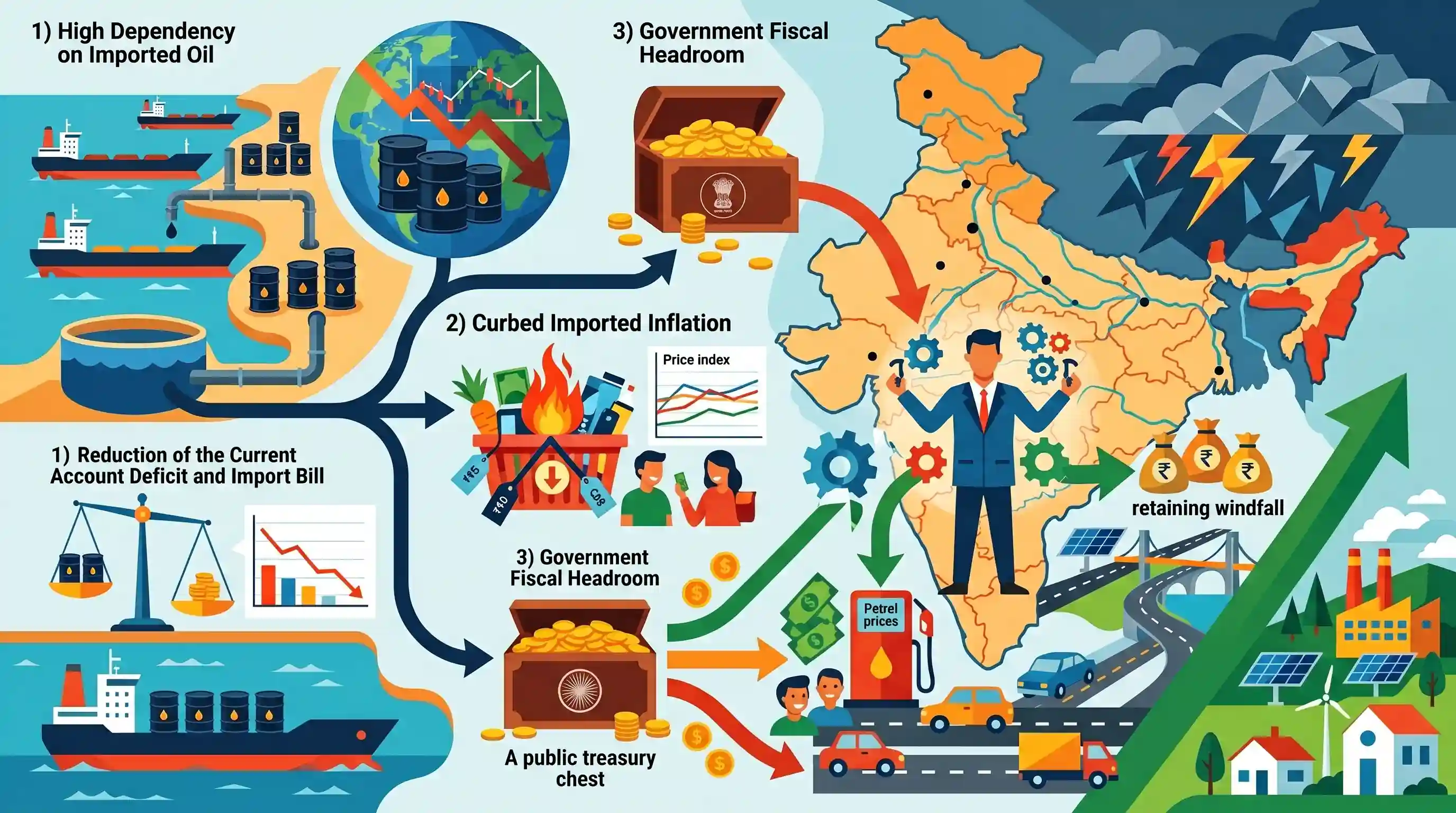
Lower global crude oil prices offer significant macroeconomic benefits for India, an economy heavily dependent on imported oil for its energy needs. A decline in oil prices helps reduce India's current account deficit and import bill, curbs imported inflation, and provides the government with essential fiscal headroom to manage subsidies or boost capital expenditure. However, translating these tailwinds into sustainable domestic growth requires a careful policy balance—particularly regarding the pass-through of lower fuel prices to consumers versus the government retaining the windfall via excise duties—amidst ongoing global geopolitical uncertainties.
Key Points
- Easing of global crude oil prices serves as a major positive macroeconomic shock for net importers like India, directly helping narrow the Current Account Deficit (CAD).
- Lower oil prices significantly mitigate inflationary pressures by decreasing fuel costs and subsequent freight and production costs across multiple sectors.
- The trend provides fiscal headroom for the government by reducing subsidy burdens and creating room for increased public capital expenditure.
- The actual benefit to the broader economy depends heavily on whether the lower international prices are passed on to domestic retail consumers or absorbed by the government through higher excise duties.
Important Terms
Current Account Deficit (CAD)

A situation where a country's total imports of goods and services exceed its exports. In India, because nearly 85% of crude oil is imported, global price hikes significantly widen this deficit.
UPSC context
GS Paper III (Economy). Tests understanding of external sector stability and how commodity shocks impact the Balance of Payments.
Imported Inflation
A rise in domestic prices driven by the increasing cost of imported goods, such as crude oil. This increases domestic costs for transportation and production, eventually raising retail prices for consumers.
UPSC context
GS Paper III (Economy). Relevant for understanding inflation dynamics and the Reserve Bank’s monetary policy responses to external supply-side shocks.
OPEC+
An alliance of OPEC members and 10 non-OPEC allies, including Russia, that coordinates oil production. By controlling supply, they influence global oil prices, directly impacting India’s energy costs and inflation.
UPSC context
GS Paper II (International Relations). Crucial for analyzing energy security, global geopolitics, and India’s strategic relationship with major oil producers.
Capital Expenditure (Capex)
Government spending aimed at creating or upgrading long-term physical assets like infrastructure. It is valued for its high "multiplier effect," where spending generates significant long-term economic growth and employment.
UPSC context
GS Paper III (Economy). Important for understanding government budgeting and the shift from consumption-oriented spending to growth-oriented investment.
Fiscal Headroom
The flexibility or budgetary space a government has to increase spending or cut taxes while still meeting its fiscal deficit targets. Lower oil prices increase this headroom by reducing subsidy bills.
UPSC context
GS Paper III (Economy). Focuses on fiscal policy, government budgeting, and the management of windfalls for sustainable economic growth.
Excise Duty
A central tax on the manufacture of goods within India. On petroleum products, it is a flexible fiscal tool used to either generate revenue or stabilize retail fuel prices for consumers.
UPSC context
GS Paper III (Economy). Relevant for discussions on tax policy, revenue generation, and the impact of fuel taxes on inflation.
Reserve Bank of India (RBI)
India's central bank responsible for monetary policy and managing the Rupee. It tracks oil prices closely as they are a primary driver of inflation and affect the country’s foreign exchange reserves.
UPSC context
GS Paper III (Economy). Essential for topics on price stability, monetary management, and the central bank's role in addressing external risks.
Prelims Trap
"A decline in global crude oil prices automatically reduces India's retail fuel prices and inflation proportionately."
The government frequently absorbs global price drops by hiking central excise duties to bolster revenues, blocking the pass-through effect to consumers.
Static Concepts Connected
How does crude oil impact India's Balance of Payments?
- Import Bill: Crude typically accounts for 20-25% of India's import bill, acting as the primary driver of the merchandise trade deficit.
- CAD Sensitivity: Every $10/barrel increase in crude prices historically widens the Current Account Deficit (CAD) by roughly 35-40 basis points of GDP.
- Currency Impact: Higher oil import payments spike the demand for US Dollars, exerting downward depreciation pressure on the Indian Rupee.
Which petroleum products are excluded from the GST regime?
- Excluded Items: Crude oil, petrol, high-speed diesel, aviation turbine fuel (ATF), and natural gas are currently kept outside GST.
- Dual Taxation: Because they are outside GST, the Centre levies Excise Duty and States levy Value Added Tax (VAT).
- Fiscal Flexibility: This structural exclusion gives governments a flexible tool to manage fiscal deficits during extreme global price shocks.
Cross-Topic Patterns
Oil prices link fiscal and monetary policy
Falling oil prices give the Centre fiscal room via excise revenue while simultaneously easing imported cost-push inflation, granting the RBI the necessary headroom to consider repo rate cuts.
Cheap crude vs. EV transition momentum
Cheaper traditional fuels can temporarily disincentivize EV adoption and green energy transitions, creating policy friction between short-term macroeconomic gains and long-term climate commitments.

Expect a 2026 multi-statement question linking global crude benchmarks (Brent/WTI), GST petroleum exclusions, and CAD impact.
Linked PYQs · 3
Linked PYQs · 3
- 2020PrelimsGS1
The term 'West Texas Intermediate', sometimes found in news, refers to a grade of
- 2021PrelimsGS1
Which one of the following is likely to be the most inflationary in its effects?
- 2018MainsGS3
How would the recent phenomena of protectionism and currency manipulations in world trade affect macroeconomic stability of India?
