Internal Migration Trends and Vulnerabilities of Migrant Workers
Source:The Hindu ↗
Why It Matters
Understanding internal migration is crucial for answering questions on urbanization, demographic changes, and the effectiveness of welfare schemes. It highlights the intersection of geography, economy, and polity in addressing the challenges faced by one of India's most vulnerable demographic groups.
Summary
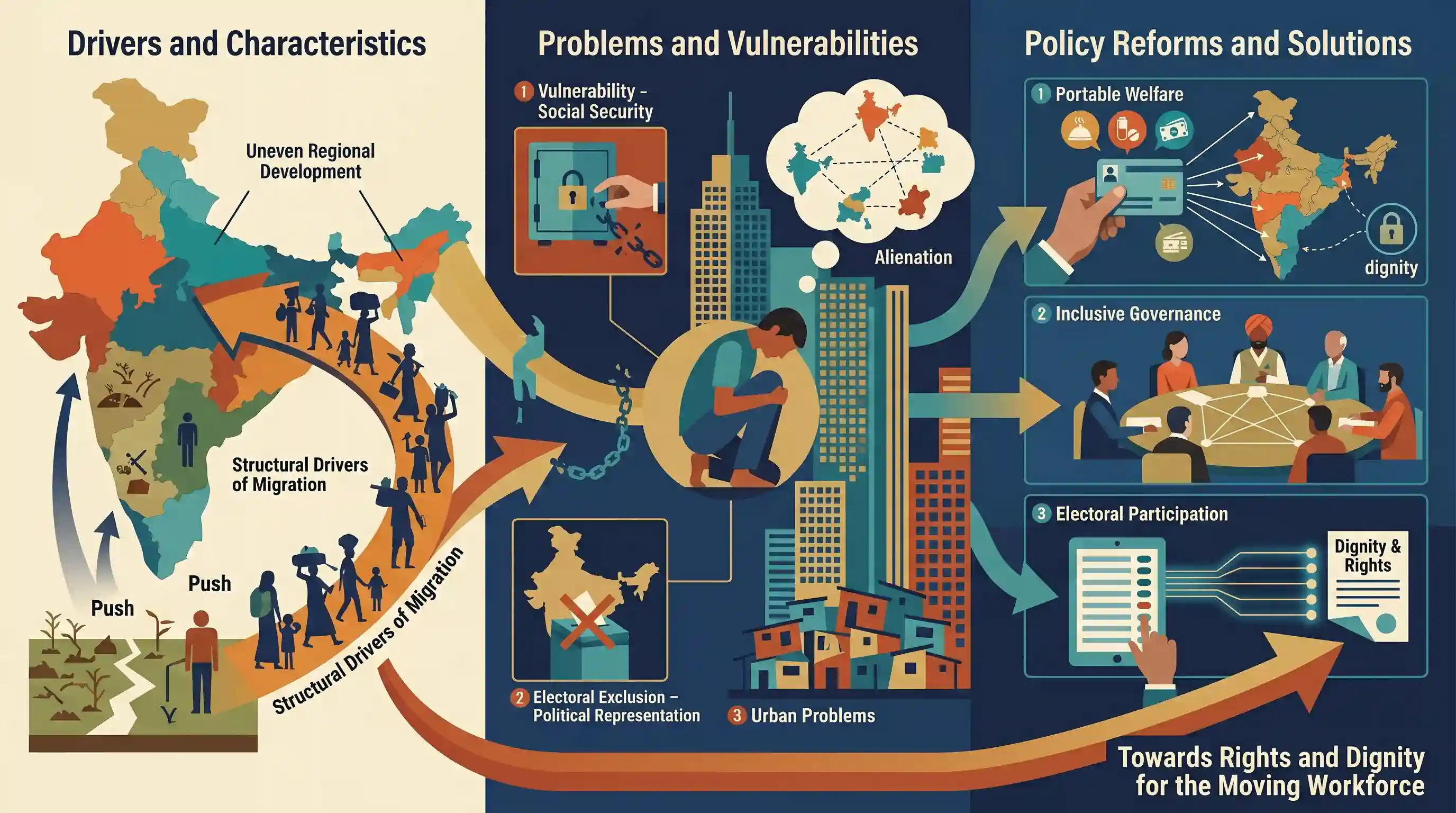
The article highlights the profound impact of internal migration on India's socio-economic fabric, characterizing the modern Indian populace as 'the moving people'. It underscores the structural drivers of migration, such as uneven regional development, and brings attention to the vulnerabilities of migrant workers, particularly in terms of social security and political representation. By reflecting on the inadequacies of current welfare mechanisms and the alienation migrants face in large urban centers, the piece advocates for comprehensive policy reforms—ranging from portable welfare entitlements to inclusive urban governance and electoral participation—to secure the rights and dignity of the moving workforce.
Key Points
- Internal migration in India is a defining demographic shift, driven by spatial inequalities in economic development and agrarian distress.
- Migrant workers form the backbone of the urban economy but face severe socio-economic exclusion, poor housing, and inadequate access to healthcare and education.
- Political disenfranchisement remains a critical issue, as moving people often lose their voting rights at their source while being excluded from the democratic process at their destination.
- While initiatives like the ONORC and the e-Shram portal have improved welfare portability, deeper structural reforms in labour laws and urban planning are necessary to ensure inclusive growth.
Important Terms
One Nation One Ration Card (ONORC)

A technology-driven scheme ensuring the portability of food security benefits, allowing NFSA beneficiaries to claim subsidized food grains from any Fair Price Shop in India using Aadhaar-linked ration cards.
UPSC context
GS Paper II (Governance); tests knowledge of social security portability, technology in PDS, and welfare for migratory populations.
e-Shram Portal
A national database (NDUW) launched in 2021 to register unorganized workers, seeded with Aadhaar, to facilitate the delivery of social security benefits and track the migrant workforce.
UPSC context
GS Paper II & III; crucial for questions on labor formalization, welfare of vulnerable sections, and digital governance.
Occupational Safety, Health and Working Conditions Code (2020)
A 2020 labor code consolidating 13 central laws to simplify compliance and expand the legal definition of migrant workers to include those migrating independently for employment.
UPSC context
GS Paper III (Economy/Labour); tests understanding of structural labor reforms, ease of doing business, and worker safety standards.
Inter-State Migrant Workmen Act, 1979
The original 1979 legislation regulating the employment of inter-state migrants; it is being subsumed by the 2020 OSH Code due to implementation gaps and limited coverage.
UPSC context
GS Paper II (Laws for Vulnerable Sections); historical context for labor exploitation and the evolution of migrant rights legislation.
Remote Electronic Voting Machine (RVM)
A prototype proposed by the Election Commission to allow domestic migrants to vote from their current location, handling multiple constituencies from a single remote booth.
UPSC context
GS Paper II (Representation of People’s Act); concerns electoral inclusivity, technological integrity, and political rights of mobile populations.
Draft National Policy on Migrant Workers
A policy framework proposing a rights-based approach to migration, recommending a central database, portable welfare, and inter-state coordination to harness migration for development.
UPSC context
GS Paper II (Social Justice/Policy-making); tests knowledge of institutional mechanisms and the shift from "handout" to "agency-based" welfare.
Prelims Trap
"All internal migrant workers, regardless of employment sector, are eligible to register on the e-Shram portal."
Only unorganized workers (aged 16-59) who are NOT members of EPFO, ESIC, or government-funded NPS can register on the e-Shram portal. Formal sector migrants are excluded.
Static Concepts Connected
What distinguish 'Push' and 'Pull' factors of internal migration?
- Push Factors: Adverse conditions driving people away from rural source areas, like agrarian distress, lack of employment, and poor infrastructure.
- Pull Factors: Favorable conditions attracting migrants to urban centers, including higher wages, better healthcare, and diverse economic opportunities.
Which Fundamental Rights explicitly protect internal migrants in India?
- Article 19(1)(d) & (e): Guarantees all citizens the right to move freely throughout India and to reside and settle in any part of the territory.
- Article 15: Prohibits discrimination by the State against any citizen on grounds only of religion, race, caste, sex, or place of birth.
Cross-Topic Patterns
Migration + Electoral Reforms (RVMs)
Political disenfranchisement of migrants drives the Election Commission's push for Remote EVMs (RVMs), linking demographic shifts directly to democratic representation debates.
Labour Codes + Welfare Portability
The absorption of the Inter-State Migrant Workmen Act into the new OSHWC Code highlights the shift from state-bound regulations to pan-India digital ecosystems like ONORC and e-Shram.

Expect a Prelims 2026 multi-statement question linking e-Shram portal eligibility criteria, ONORC functionality, and Remote EVM proposals.
Linked PYQs · 3
Linked PYQs · 3
- 2015MainsGS1
Discuss the changes in the trends of labour migration within and outside India in the last four decades.
- 2024MainsGS1
Why do large cities tend to attract more migrants than smaller towns? Discuss in the light of conditions in developing countries.
- 2024MainsGS3
Discuss the merits and demerits of the four 'Labour Codes' in the context of labour market reforms in India. What has been the progress so far in this regard?
