आंतरिक प्रवास के रुझान क्षेत्रीय जनसांख्यिकी बदलावों को उजागर करते हैं
स्रोत:द हिंदू ↗
क्यों मायने रखता है
Internal migration is a foundational driver of India's urbanization and economic growth. Understanding the intersection of demography, labor mobility, and regional imbalance is critical for UPSC aspirants, as it frequently features across GS1 (Society & Geography), GS2 (Federalism & Vulnerable Sections), and GS3 (Employment & Economy).
सारांश
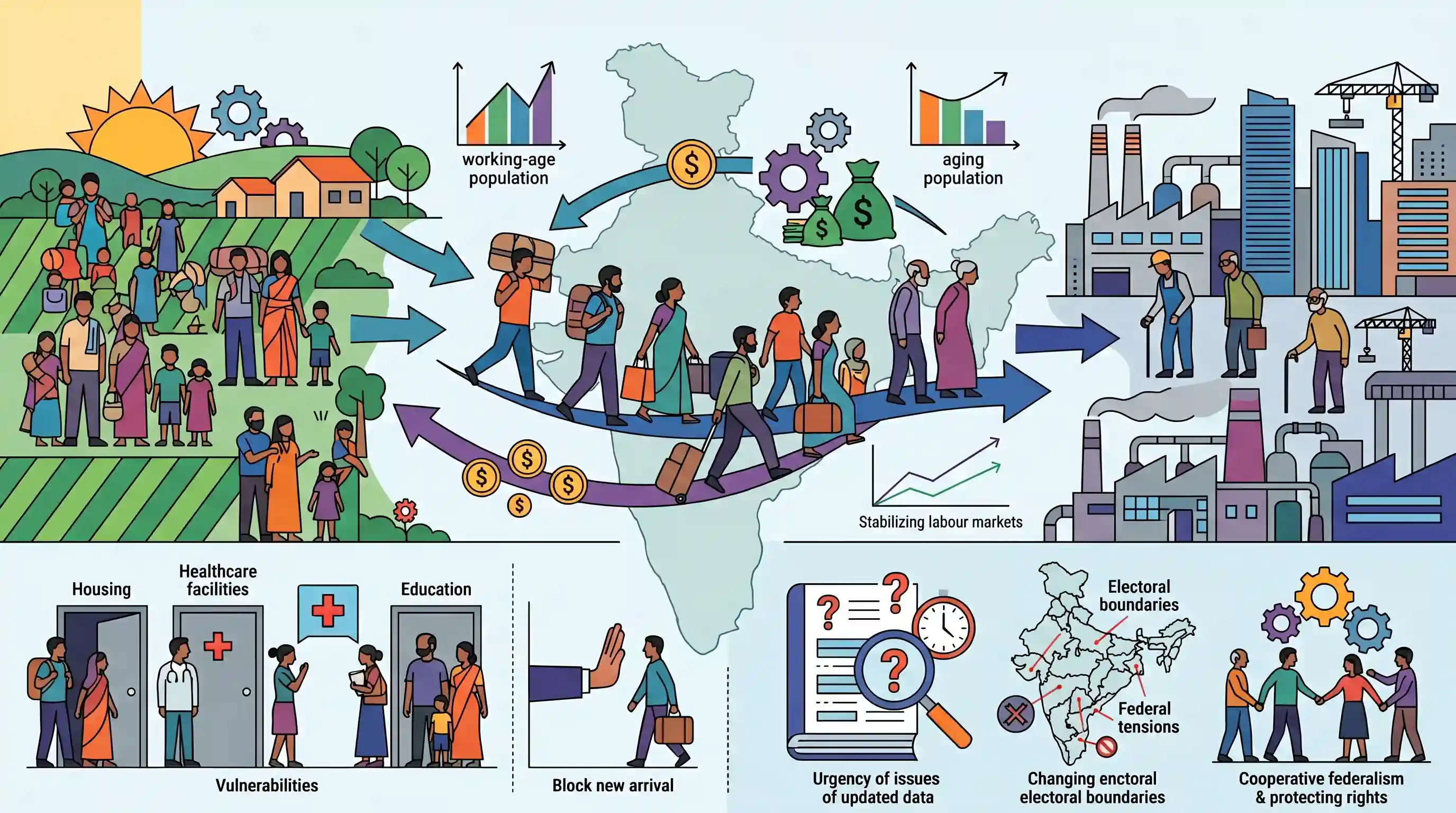
The article 'The story of we, the moving people' examines the sweeping trends of internal migration in India, contextualized by regional economic disparities and divergent demographic transitions. It highlights how workers from younger, populous states in the North and East are increasingly migrating to older, more industrialized states in the South and West. While this mobility stabilizes regional labor markets and generates critical remittances, it also exposes migrants to vulnerabilities regarding welfare access, social integration, and nativist pushback. Furthermore, the piece underscores the urgency of updating Census data to capture these demographic realities accurately, warning that impending challenges like political delimitation and shifting federal dynamics must be managed with a cooperative approach that safeguards migrant rights.
मुख्य बिंदु
- Internal migration in India is increasingly driven by a stark demographic divergence between the younger, labor-surplus North/East and the economically advanced, aging South/West.
- The movement of 'moving people' serves as an economic bridge, fulfilling the labor demands of industrialized states while providing remittance lifelines to poorer states.
- The ongoing delay in conducting the decadal Census severely impedes the drafting of accurate, data-driven policies and welfare mechanisms tailored for urban migrants.
- Migration triggers complex socio-political anxieties, including regional nativism and concerns over the upcoming political delimitation, which threatens to penalize states that have successfully stabilized their populations.
- Ensuring the portability of social security and voting rights remains critical for integrating internal migrants into the broader socio-economic fabric of destination states.
महत्वपूर्ण शब्द
Census of India

जनगणना अधिनियम, 1948 के तहत जनसांख्यिकीय, सामाजिक और आर्थिक डेटा एकत्र करने के लिए आयोजित एक दसवर्षीय प्रशासनिक अभ्यास; यह नीति-निर्माण के लिए सांख्यिकीय आधार प्रदान करता है।
UPSC context
GS Paper I (Population) and Paper II (Governance). It is the primary data source for measuring migration and determining federal shares.
Delimitation Act
अनुच्छेद 82 और 170 के तहत अधिनियमित वह विधान, जिसके माध्यम से समान मतदाता प्रतिनिधित्व सुनिश्चित करने के लिए नवीनतम जनगणना के आधार पर लोकसभा और विधानसभा निर्वाचन क्षेत्रों की सीमाओं का पुनर्निर्धारण किया जाता है।
UPSC context
GS Paper II (Polity). Critical for understanding potential political friction between high-growth Northern and demographic-transitioned Southern states post-2026.
Finance Commission of India
A constitutional body (Article 280) that recommends the distribution of tax proceeds between the Union and States, and among States, based on various socio-economic criteria.
UPSC context
GS Paper II (Constitutional Bodies). Central to addressing regional disparities and balancing demographic performance against population needs in fiscal devolution.
One Nation One Ration Card (ONORC)
A scheme under the National Food Security Act enabling beneficiaries to access subsidized food grains from any Fair Price Shop in India using Aadhaar-linked biometric authentication.
UPSC context
GS पेपर II (सामाजिक न्याय/कल्याणकारी योजनाएं)। भारत की बड़ी आंतरिक प्रवासी आबादी के लिए खाद्य सुरक्षा और पोर्टेबल कल्याणकारी लाभ सुनिश्चित करने के लिए महत्वपूर्ण।
Inter-State Migrant Workmen Act
A 1979 law regulating employment and conditions of service of inter-state migrants, mandating registration of establishments and licensing of contractors to prevent worker exploitation.
UPSC context
GS Paper II (Governance/Labor Laws). Tests understanding of migrant rights, legal safeguards, and the challenges of informal labor.
प्रारंभिक ट्रैप
Lok Sabha constituencies will be reallocated automatically in 2026 based on the delayed 2021 Census data.
The 84th Constitutional Amendment froze seat allocation until the figures for the first census taken AFTER the year 2026 are published, not exactly in 2026.
संबंधित अवधारणाएँ
What constitutional provisions govern the Delimitation of constituencies?
- अनुच्छेद 82: Empowers Parliament to enact a Delimitation Act after every census. However, the 84th Amendment froze state-wise seat allocation until the first census post-2026.
- Judicial Immunity: Orders issued by the Delimitation Commission have the force of law and cannot be challenged in any court, preventing endless litigation from delaying elections.
- 87वां संशोधन: While total state seats remained frozen, the 87th Amendment allowed for the internal redrawing of territorial constituencies within states based on the 2001 Census.
What were the coverage constraints of the Inter-State Migrant Workmen Act, 1979?
- Contractor Applicability: Historically, it only applied to establishments employing five or more migrants recruited strictly through a contractor, effectively excluding millions of independent internal migrants.
- OSH Code 2020: The 1979 Act was subsumed into the Occupational Safety, Health and Working Conditions Code (2020) to expand definitions and coverage, though implementation is still pending.
अंतर-विषय पैटर्न
Finance Commission vs. Demographic Dividends
The 16th Finance Commission must balance equity for populous, poorer Northern states against efficiency rewards for Southern states that successfully stabilized their demographics.
Remote Voting (RVMs) for Migrant Enfranchisement
To prevent political disenfranchisement of internal migrants, the Election Commission has proposed Multi-Constituency Remote EVMs (RVMs), sparking constitutional and logistical debates.

North-South demographic divergence + the post-2026 delimitation freeze + migrant enfranchisement is a prime GS-2 Mains target for 2026.
संबद्ध PYQ · 5
संबद्ध PYQ · 5
- 2024MainsGS1
Why do large cities tend to attract more migrants than smaller towns? Discuss in the light of conditions in developing countries.
- 2015MainsGS1
Discuss the changes in the trends of labour migration within and outside India in the last four decades.
- 2024MainsGS1
What is regional disparity? How does it differ from diversity? How serious is the issue of regional disparity in India?
- 2024MainsGS2
What changes has the Union Government recently introduced in the domain of Centre-State relations ? Suggest measures to be adopted to build the trust between the Centre and the States and for strengthening federalism.
- 2023MainsGS2
“Development and welfare schemes for the vulnerable, by its nature, are discriminatory in approach.” Do you agree? Give reasons for your answer.
