Internal Migrant Workers Face Systemic Barriers To Welfare Rights
Source:The Hindu ↗
Why It Matters
Migrant workers constitute a significant proportion of India's workforce and informal economy. Understanding their socio-economic and political challenges is critical for answering questions related to urbanization, demography, labor laws, and inclusive growth in GS1, GS2, and GS3.
Summary
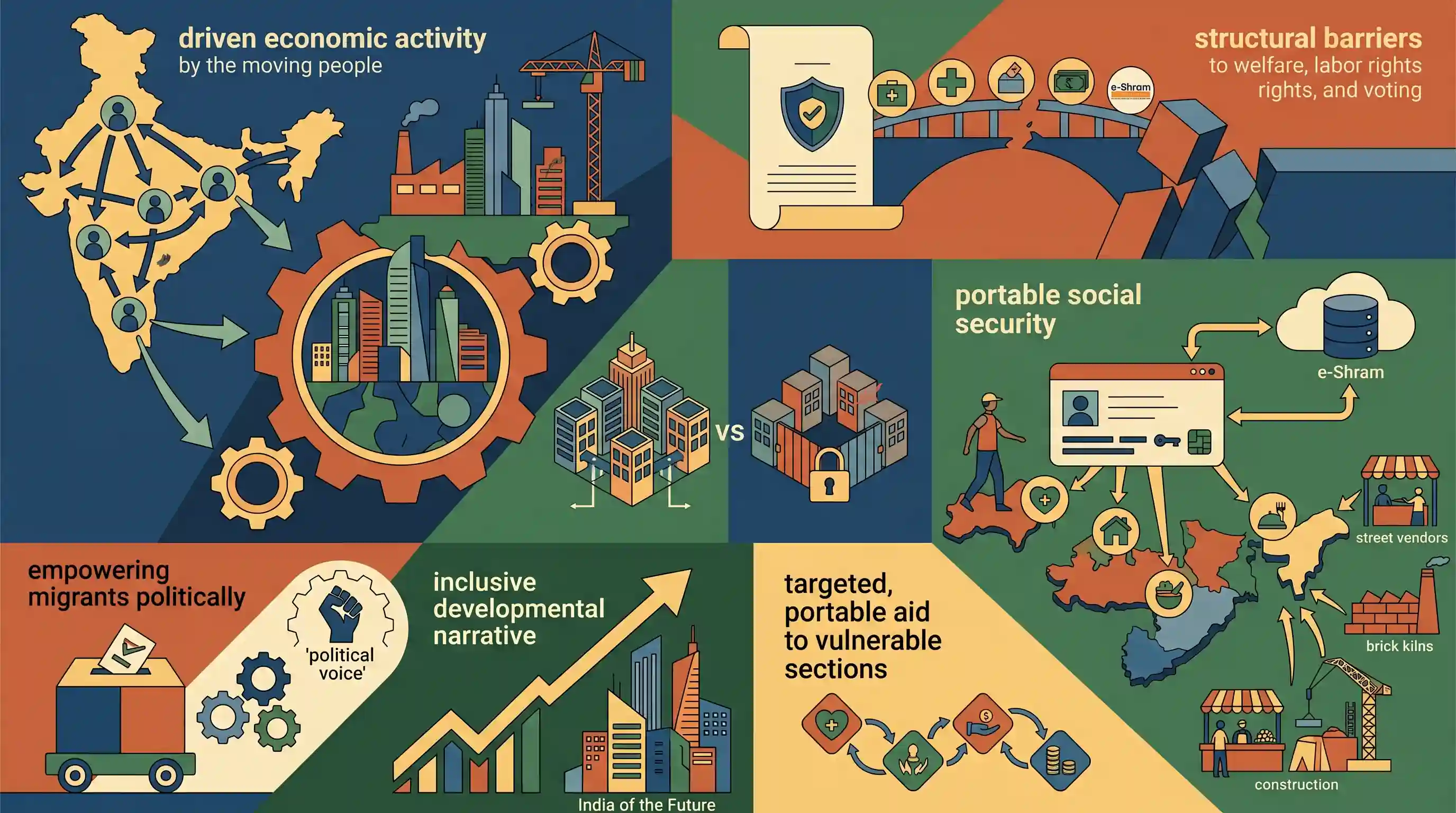
The article reflects on the plight and position of internal migrant workers in India, characterizing them as the essential 'moving people' who drive economic activity yet remain socially and politically marginalized. Despite Constitutional protections guaranteeing freedom of movement and residence, migrants face structural barriers in accessing welfare schemes, labor rights, and voting mechanisms. The piece underscores the urgency of implementing portable social security measures, improving data integration via platforms like e-Shram, and empowering migrants politically to ensure their comprehensive inclusion in India's developmental narrative.
Key Points
- Investigates the state of India's internal migrant population, drawing a parallel to the Constitutional 'We, the people' to emphasize their integral role in the economy and their rightful claims to citizenship benefits.
- Highlights the socio-economic vulnerabilities of migrant workers, including lack of job security, inadequate housing, and exclusion from political participation due to circular mobility.
- Discusses the systemic failures in providing a comprehensive social security net and robust implementation of labor laws for informal and migrant workers in the unorganized sector.
- Emphasizes the need for policy interventions such as the portability of voting rights (e.g., remote EVMs) and welfare benefits to ensure inclusive growth and uphold constitutional guarantees under Article 19.
Important Terms
e-Shram portal

A national database launched by the Ministry of Labour and Employment to register unorganized workers, providing them a 12-digit Universal Account Number (UAN) to facilitate portable social security benefits.
UPSC context
Relevant for GS Paper II (Welfare Schemes) and GS Paper III (Inclusive Growth/Informal Economy). Tests knowledge of digital governance and social security.
One Nation One Ration Card (ONORC)
A reform allowing National Food Security Act (NFSA) beneficiaries, especially migrants, to access subsidized food grains from any Fair Price Shop in India using biometric authentication.
UPSC context
Critical for GS Paper II (Poverty and Hunger) and GS Paper III (Food Security). Tests understanding of cooperative federalism and welfare portability.
Occupational Safety, Health and Working Conditions (OSH) Code, 2020
A comprehensive code consolidating 13 labor laws to simplify compliance and expand the definition of inter-state migrant workers to include those migrating on their own.
UPSC context
Essential for GS Paper III (Labour Reforms) and GS Paper II (Government Policies). Evaluates knowledge of legislative shifts from regulation to facilitation.
Inter-State Migrant Workmen Act, 1979
A 1979 central legislation designed to prevent the exploitation of inter-state migrants recruited through contractors, requiring registration of establishments and licensing of contractors; now being subsumed by the OSH Code.
UPSC context
Relevant for GS Paper II (Statutory Bodies/Laws). Important for understanding the evolution of labor rights and historical protection frameworks.
Remote Electronic Voting Machine (RVM)
A prototype proposed by the Election Commission of India (ECI) to allow domestic migrants to vote from their place of work without traveling to their home constituencies.
UPSC context
Significant for GS Paper II (Electoral Reforms/Constitutional Bodies). Tests awareness of technological solutions for political inclusion and voter turnout.
Article 19(1)(d) and (e)
Constitutional provisions ensuring citizens' rights to move freely throughout India and to reside/settle in any part, forming the legal basis for internal migration and labor mobility.
UPSC context
Core to GS Paper II (Indian Constitution). Tests the application of fundamental rights in the context of socio-economic challenges like migration.
Prelims Trap
"Internal migrants can currently vote from their destination states using Remote EVMs (RVMs)."
Remote EVMs (RVMs) are currently only a prototype developed by the Election Commission. They have not yet been legally enabled or deployed for elections.
Static Concepts Connected
What are the Constitutional rights governing internal migration and their limitations?
- Freedom of Movement: Article 19(1)(d) guarantees the right to move freely throughout the territory of India.
- Freedom of Residence: Article 19(1)(e) guarantees the right to reside and settle in any part of the territory of India.
- Article 19(5) Restrictions: The State can impose reasonable restrictions on these rights in the interests of the general public or for the protection of any Scheduled Tribe.
How does the OSH Code 2020 alter protections for inter-state migrant workers?
- Subsumption of Laws: It subsumes the Inter-State Migrant Workmen Act of 1979, consolidating protections under a broader occupational safety umbrella.
- Broader Definition: It includes workers who migrate on their own (not just via contractors) and earn up to ₹18,000 per month.
- Journey Allowance: Employers are mandated to pay a lump sum journey allowance to migrant workers once a year to visit their native places.
Cross-Topic Patterns
Climate distress and informal migration
Droughts, floods, and sea-level rise are accelerating rural-to-urban distress migration. This links environmental degradation directly to the expansion of India's vulnerable urban unorganized sector.
Demographic skew and urban infrastructure
Surplus young labor from Northern states migrating to aging Southern states creates severe socio-political friction and tests the carrying capacity of urban infrastructure schemes like AMRUT.

Expect a 2026 Prelims question combining e-Shram features, ONORC portability, and the OSH Code's updated definitions of migrant workers.
Linked PYQs · 3
Linked PYQs · 3
- 2015MainsGS1
Discuss the changes in the trends of labour migration within and outside India in the last four decades.
- 2024MainsGS1
Why do large cities tend to attract more migrants than smaller towns? Discuss in the light of conditions in developing countries.
- 2024MainsGS3
Discuss the merits and demerits of the four 'Labour Codes' in the context of labour market reforms in India. What has been the progress so far in this regard?
