Rupee depreciation drivers and macroeconomic balance of payments
Source:Indian Express ↗
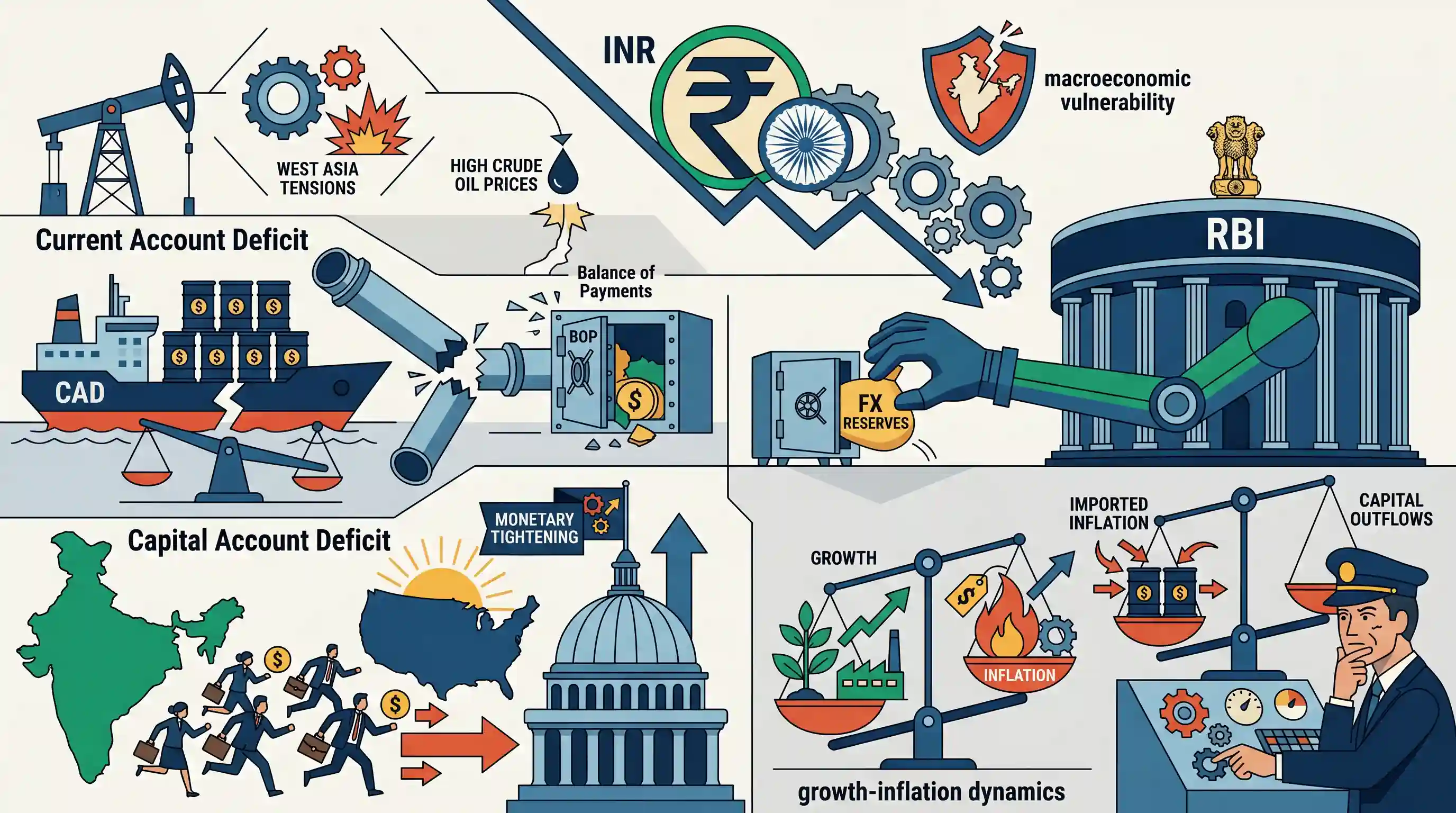
Why It Matters
Understanding the mechanics of currency depreciation, capital flight, and central bank intervention is fundamental for the UPSC Economics syllabus. The article provides a real-world case study of how global monetary tightening and geopolitical shocks affect India's macroeconomic stability.
Summary
The steady depreciation of the Indian rupee highlights emerging macroeconomic vulnerabilities, primarily driven by a widening Current Account Deficit (CAD) and significant capital flight by Foreign Portfolio Investors (FPIs). Global headwinds, including the US Federal Reserve's monetary tightening and geopolitical tensions in West Asia leading to high crude oil prices, have strained India's balance of payments. The Reserve Bank of India (RBI) has intervened heavily to stabilize the currency, but the combination of imported inflation and capital outflows presents a complex policy challenge for managing growth-inflation dynamics.
Key Points
- The Indian rupee has experienced a persistent decline against the US dollar, depreciating by around 5% last year and a further 5.64% this year.
- The depreciation is driven by a widening Current Account Deficit (CAD) and significant capital outflows, with Foreign Portfolio Investors (FPIs) pulling out $21.2 billion this year.
- Geopolitical tensions in West Asia and elevated global crude oil prices (Brent crude at $113/barrel) have exacerbated imported inflation and balance of payments pressures.
- To prevent a free fall, the RBI has aggressively intervened in the foreign exchange market by selling dollars, causing its short dollar book to swell.
- Despite the current challenges, India's macroeconomic fundamentals, such as a projected CAD of 2% of GDP, remain stronger than during the 2012-13 taper tantrum episode.
Important Terms
Balance of Payments (BoP)

A systematic record of all economic transactions between residents of a country and the rest of the world over a specific period, typically a year.
UPSC context
GS Paper III: Indian Economy. Essential for understanding trade stability, external debt, and foreign exchange reserve management.
Current Account Deficit (CAD)
A measurement of trade where the value of imported goods, services, and transfers exceeds the value of those exported.
UPSC context
GS Paper III: External Sector. Key indicator of macroeconomic health and currency valuation pressures.
Foreign Portfolio Investors (FPI)
Passive investment by non-residents in Indian financial assets like stocks and bonds. Often called 'hot money' due to its high volatility and quick exit during global uncertainty.
UPSC context
GS Paper III: Investment Models. Tests knowledge of capital account volatility and its impact on the rupee's value.
FCNR-B deposits
Foreign Currency Non-Resident (Bank) deposits allow NRIs to maintain fixed deposits in foreign currencies. They help the RBI stabilize the rupee by attracting foreign currency inflows without exchange risk for the depositor.
UPSC context
GS Paper III: External Sector. A specific tool used by the RBI to manage foreign exchange reserves and currency depreciation.
US Federal Reserve
The central banking system of the United States. Its monetary policy decisions, particularly interest rate hikes, significantly influence global capital flows and the strength of the US dollar.
UPSC context
GS Paper III: Global Economics. Highlights how external monetary shocks affect India’s financial markets and currency stability.
Imported Inflation
General price increases in a country caused by rising costs of imported commodities, such as crude oil, often intensified by a weakening domestic currency.
UPSC context
GS Paper III: Inflationary Trends. Tests the link between exchange rate depreciation and domestic cost-of-living increases.
Prelims Trap
"To stabilize the rupee, the RBI sells dollars which increases domestic rupee liquidity."
When RBI sells dollars from its reserves, buyers pay in rupees. This removes rupees from circulation, tightening domestic liquidity rather than increasing it.
Static Concepts Connected
How does RBI intervention in the forex market affect domestic money supply?
- Liquidity absorption: Selling US dollars removes equivalent Indian rupees from the banking system, reducing the overall monetary base and tightening liquidity.
- Sterilized intervention: To prevent extreme liquidity tightening, the RBI may conduct Open Market Operations (buying bonds) to inject rupees back into the system.
How is a Current Account Deficit (CAD) financed in the Balance of Payments?
- Capital inflows: A CAD is fundamentally financed by generating a net surplus in the capital account (FDI, FPI, external commercial borrowings, NRI deposits).
- Forex depletion: When capital inflows fall short or reverse (e.g., FPI flight), the RBI must draw down its foreign exchange reserves to bridge the BoP deficit.
Cross-Topic Patterns
Exchange rates & Imported Inflation
A weakening rupee makes inelastic imports like crude oil costlier. This 'imported inflation' feeds directly into domestic CPI, constraining the RBI's ability to lower interest rates to boost growth.
US Fed & Hot Money Flight
US monetary tightening raises Treasury yields, prompting FPIs to flee emerging markets. This exposes vulnerabilities in nations relying heavily on 'hot money' to finance structural Current Account Deficits.

Expect a 2026 prelims question linking US Fed tightening, FPI capital flight, and the specific mechanics of RBI's forex sterilization.
Linked PYQs · 5
Linked PYQs · 5
- 2022PrelimsGS1
Consider the following statements: 1. Tight monetary policy of US Federal Reserve could lead to capital flight. 2. Capital flight may increase the interest cost of firms with existing External Commercial Borrowings (ECBs). 3. Devaluation of domestic currency decreases the currency risk associated with ECBs. Which of the statements given above are correct?
- 2022PrelimsGS1
With reference to the Indian economy, consider the following statements: 1. If the inflation is too high, Reserve Bank of India (RBI) is likely to buy government securities. 2. If the rupee is rapidly depreciating, RBI is likely to sell dollars in the market. 3. If interest rates in the USA or European Union were to fall, that is likely to induce RBI to buy dollars. Which of the statements given above are correct?
- 2019PrelimsGS1
Which one of the following is not the most likely measure the Government/RBI takes to stop the slide of Indian rupee?
- 2022PrelimsGS1
With reference to the Indian economy, consider the following statements: 1. An increase in Nominal Effective Exchange Rate (NEER) indicates the appreciation of rupee. 2. An increase in the Real Effective Exchange Rate (REER) indicates an improvement in trade competitiveness. 3. An increasing trend in domestic inflation relative to inflation in other countries is likely to cause an increasing divergence between NEER and REER. Which of the above statements are correct?
- 2018MainsGS3
How would the recent phenomena of protectionism and currency manipulations in world trade affect macroeconomic stability of India?
