Global South Perspectives in Climate Negotiations
Source:The Hindu ↗
Why It Matters
Understanding the geopolitical and economic dimensions of climate change is crucial for UPSC aspirants. India frequently positions itself as the voice of the Global South in multilateral forums like the UNFCCC, pushing for climate justice, equity, and finance. This topic heavily intersects with both GS2 (International Relations) and GS3 (Environment & Energy).
Summary
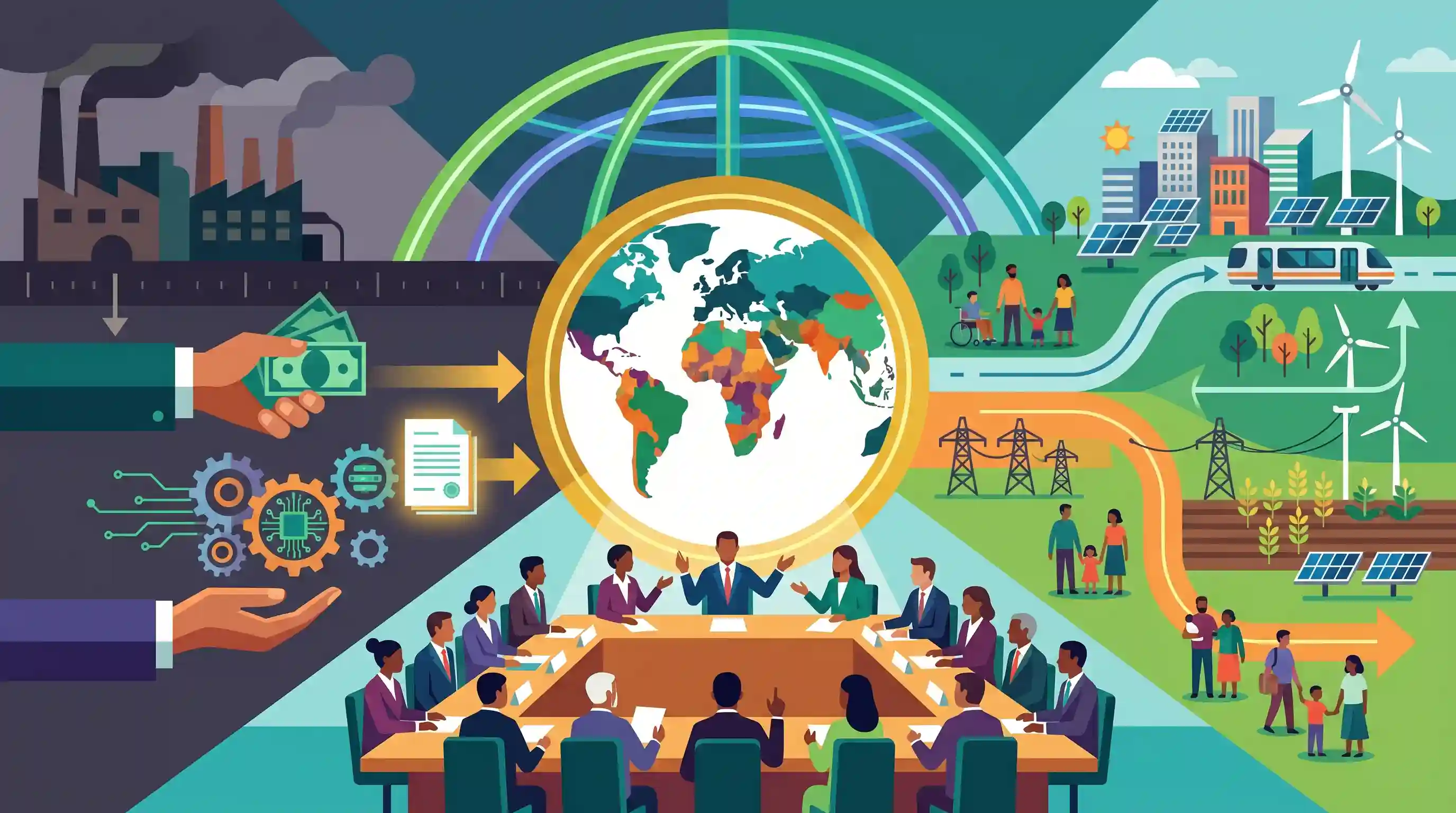
The article argues for prioritizing the perspectives and needs of the Global South in global energy and environmental policies. It underscores the ongoing challenges developing nations face in balancing rapid economic growth and poverty eradication with the transition to clean energy. A central theme is the call for climate justice, emphasizing that developed nations must honor their historical responsibilities by providing substantial climate finance and facilitating technology transfer. By placing the Global South at the center of climate negotiations, international frameworks can better reflect the principles of equity and Common But Differentiated Responsibilities (CBDR), ensuring a just transition for vulnerable populations.
Key Points
- The discourse highlights the critical need to place the Global South at the center of international energy and climate negotiations, ensuring equitable distribution of the global carbon budget.
- Developing nations emphasize the principle of Common But Differentiated Responsibilities (CBDR), advocating for historical accountability from industrialized nations.
- There is a pressing demand for predictable, adequate climate finance and technology transfer to facilitate the Global South's transition to renewable energy without compromising their developmental imperatives.
- The article calls for recalibrating global climate frameworks to address vulnerabilities specific to developing countries, including operationalizing loss and damage mechanisms and scaling adaptation funds.
Important Terms
UNFCCC

Adopted at the 1992 Rio Earth Summit, this foundational treaty aims to stabilize greenhouse gas concentrations. It provides the framework for global climate negotiations, including the Kyoto Protocol and Paris Agreement.
UPSC context
GS Paper III (Environment) & II (IR). Tests global environmental governance and India's role in international climate negotiations.
Kyoto Protocol
A 1997 UNFCCC extension that mandated legally binding emission reduction targets for industrialized nations. It operationalized the principle of historical responsibility, exempting developing nations from initial binding cuts.
UPSC context
GS Paper III (Environment). Understanding the evolution of binding climate commitments and the 'Polluter Pays' principle.
Paris Agreement
A 2015 legally binding treaty aimed at limiting global warming to well below 2°C, preferably 1.5°C. It uses self-determined, 'bottom-up' climate action plans called Nationally Determined Contributions (NDCs).
UPSC context
GS Paper III (Environment). Focus on India’s NDC commitments and global progress toward net-zero targets.
International Solar Alliance (ISA)
An India-France initiative launched in 2015 to promote solar energy. It aims to mobilize $1 trillion in investment by 2030, specifically supporting 'sunshine countries' in the Global South.
UPSC context
GS Paper II (IR) & III (Energy). Highlights India’s soft power and leadership in South-South renewable energy cooperation.
Common But Differentiated Responsibilities (CBDR)
A principle establishing that all states must address climate change, but developed nations bear a greater burden due to historical emissions and superior financial/technological capacities.
UPSC context
GS Paper III (Environment/Ethics). Central to debates on climate justice, equity, and the North-South divide in negotiations.
Climate Finance
Financial resources provided to developing nations for climate mitigation and adaptation. It is vital for a 'just transition' and reflects the historical responsibilities of developed nations.
UPSC context
GS Paper III (Environment/Economy). Tests knowledge of funding mechanisms like the Green Climate Fund and the $100 billion annual goal.
Prelims Trap
The Loss and Damage Fund is hosted and managed directly by the UNFCCC Secretariat.
The Loss and Damage Fund is not an independent UN entity; it was operationalized at COP28 with the World Bank acting as the interim host for four years.
Static Concepts Connected
What is the principle of CBDR under the UNFCCC framework?
- Core premise: All states share responsibility for environmental protection, but developed nations bear a heavier burden due to their disproportionate historical greenhouse gas emissions.
- Origin: It was formalized at the 1992 Rio Earth Summit as Principle 7 of the Rio Declaration.
- Paris adaptation: The Paris Agreement modified it to "CBDR with Respective Capabilities (CBDR-RC), in the light of different national circumstances."
What are the major global climate funds under the UNFCCC?
- Green Climate Fund: Established at COP16 (Cancun), it is the world’s largest dedicated climate fund, aiming to equally split funding between mitigation and adaptation.
- GEF: The Global Environment Facility operates as a financial mechanism not just for the UNFCCC, but also for biodiversity and desertification conventions.
- Adaptation Fund: Established under the Kyoto Protocol to finance concrete adaptation projects in vulnerable developing nations, primarily funded by a share of CDM proceeds.
Cross-Topic Patterns
Climate finance + Multilateral Bank reform
India's push for Global South climate justice links directly to the MDB reform agenda (like the NK Singh committee) aiming to unlock concessional climate finance without worsening debt distress.
Just Transition + Core energy dependency
The Global South's demand for 'developmental space' and equitable carbon budgets directly underpins India's stance on phasing down, rather than phasing out, coal at recent UN climate summits.

Expect a multi-statement question in 2026 linking the NCQG targets with the Loss & Damage Fund's World Bank hosting and CBDR principles.
Linked PYQs · 4
Linked PYQs · 4
- 2025MainsGS3
Write a review on India's climate commitments under the Paris Agreement (2015) and mention how these have been further strengthened in COP26 (2021). In this direction, how has the first Nationally Determined Contribution intended by India been updated in 2022?
- 2021MainsGS3
Describe the major outcomes of the 26th session of the Conference of the Parties (COP) to the United Nations Framework Convention on Climate Change (UNFCCC). What are the commitments made by India in this conference?
- 2018MainsGS3
“Access to affordable, reliable, sustainable and modern energy is the sine qua non to achieve Sustainable Development Goals (SDGs).” Comment on the progress made in India in this regard.
- 2020MainsGS3
Explain intra-generational and inter-generational issues of equity from the perspective of inclusive growth and sustainable development.
