US Small Enterprises Pushback Against Protectionist Tariff Policies
Source:Indian Express ↗
Why It Matters
Understanding the domestic pushback against protectionist policies in major economies like the US is crucial for UPSC aspirants. It illustrates the complexities of global supply chains and helps analyze how trade wars and tariff barriers impact both global economic stability and developing countries like India.
Summary
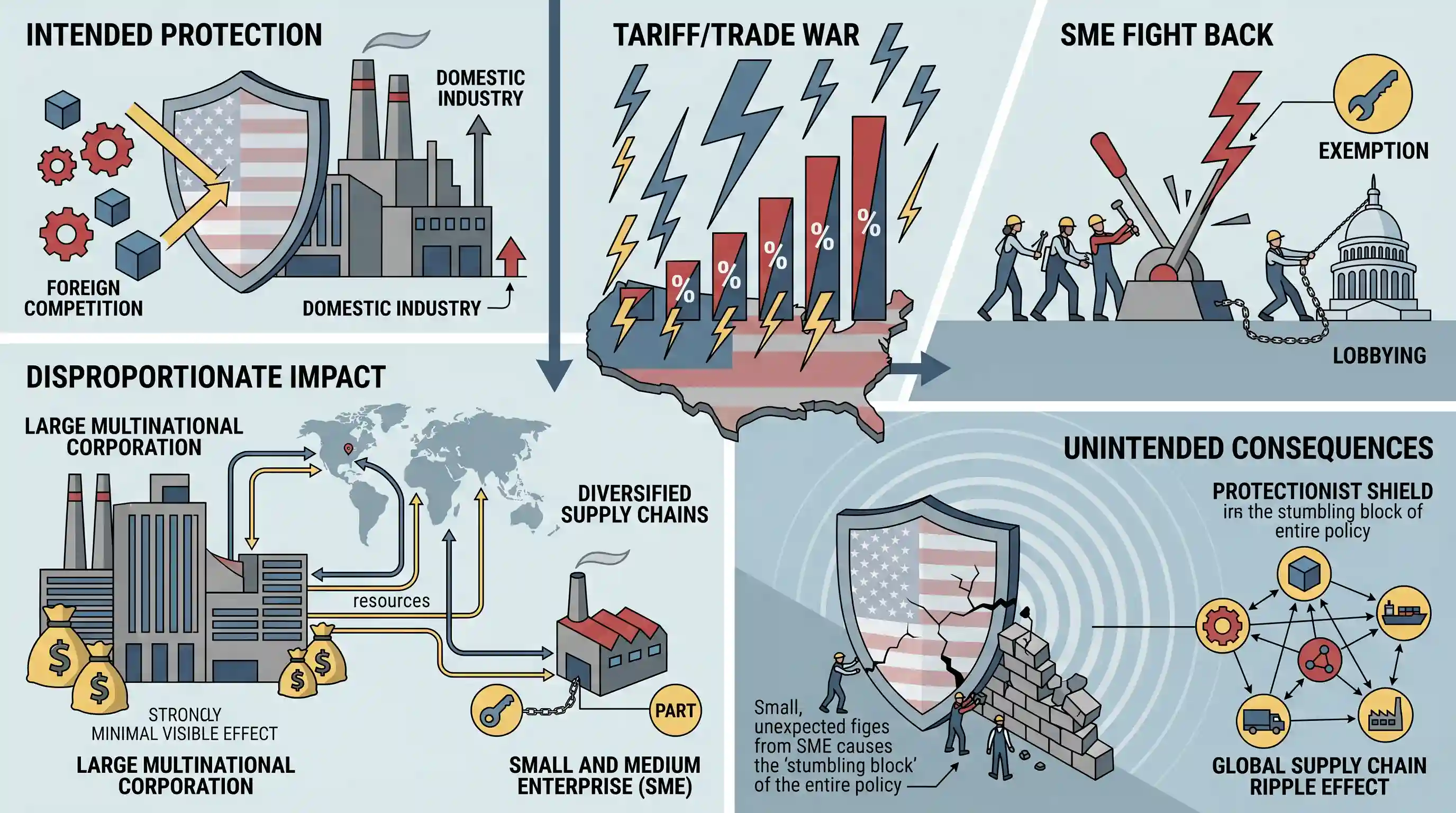
The article explores how small and medium-sized American enterprises (SMEs) have become an unexpected stumbling block in the aggressive tariff policies and trade wars championed by the Trump administration. While tariffs are often designed to shield domestic industries from foreign competition, they disproportionately hurt smaller U.S. businesses that depend on imported components and affordable goods to survive. Lacking the resources and diversified supply chains of larger multinational corporations, these SMEs have fought back by aggressively seeking tariff exemptions and lobbying against sweeping import duties. Their resistance underscores the complex realities of globalized supply chains and illustrates how unilateral protectionist measures often trigger unintended domestic economic consequences.
Key Points
- Sweeping tariff policies intended to protect domestic industries often inadvertently harm small and medium-sized enterprises (SMEs) that rely on imported raw materials and intermediate goods.
- Unlike large multinational corporations, small American firms lack the financial cushion and supply-chain flexibility to absorb or quickly bypass increased import duties.
- Resistance from SMEs—through lobbying and filing thousands of requests for tariff exemptions—creates significant administrative and political hurdles for broad protectionist agendas.
- The pushback highlights the deep interdependence of modern global supply chains and demonstrates how unilateral trade wars can cause unintended domestic economic friction.
Important Terms
Protectionism

Government policies that restrict international trade through tariffs, quotas, or subsidies to protect domestic industries from foreign competition. It aims to shield local businesses and workers.
UPSC context
GS Paper 2 & 3: International relations and economic development; tests understanding of trade barriers versus liberalization.
Global Value Chains (GVCs)
The international fragmentation of production where different stages of making a product are located in multiple countries, adding value at each step.
UPSC context
GS Paper 3: Indian economy; focuses on how global trade integration impacts domestic manufacturing and export competitiveness.
World Trade Organization (WTO)
An international organization regulating global trade by providing a framework for trade agreements and a mechanism for resolving disputes among its 164 member nations.
UPSC context
GS Paper 2: Important International institutions; tests knowledge of multilateralism and rules-based global trade governance.
Trade War
An economic conflict where countries retaliate against each other by imposing import duties or restrictions, often leading to disrupted supply chains and higher costs.
UPSC context
GS Paper 2: Effect of policies of developed countries; tests understanding of bilateral tensions like the US-China trade conflict.
Small and Medium-sized Enterprises (SMEs)
Businesses with limited employees and revenue that often lack the diversified supply chains or financial reserves of large corporations, making them vulnerable to trade shocks.
UPSC context
GS Paper 3: Indian Economy; relates to MSMEs, which are crucial for employment and manufacturing in India.
Tariff Exemptions
A formal process where businesses request relief from paying specific import duties, typically granted when no domestic alternative for a component exists.
UPSC context
GS Paper 3: Economic policy; tests knowledge of technical trade administrative processes and their business impacts.
Prelims Trap
Tariffs uniformly protect and benefit all domestic manufacturing industries by reducing foreign competition.
Tariffs on intermediate goods often harm domestic SMEs reliant on cheap imported inputs, raising their production costs and reducing overall global competitiveness.
Static Concepts Connected
What is the Most Favoured Nation (MFN) principle under the WTO?
- Non-discrimination: Member countries cannot normally discriminate between their trading partners. Granting a special favor to one requires doing the same for all.
- GATT Article 1: MFN is the first article of the General Agreement on Tariffs and Trade (GATT), forming the foundation of global trade.
- Permitted Exceptions: Exceptions exist for Free Trade Agreements (FTAs) and providing special market access to developing countries.
How do protective tariffs trigger domestic cost-push inflation?
- Cost-Push Effect: Higher import duties on raw materials and intermediate goods directly increase production costs for domestic manufacturers.
- Consumer Burden: Firms pass these increased input costs down to consumers, leading to higher retail prices across the domestic economy.
- Export Competitiveness: More expensive final goods reduce the global export competitiveness of the very industries the tariffs sought to protect.
Cross-Topic Patterns
Parallels with India's PLI & Tariffs
Similar to the US, India faces a dilemma where high import duties on electronic components (to shield domestic makers) hurt local assemblers reliant on those inputs, countering the PLI scheme's goals.
Protectionism vs. Global Value Chains
Modern trade wars disproportionately disrupt Global Value Chains (GVCs), impacting emerging economies like India and Vietnam that supply intermediate components to Western SMEs.

Expect a prelims statement interlinking unilateral tariff hikes, Global Value Chains (GVCs) disruption, and WTO's MFN exceptions.
Linked PYQs · 3
Linked PYQs · 3
- 2018MainsGS2
What are the key areas of reform if the WTO has to survive in the present context of "Trade War', especially keeping in mind the interest of India?
- 2012MainsGS2
Discuss the likely negative impact of the protectionist measures proposed by the US on India's software industry.
- 2016MainsGS2
The broader aims and objectives of WTO are to manage and promote international trade in the era of globalization. But the Doha round of negotiations seem doomed due to differences between the developed and the developing countries." Discuss in the Indian perspective.
