Child Labour and Malnutrition Crisis in Andhra Pradesh
Source:The Hindu ↗
Why It Matters
Child protection is a recurrent theme in UPSC GS2 (Social Justice) and GS1 (Society). Understanding the socio-economic drivers behind child labour, malnutrition, and child marriages—and the corresponding legal and institutional frameworks (like the Child Labour Act, NCPCR, and Constitutional provisions)—is critical for answering Mains questions on human capital and social welfare, as well as Prelims questions on constitutional rights and international conventions (e.g., ILO).
Summary
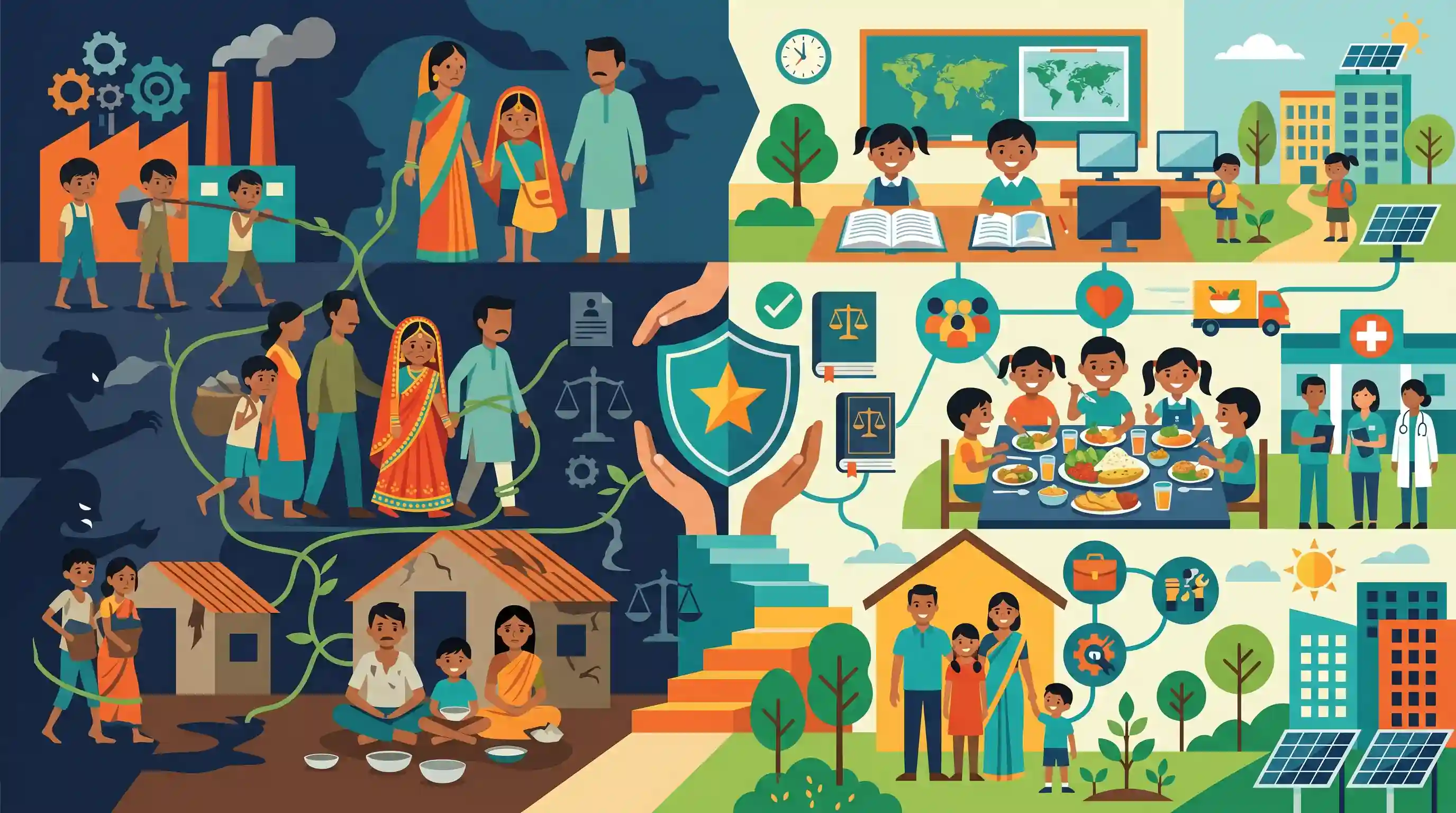
The article sheds light on the grave challenges threatening the well-being of children in Andhra Pradesh, often referred to as a 'silent scourge'. It points to deep-rooted issues such as child labour, early marriages, and inadequate nutrition that collectively strangle childhoods. Driven by socio-economic distress and poverty, these practices persist despite legal frameworks. The piece underscores the necessity for rigorous enforcement of child protection laws, robust poverty alleviation measures, and comprehensive community-level interventions to safeguard child rights and ensure a secure environment for their holistic development.
Key Points
- The article highlights the persistent 'silent scourge' of child exploitation, encompassing issues like child labour, child marriages, and trafficking in Andhra Pradesh.
- Socio-economic vulnerabilities, primarily poverty and lack of educational access, continue to drive families to push children into early employment or marriage, effectively strangling their childhood.
- There is an urgent need for stricter enforcement of child protection laws and enhanced coordination between state agencies and civil society.
- Tackling this crisis requires a multidimensional approach, including improving foundational nutrition, ensuring compulsory education, and raising grassroots awareness about child rights.
Important Terms
Article 24 of the Constitution

A fundamental right prohibiting the employment of children below 14 years in factories, mines, or any other hazardous occupations.
UPSC context
GS Paper 2 (Polity); tests understanding of Fundamental Rights and socio-economic safeguards for vulnerable populations.
National Commission for Protection of Child Rights (NCPCR)
A statutory body established under the CPCR Act, 2005, to monitor child rights implementation, investigate violations, and ensure laws align with the UN Convention.
UPSC context
GS Paper 2 (Statutory Bodies); crucial for questions on institutional mechanisms for protecting child rights.
Child and Adolescent Labour (Prohibition and Regulation) Act
Prohibits employment of children under 14 in all occupations (except family enterprises) and bans adolescents (14-18) from hazardous work, with increased penalties.
UPSC context
GS Paper 2 (Social Justice); relevant for evaluating legislative measures to eradicate child labor.
Prohibition of Child Marriage Act (PCMA)
Legislation setting the minimum marriage age at 18 for women and 21 for men, making child marriages voidable at the option of the minor.
UPSC context
GS Paper 2 (Social Justice); critical for analyzing women’s empowerment and social reform laws.
International Labour Organization (ILO)
The UN agency that sets global labor standards; India ratified its core conventions (No. 138 and 182) in 2017 to eliminate child labor.
UPSC context
GS Paper 2 (International Relations); tests knowledge of international treaties influencing India's social policies.
Prelims Trap
"The 2016 Amendment completely bans the employment of adolescents (14-18 years) in all forms of occupations and enterprises."
The 2016 Act bans children (<14) in all occupations, but adolescents (14-18) are only prohibited from hazardous work. It also allows children <14 to help in family enterprises.
Static Concepts Connected
What are the constitutional and legal protections against child labour in India?
- Article 24: Prohibits the employment of children below 14 years in factories, mines, or any other hazardous employment.
- 2016 Amendment Act: Bans employment of children <14 in all occupations (except non-hazardous family enterprises post-school) and prohibits adolescents (14-18) in hazardous work.
- Article 21A: Elevated the Right to Education for children aged 6 to 14 years to a fundamental right, indirectly curbing child labour.
Which ILO core conventions on child labour were ratified by India in 2017?
- Convention 138: Mandates that the minimum age for employment should not be less than the age of completion of compulsory schooling.
- Convention 182: Requires the strict prohibition and immediate action for the elimination of the worst forms of child labour (trafficking, forced labour).
Cross-Topic Patterns
Intergenerational Cycle of Malnutrition
Early marriages lead to teenage pregnancies, which heavily correlate with low birth weight, infant stunting, and maternal anemia—a nexus directly targeted by POSHAN Abhiyaan.
Demographic Dividend vs Human Capital
Rampant child labour disrupts foundational education, threatening to turn India’s youthful demographic dividend into an unskilled demographic burden due to poor human capital formation.

Expect a 2026 multi-statement question mapping exceptions in the Child Labour Act 2016 against ILO Conventions 138 and 182.
Linked PYQs · 3
Linked PYQs · 3
- 2018PrelimsGS1
International Labour Organization's Conventions 138 and 182 are related to
- 2017PrelimsGS1
Which of the following are envisaged by the Right against Exploitation in the Constitution of India? 1. Prohibition of traffic in human beings and forced labour 2. Abolition of untouchability 3. Protection of the interests of minorities 4. Prohibition of employment of children in factories and mines Select the correct answer using the code given below:
- 2024MainsGS2
Poverty and malnutrition create a vicious cycle, adversely affecting human capital formation. What steps can be taken to break the cycle ?
