Indonesia to Procure Indigenous Astra Missiles From India
Source:Indian Express ↗
Why It Matters
The article highlights India's strategic shift from one of the world's largest defense importers to a major defense exporter, particularly in the critical Indo-Pacific and ASEAN regions. Understanding the technical aspects of indigenous missile programs (like SFDR and BVRAAMs) and their geopolitical implications is vital for both Prelims (defense systems) and Mains (internal security, indigenization, and international relations).
Summary
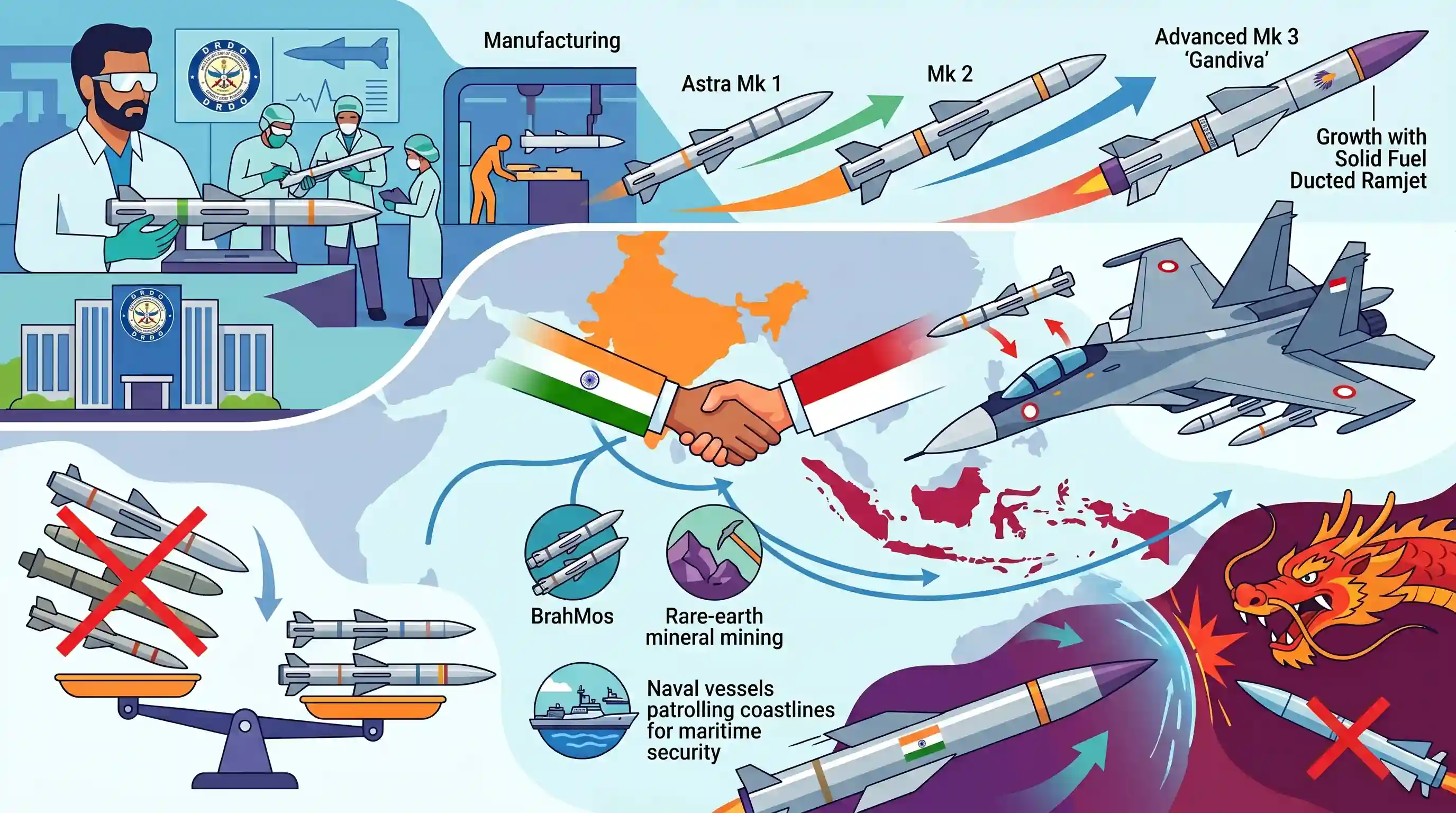
India has reached a major milestone in defense diplomacy and export capability by signing its first-ever export deal for the indigenous Astra Mk 1 beyond-visual-range air-to-air missile (BVRAAM) with Indonesia. Developed by the Defence Research and Development Organisation (DRDO), the Astra Mk 1 will arm Indonesia's Su-30 fighter fleet. The deal is accompanied by agreements on the sale of BrahMos missiles, critical minerals, and maritime security. The Astra family—including the under-development Astra Mk 2 (200 km range) and Astra Mk 3 'Gandiva' (featuring Solid Fuel Ducted Ramjet technology)—aims to achieve defense self-reliance ('Atmanirbharta') by reducing dependence on foreign missiles like Meteor and R-77. Strategically, these missiles act as a critical counterweight to China's PL-15 missile, elevating India's role as a key net security provider in the Indo-Pacific region.
Key Points
- First Astra Export Deal: India and Indonesia have signed a historic agreement for the supply of Astra Mk 1 beyond-visual-range air-to-air missiles (BVRAAMs) to arm Indonesia's Su-30 fighter fleet, marking the first-ever export of the Astra missile system.
- Astra Missile Profile: Developed by DRDO, Astra is a family of indigenous BVRAAMs (engaging targets beyond 37 km / 20 nautical miles) designed to destroy airborne targets.
- Astra Mk 1 Specifications: Offers a range of 80 to 110 km, altitude up to 20 km, and speed of Mach 4.5. It features inertial guidance, mid-course update, terminal active radar homing with an indigenous RF seeker, and is powered by a single-pulse smokeless solid-fuel motor.
- Advanced Astra Variants: Astra Mk 2 has an enhanced range of 200 km and utilizes a dual-pulse solid rocket motor to conserve energy and reignite in the terminal phase. Astra Mk 3 (named 'Gandiva') is under development, utilizing Solid Fuel Ducted Ramjet (SFDR) engine technology to provide continuous thrust and a range exceeding 350 km.
- Strategic Necessity: The Astra missile family provides India with a direct, indigenous counter to the Chinese/Pakistani long-range PL-15 active radar-guided missile. The criticality of such long-range BVRAAMs was demonstrated during India's 'Operation Sindoor' in 2025.
- Atmanirbharta in Defence: Local production and deployment of Astra help India transition away from relying on expensive foreign imports like the European Meteor or Russian R-77 BVRAAMs.
- Growing Indo-Pacific Defence Footprint: Alongside the Astra deal, India is exporting BrahMos supersonic cruise missiles to the Philippines, Vietnam, and Indonesia, highlighting India's rising status as a key security provider and defense exporter in Southeast Asia to balance China's influence.
Important Terms
Atmanirbharta Bharat

A national campaign launched by India to achieve self-reliance across critical sectors, particularly in defense, by promoting indigenous research, design, and manufacturing to reduce reliance on foreign imports.
UPSC context
GS Paper III (Security/Technology Indigenization); tests understanding of defense manufacturing policies and self-reliance initiatives.
Operation Sindoor
A coordinated 2025 Indian precision military campaign targeting Pakistan-backed terrorist infrastructure, demonstrating the pivotal role of stand-off weapons, advanced air defense, and long-range air-to-air systems.
UPSC context
GS Paper III (Security Challenges); evaluates state responses to cross-border terrorism, escalation dynamics, and modern non-contact warfare strategy.
Act East Policy
A strategic foreign policy initiative aimed at strengthening economic, strategic, and cultural relations with the Asia-Pacific region, promoting security cooperation and bilateral partnerships.
UPSC context
GS Paper II (Bilateral & Regional Groupings); tests knowledge of India's foreign policy and maritime strategic footprint in Southeast Asia.
Defence Acquisition Council (DAC)
The highest decision-making body within the Ministry of Defence, chaired by the Defence Minister, responsible for approving capital procurement and policies for the Indian armed forces.
UPSC context
GS Paper II & III (Security/Governance); tests understanding of defense procurement structures, operational preparedness, and indigenization processes.
Defence Research and Development Organisation (DRDO)
The premier agency under India's Ministry of Defence charged with the design and development of state-of-the-art military technology, systems, and hardware.
UPSC context
GS Paper III (Science & Technology/Indigenization); tests understanding of indigenous technology development and key national defense research bodies.
Indian Air Force (IAF)
The aerospace warfare branch of the Indian Armed Forces, primary operator of strategic air superiority fighters and the indigenous Astra air-to-air missile family.
UPSC context
GS Paper III (Security Challenges); tests awareness of modern air defense capability, aerial warfare strategies, and external security deterrence.
Prelims Trap
All variants of the indigenous Astra missile family utilize Solid Fuel Ducted Ramjet (SFDR) technology.
Only Astra Mk 3 uses SFDR. Mk 1 uses a single-pulse solid motor, and Mk 2 uses a dual-pulse solid motor. UPSC often generalises propulsion tech across an entire missile family.
Static Concepts Connected
What is Solid Fuel Ducted Ramjet (SFDR) technology?
- Air-breathing propulsion: SFDR is an air-breathing engine that takes oxygen from the atmosphere during flight, eliminating the need for a heavy onboard oxidizer.
- Sustained thrust: Unlike conventional rocket motors that burn out quickly, SFDR provides sustained thrust and high speed throughout the terminal engagement phase.
- Hybrid design: It uses a nozzle-less solid booster for initial acceleration, followed by solid-fuel ramjet operation for cruise.
How does a Beyond-Visual-Range Air-to-Air Missile (BVRAAM) guide itself?
- Inertial guidance: Immediately after launch, the missile relies on an internal computer to calculate its trajectory relative to the target.
- Mid-course data link: The launching fighter jet transmits real-time coordinates to correct the missile's flight path mid-way.
- Terminal active homing: In the final phase, the missile activates its own onboard active radar homing seeker to track and lock onto the target autonomously.
Cross-Topic Patterns
Defence diplomacy + Act East policy
Exporting advanced offensive systems like BrahMos and Astra to ASEAN nations transforms India's 'Act East' from cultural-economic ties into a hard security partnership.
Atmanirbharta + Balance of payments
The shift from importing Meteor/R-77 to exporting Astra demonstrates how indigenization directly reduces fiscal current account strain while building domestic aerospace manufacturing ecosystems.

Astra's solid/SFDR propulsion and its strategic export to ASEAN states are highly likely to feature in 2026 Prelims tech-and-diplomacy questions.
Linked PYQs · 3
Linked PYQs · 3
- 2023PrelimsGS1
Consider the following statements: 1. Ballistic missiles are jet-propelled at subsonic speeds throughout their flights, while cruise missiles are rocket-powered only in the initial phase of flight. 2. Agni-V is a medium-range supersonic cruise missile, while BrahMos is a solid-fuelled intercontinental ballistic missile. Which of the statements given above is/are correct?
- 2014MainsGS2
With respect to the South China sea, maritime territorial disputes and rising tension affirm the need for safeguarding maritime security to ensure freedom of navigation and over flight throughout the region. In this context, discuss the bilateral issues between India and China.
- 2026PrelimsGS1
Which of the following items of defence hardware is/are manufactured in India ? 1. Su-30 MKI Fighter Jets 2. T-90 MK-III Tanks 3. Akula Class Submarine Select the answer using the code given below :
