Siang Dam Project Strategic Ambitions and Ecological Concerns
Source:The Hindu ↗
Why It Matters
It addresses critical themes of transboundary water geopolitics, infrastructure development in border regions, and the friction between national security imperatives and ecological sustainability in the Northeast.
Summary
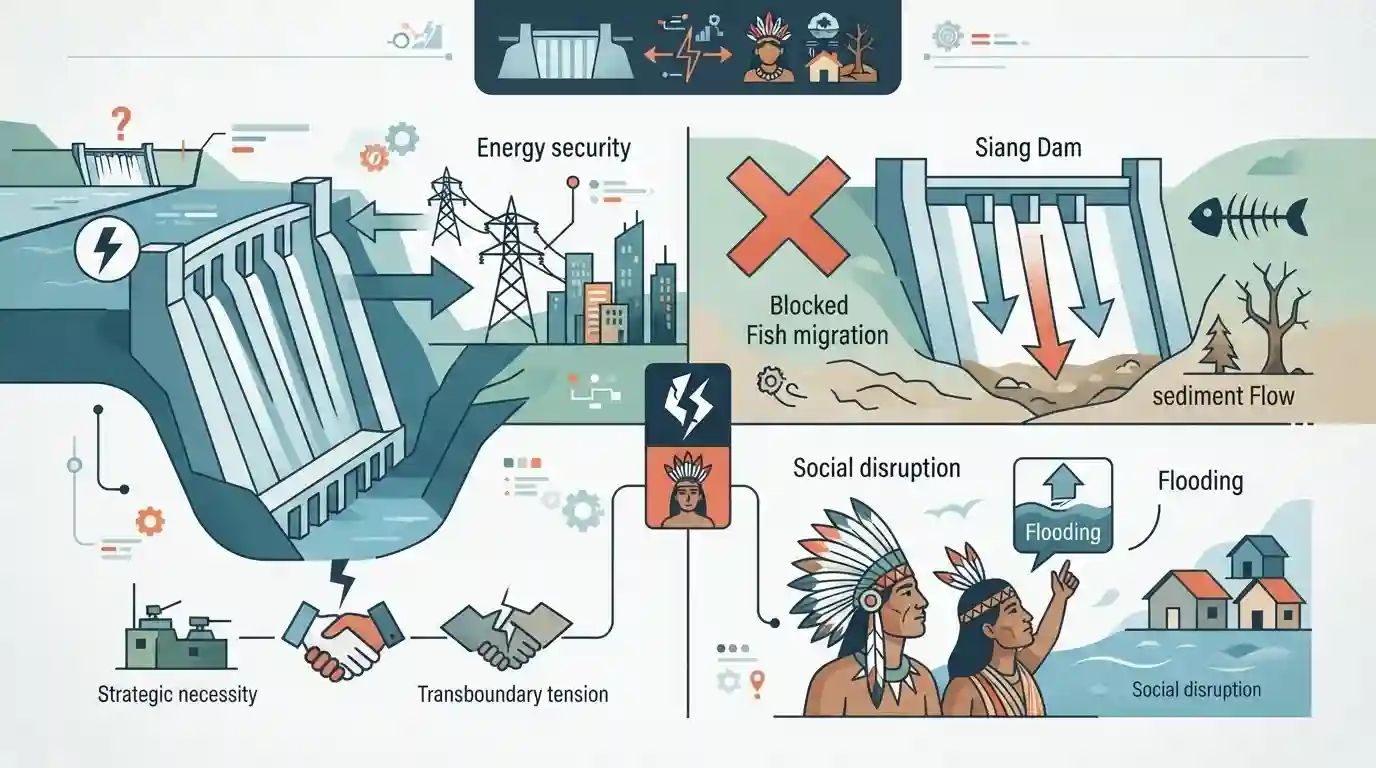
An analytical examination of the proposed Siang Dam project in Arunachal Pradesh, balancing its geopolitical and strategic necessity against China's upstream dam construction with its profound ecological, seismic, and social impacts on indigenous communities.
Key Points
- The proposed Siang Upper Multipurpose Project in Arunachal Pradesh is a massive mega-dam initiative intended to counter China's upstream hydro-hegemony and dam-building activity on the Yarlung Tsangpo in Tibet.
- While viewed as a strategic counter-measure and water-security asset for India, the dam poses severe ecological hazards, including threats to biodiversity, river morphology, and seismic stability in the fragile Eastern Himalayas.
- Large-scale displacement of indigenous Adi communities and disruption of traditional land and river-based livelihoods are major socioeconomic concerns.
- The article highlights the tension between national security imperatives in transboundary river basins and local environmental justice, urging balanced regional assessments and transparent public consultations.
Important Terms
Medog Dam Project

A massive, multi-gigawatt hydropower cascade project initiated by China on the lower reaches of the Yarlung Tsangpo River in Tibet, raising downstream water security and ecological concerns for India's Brahmaputra basin.
UPSC context
Important for GS Paper II (International Relations - Bilateral ties with China and transboundary water diplomacy) and GS Paper III (Infrastructure and Security).
China Huaneng Group
A premier state-owned enterprise in China responsible for major power generation and infrastructure undertakings, including large-scale controversial hydropower projects in river basins bordering South Asia.
UPSC context
Relevant for GS Paper II (International Relations/Geopolitics) and GS Paper III (Energy Security and Transboundary Infrastructure).
National Hydroelectric Power Corporation (NHPC)
A premier Indian public sector undertaking under the Ministry of Power tasked with planning, developing, and executing major hydroelectric projects, including the controversial Siang Upper Multipurpose Project in Arunachal Pradesh.
UPSC context
Crucial for GS Paper III (Energy, Infrastructure Development, Environmental Impact Assessment, and Disaster Management).
Static Concepts Connected
What are the key mechanisms and principles governing transboundary river waters in international law?
- Indo-China Treaty Gap: No formal bilateral water-sharing treaty exists between India and China for the Brahmaputra (Yarlung Tsangpo), only hydrological data-sharing Memoranda of Understanding (MoUs).
- UN Convention: The UN Watercourses Convention emphasizes equitable and reasonable utilization and the obligation not to cause significant harm to other riparian states.
- Riparian Dynamics: Riparian rights distinguish between upper riparians (who control geographical sourcing) and lower riparians (who depend on historical volumetric flows for sustenance).
What are the major ecological and seismic vulnerabilities of dam construction in the Eastern Himalayas?
- Seismic Fragility: The Eastern Himalayas represent a young, highly active tectonic zone prone to severe earthquakes and massive landslide damming risks.
- Induced Seismicity: Large reservoirs in geologically unstable terrain can induce reservoir-triggered seismicity (RTS) due to immense water weight shifting on fault lines.
- Ecological Impact: Mega-dams fragment river connectivity, block migratory fish species, alter downstream nutrient transport (silt starvation), and submerge dense endemic biodiversity hotspots.
Cross-Topic Patterns
Transboundary Hydro-Infrastructure vs. Tribal Rights
Mega-dams in fragile border areas test the balance between sovereign defense infrastructure and Scheduled Tribe land rights under the Fifth/Sixth Schedules.
Hydro-Hegemony and Water Security in Asia
Upstream mega-dams by rival powers turn hydrology into a strategic weapon, forcing lower riparian states to balance deterrence with ecological survival.

Transboundary rivers + Eastern Himalayan seismic zone + upstream Chinese dams will likely feature in a multi-statement Prelims/Mains question.
Linked PYQs · 2
Linked PYQs · 2
- 2017MainsGS3
Not many years ago, river linking was a concept but it is becoming a reality in the country. Discuss the advantages of river linking and its possible impact on the environment.
- 2022MainsGS2
‘Clean energy is the order of the day.’ Describe briefly India's changing policy towards climate change in various international fora in the context of geopolitics.
