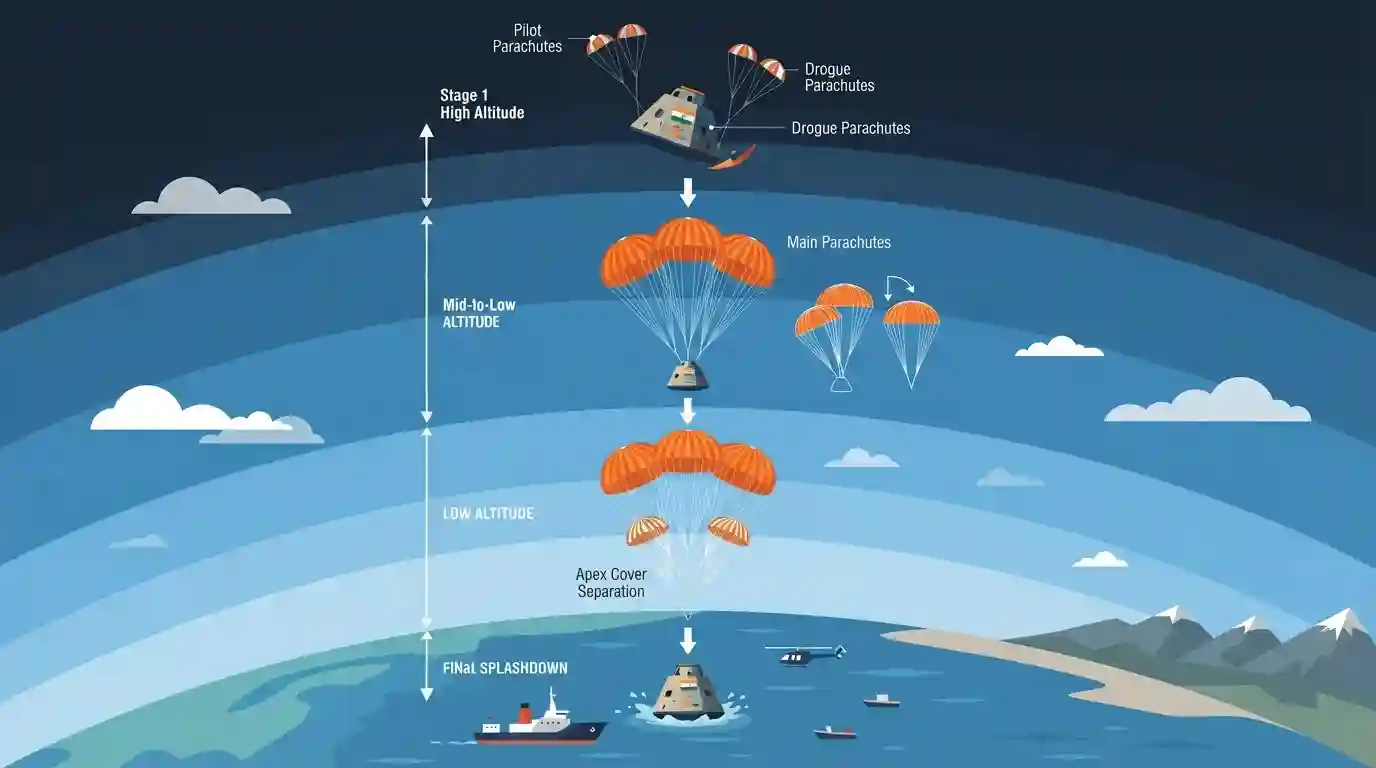
Gaganyaan Crew Module Parachute Deceleration Engineering
Source:The Hindu ↗
ఇది ఎందుకు ముఖ్యం
As India advances toward its maiden human spaceflight mission (Gaganyaan) and future space stations, understanding critical safety subsystems like parachute deceleration systems is vital for GS3 Science and Technology syllabus.
సారాంశం
An explanation of the parachute system engineering behind India's Gaganyaan human spaceflight mission, highlighting the multi-stage deceleration process necessary for safely landing the crew module.
ముఖ్య అంశాలు
- The Gaganyaan mission relies on a complex sequence of parachutes to safely decelerate and land the crew module.
- Parachute technology for human spaceflight requires high reliability, multi-stage deployment (apex cover separation, extraction, drogue, and main parachutes), and rigorous testing under extreme aerodynamic loads.
- It showcases India's indigenous capabilities in crucial life-support and crew-safety mechanisms required for manned space missions.
ముఖ్యమైన పదాలు
Gaganyaan

India's first human spaceflight program aiming to demonstrate human spaceflight capability by launching a crew into low Earth orbit and bringing them back safely to Earth.
UPSC context
GS Paper III (Science & Technology - Space). Tests awareness of India's indigenous human spaceflight missions and achievements.
ISRO
The apex national space agency of India, responsible for planning and executing space exploration, satellite deployment, and advanced cosmic research programs.
UPSC context
GS Paper III (Science & Technology - Space). Essential for questions on institutional frameworks and achievements in Indian space science.
Vikram Sarabhai Space Centre (VSSC)
A major research and development center under ISRO located in Thiruvananthapuram, specializing in rocket vehicles and launch vehicle technology for satellite and space missions.
UPSC context
GS Paper III (Science & Technology). Highlights premier Indian research institutions contributing to launch vehicle and crew safety systems.
ప్రిలిమ్స్ ఉచ్చు
Gaganyaan mission relies on a single main parachute for crew module landing.
The Gaganyaan crew module utilizes a redundant system featuring three main parachutes (where any two are sufficient), not a single main parachute.
అనుసంధానమైన స్థిర భావనలు
Which Indian research and development establishments collaborate with ISRO on crew module recovery systems?
- Apex Body: ISRO is the primary agency under the Department of Space responsible for national space program management.
- ADRDE Role: ADRDE (Agra) under DRDO specializes in aerial delivery systems, parachutes, and heavy-drop platforms used by both defense and space sectors.
- TBRL Contribution: TBRL (Chandigarh) conducts terminal ballistics and shock testing critical for parachute deployment validation under extreme loads.
అంతర-అంశ నమూనాలు
ISRO-DRDO synergy in human spaceflight
ISRO's crew module recovery relies on ADRDE (DRDO) and TBRL, illustrating vital civil-military synergy in high-stakes aerospace technology.
Atmanirbhar Bharat in strategic space tech
Indigenous development of critical life-support and deceleration systems mirrors Atmanirbhar Bharat goals in high-end strategic manufacturing.

Expect statements on multi-stage parachute redundancy and inter-agency roles (ISRO + DRDO/ADRDE) in human spaceflight tech.
అనుసంధాన PYQలు · 3
అనుసంధాన PYQలు · 3
- 2019MainsGS3
What is India's plan to have its own space station and how will it benefit our space programme?
- 2017MainsGS3
India has achieved remarkable successes in unmanned space missions including the Chandrayaan and Mars Orbitter Mission, but has not ventured into manned space missions. What are the main obstacles to launching a manned space mission, both in terms of technology and logistics? Examine critically.
- 2023MainsGS3
What is the main task of India's third moon mission which could not be achieved in its earlier mission? List the countries that have achieved this task. Introduce the subsystems in the spacecraft launched and explain the role of the Virtual Launch Control Centre' at the Vikram Sarabhai Space Centre which contributed to the successful launch from Sriharikota.
