Gaganyaan Mission Parachute System Engineering and Design
Source:The Hindu ↗
কেন এটি গুরুত্বপূর্ণ
Understanding the parachute technology for Gaganyaan is crucial for evaluating India's preparedness, indigenous technological self-reliance, and safety engineering in executing complex human spaceflight missions.
সারসংক্ষেপ
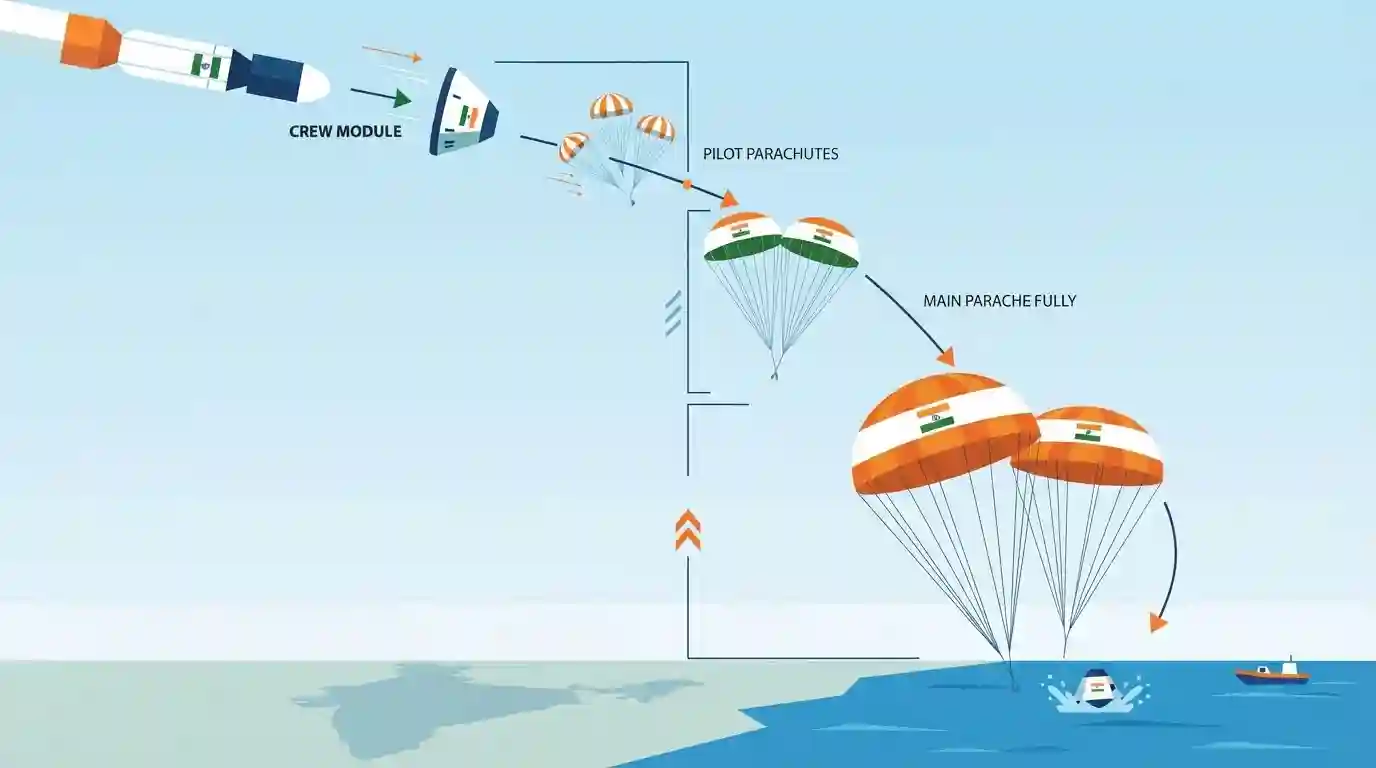
The article breaks down the complex science, engineering, and sequential deployment of the parachute system designed for ISRO's Gaganyaan human spaceflight mission. It details how the crew module relies on various stages of parachutes—including pilot, drogue, and main parachutes—to safely slow down from supersonic speeds and ensure a soft landing, representing a vital indigenous capability for India's space program.
মূল বিষয়
- The Gaganyaan mission relies on a complex, multi-stage parachute system developed to safely decelerate and land the crew module.
- Parachute systems for human spaceflight require extreme reliability, redundancy, and rigorous testing under supersonic and subsonic conditions.
- Deceleration systems involve pilot chutes, apex cover separation chutes, drogue parachutes, and main parachutes deployed in a precise sequence.
- This technology marks a critical milestone for India's indigenous human spaceflight capabilities, highlighting advancements in aerospace engineering and materials science.
গুরুত্বপূর্ণ শব্দ
Gaganyaan Mission

India's flagship human spaceflight mission aiming to demonstrate human spaceflight capability by launching a crew into low Earth orbit and returning them safely.
UPSC context
GS Paper III (Science & Technology - Space). Tests understanding of India's space missions, technological milestones, and human spaceflight programs.
ISRO
The national space agency of India responsible for planning, executing, and managing major space exploration programs, satellite launches, and indigenous space research.
UPSC context
GS Paper III (Science & Technology - Space). Essential for questions related to institutional achievements, space policy, and technological self-reliance.
Vikram Sarabhai Space Centre (VSSC)
A lead research and development center of ISRO located in Thiruvananthapuram, specializing in launch vehicle technology and critical recovery systems like Gaganyaan parachutes.
UPSC context
GS Paper III (Science & Technology - Space). Highlights India's premier scientific institutions and their role in domestic space research and development.
সংযুক্ত স্থির ধারণা
What are the key functional stages and redundancy features of spacecraft parachute recovery systems?
- Pilot Chutes:: Pilot chutes pull out larger drogue or main parachutes to initiate the sequential deceleration process reliably.
- Drogue Chutes:: Drogue parachutes deploy at supersonic/high-speed conditions to stabilize the descending module and shed extreme aerodynamic loads.
- Main Chutes:: Main parachutes provide the final terminal velocity reduction for a safe, survivable soft landing.
- Redundancy Design:: High redundancy ensures that the failure of individual parachutes (e.g., using 3 main chutes where 2 suffice) does not compromise crew safety.
আন্তঃবিষয় প্যাটার্ন
Space tech + Defense R&D convergence
The Gaganyaan deceleration system brings together ISRO's space design and DRDO's ADRDE aerial delivery tech, showcasing vital inter-agency synergy for critical national defense and space tech.
Indigenous testing infrastructure + Atmanirbhar Bharat
Heavy dependence on indigenous testing facilities like RTRS highlights how domestic infrastructure supports self-reliance in high-end aerospace engineering.

Expect a statement-based Q on Gaganyaan's multi-stage parachute redundancy and sequential deployment stages (pilot, drogue, main).
সংযুক্ত PYQ · 3
সংযুক্ত PYQ · 3
- 2016MainsGS3
Discuss India's achievements in the field of Space Science and Technology. How the application of this technology has helped India in its socio-economic development?
- 2017MainsGS3
India has achieved remarkable successes in unmanned space missions including the Chandrayaan and Mars Orbitter Mission, but has not ventured into manned space missions. What are the main obstacles to launching a manned space mission, both in terms of technology and logistics? Examine critically.
- 2025PrelimsGS1
Consider the following space missions : I. Axiom-4 II. SpaDeX III. Gaganyaan How many of the space missions given above encourage and support micro-gravity research?
