Scientific Consensus Questions Effectiveness of Social Media Bans
Source:The Hindu ↗
हे का महत्त्वाचे आहे
As India implements the Digital Personal Data Protection (DPDP) Act, 2023, and debates child safety online, understanding the regulatory, ethical, and psychological shortcomings of blunt bans vs. nuanced 'safety by design' regulations is crucial for public policy, digital rights, and governance questions in UPSC GS Paper 2 and 3.
सारांश
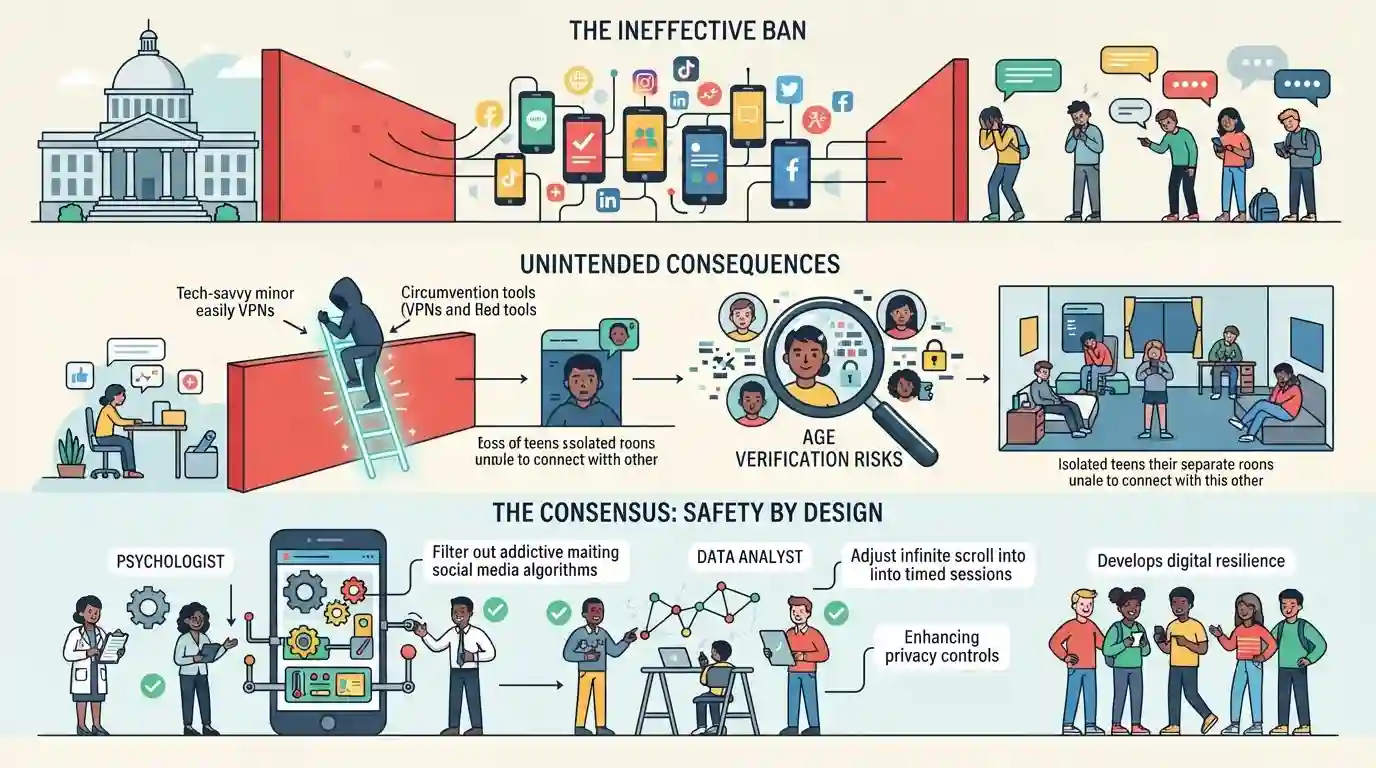
The article examines the rising trend of governments imposing age-based social media bans to protect adolescent mental health and explains why scientific evidence suggests these bans are ineffective. Psychologists and tech experts argue that blanket bans fail to address the root causes of mental health issues, restrict access to vital peer support groups for marginalized youth, and prevent the development of digital resilience. Furthermore, the technological mechanisms required for age verification present severe privacy risks, and tech-savvy minors easily bypass these restrictions. Instead of outright bans, the scientific consensus supports 'Safety by Design' regulations, holding tech conglomerates accountable to reform addictive algorithms and enhance safety features for minor users.
मुख्य मुद्दे
- Global governments, including Australia and various US states, are enacting or proposing blanket bans on social media for minors, citing mental health concerns.
- Psychological consensus, including views from the American Psychological Association (APA), suggests that social media is not inherently toxic but depends on design, usage, and individual vulnerabilities.
- Blanket bans fail due to simple technological bypasses (such as VPNs and alternative platforms), which may inadvertently drive children to unregulated and more dangerous parts of the internet.
- Enforcing age verification poses serious privacy, data sovereignty, and security risks, as it typically requires biometric data or official ID uploads.
- Outright bans prevent adolescents from learning crucial digital literacy, critical thinking, and online self-regulation under parental supervision.
- Experts advocate for 'Safety by Design' regulations, forcing platforms to disable addictive algorithmic features (like infinite scroll or push notifications) and toxic targeted advertising for minors rather than placing the burden on users.
महत्त्वाच्या संज्ञा
Digital Personal Data Protection (DPDP) Act, 2023

India's premier data privacy legislation that defines individuals under 18 as children, requiring verifiable parental consent and prohibiting the tracking or behavioral monitoring of minors.
UPSC context
GS Paper 2 (Polity) & GS Paper 3 (Cyber Security); tests data privacy frameworks and child data protection.
Online Safety Act
A landmark UK legislation (2023) enforcing a statutory duty of care on tech companies to protect children from harmful content online, mandating robust age verification.
UPSC context
GS Paper 2 (Polity/Governance); tests international legislative approaches to cyber safety and intermediary liability.
Kids Online Safety Act (KOSA)
A bipartisan US legislative proposal imposing a "duty of care" on online platforms to protect minors from harmful algorithms, cyberbullying, sexual exploitation, and addictive design features.
UPSC context
GS Paper 2 (Social Sector/Governance); tests international comparisons in social media regulation and child health.
National Commission for Protection of Child Rights (NCPCR)
India's apex statutory body under the CPCR Act, 2005, tasked with safeguarding child rights and currently drafting a child-safety code of conduct for social media.
UPSC context
GS Paper 2 (Statutory Bodies); tests the role of domestic institutions in regulating child safety in digital spaces.
American Psychological Association (APA)
The prominent scientific and professional organization of psychologists in the US, known for issuing evidence-based advisories on social media usage to protect adolescent mental health.
UPSC context
GS Paper 2 (Social Sector - Health); tests the use of scientific consensus in evaluating international developmental policies.
World Health Organization (WHO)
The specialized United Nations agency for public health, which issues global screen time guidelines and researches the rise of problematic digital and social media addiction.
UPSC context
GS Paper 2 (International Agencies); tests global health standards and international frameworks addressing adolescent well-being.
पूर्वपरीक्षा सापळा
The Digital Personal Data Protection (DPDP) Act, 2023 sets the age of digital consent at 16 years, aligning with European GDPR standards.
Under Section 2(f) of the DPDP Act 2023, India defines a 'child' as an individual who has not completed 18 years of age, unlike jurisdictions like the US (13) or EU (16).
संबंधित स्थिर संकल्पना
What is 'Safety by Design' in digital platform regulation?
- Core Principle: Designing digital products with user safety embedded as a fundamental, non-negotiable architectural requirement from inception rather than a retrofitted policy.
- Onus Shift: Legally shifts the burden of user safety (especially for minors) onto technology conglomerates and developers rather than placing it on parents or children.
- Key Implementations: Disabling high-dopamine features like infinite scroll, autoplay, and behavioral targeted advertising by default for minor accounts.
आंतर-विषय नमुने
Privacy vs. Child Protection
Stringent age-verification mandates clash with the core data minimization tenets of India's DPDP Act 2023 by forcing invasive ID or biometric data collection.
Public Health & Tech Oligopoly
Shifting the narrative of teenage mental health away from individual willpower toward structural corporate accountability and ethical algorithmic design.

Analysis of digital paternalism vs. 'Safety by Design' under India's DPDP Act likely to feature in GS Paper 2/3 regulation questions.
संबंधित PYQ · 2
संबंधित PYQ · 2
- 2025MainsGS2
The National Commission for Protection of Child Rights has to address the challenges faced by children in the digital era. Examine the existing policies and suggest measures the Commission can initiate to tackle the issue.
- 2024MainsGS3
Social media and encrypting messaging services pose a serious security challenge. What measures have been adopted at various levels to address the security implications of social media? Also suggest any other remedies to address the problem.
