Sachar Committee Report Implementation and Minority Development
Source:The Hindu ↗
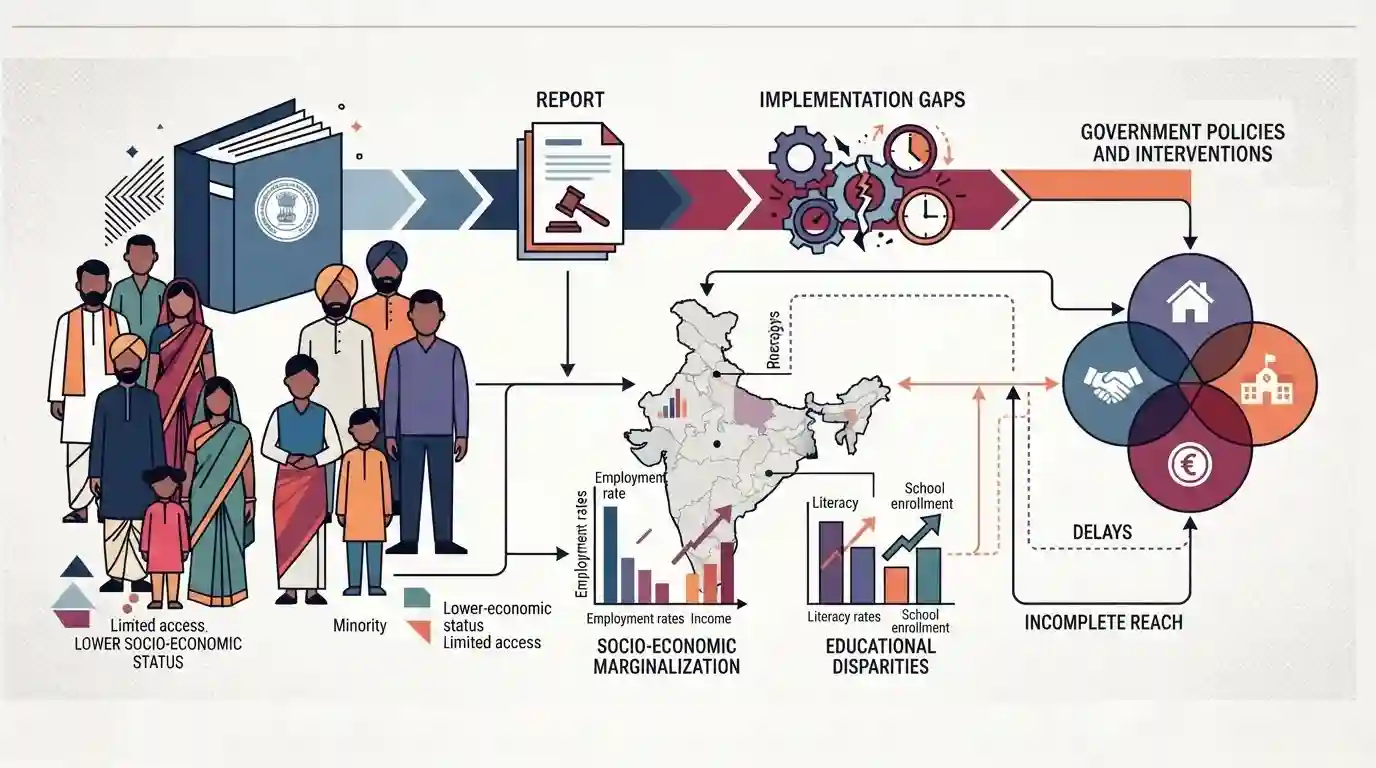
Why It Matters
Crucial for understanding the structural marginalization of minorities in India, the effectiveness of committee recommendations, and policy gaps in achieving inclusive social justice.
Summary
An analysis of the enduring relevance and delayed implementation of the Sachar Committee report, evaluating the socio-economic and educational marginalization of minorities in India and the gaps in policy action.
Key Points
- The Sachar Committee report, commissioned to examine the social, economic, and educational status of the Muslim community in India, highlighted deep-seated marginalization.
- Despite exhaustive documentation of deprivations in employment, education, and credit access, the policy response and implementation of its recommendations remain inadequate.
- The article argues that mainstream development policies have often overlooked specific structural barriers faced by minorities, necessitating renewed focus on affirmative action and data-driven equity.
- Institutional mechanisms like the Equal Opportunity Commission and Diversity Index recommended by expert bodies have not seen substantial realization.
Important Terms
Sachar Committee Report

A landmark 2006 government report detailing the stark socio-economic, educational, and employment backwardness of India's Muslim community, prompting policy interventions for minority welfare.
UPSC context
GS Paper II (Social Justice, Vulnerable Sections). Essential for understanding minority deprivation indices, equity policies, and developmental planning.
Equal Opportunity Commission
A proposed statutory body recommended by the Sachar Committee to investigate, monitor, and redress grievances regarding systemic discrimination in employment, education, and housing across vulnerable groups.
UPSC context
GS Paper II (Statutory/Regulatory Bodies, Social Justice). Evaluates institutional frameworks for non-discrimination and equality in governance.
Ranganath Misra Commission
A 2004 commission under Justice Ranganath Misra that examined criteria for backwardness within religious and linguistic minorities, recommending affirmative action and reservations.
UPSC context
GS Paper II (Social Justice, Constitutional and Legal Frameworks). Tests the debate over minority-based reservations and inclusive growth.
Static Concepts Connected
What are the constitutional provisions and statutory bodies safeguarding minorities in India?
- Constitutional Basis: Constitutional Safeguards: Articles 29 and 30 protect cultural, educational, and institutional rights of minorities; Article 350A mandates mother tongue instruction at the primary stage.
- NCM Act 1992: Statutory Bodies: National Commission for Minorities (NCM) Act, 1992 established the NCM to monitor the working of constitutional safeguards.
- Expert Panels: Expert Panels: Sachar Committee (2005) and Ranganath Misra Commission (2007) examined social status and linguistic/religious minority reservations respectively.
Cross-Topic Patterns
Minority Welfare + Federal Fiscal Devolution
The debate over minority socio-economic indices intersects with federal allocation of development funds (like MsDP) and Constitutional protections under Articles 15, 16, and 30.
Financial Inclusion + Priority Sector Lending
Sachar Committee findings on credit access gaps connect directly to priority sector lending (PSL) frameworks for minority-concentrated districts governed by RBI guidelines.

Sachar Committee's institutional recommendations (EOC, Diversity Index) vs Constitutional validity of religious quotas likely in Mains Qs.
Linked PYQs · 3
Linked PYQs · 3
- 2024MainsGS1
Despite comprehensive policies for equity and social justice, underprivileged sections are not yet getting the full benefits of affirmative action envisaged by the Constitution. Comment.
- 2024MainsGS1
Critically analyse the proposition that there is a high correlation between India's cultural diversities and socio-economic marginalities.
- 2023MainsGS2
The crucial aspect of development process has been the inadequate attention paid to Human Resource Development in India. Suggest measures that can address this inadequacy.
