Lucknow Urban Building Bye-Laws and Municipal Accountability
Source:The Hindu ↗
Why It Matters
This article ties a localized municipal tragedy to fundamental constitutional and statutory frameworks of urban governance (74th Amendment Act), national structural standards (NBC by BIS), and the Disaster Management Act, which are frequent areas of testing in the UPPSC PCS Prelims.
Summary
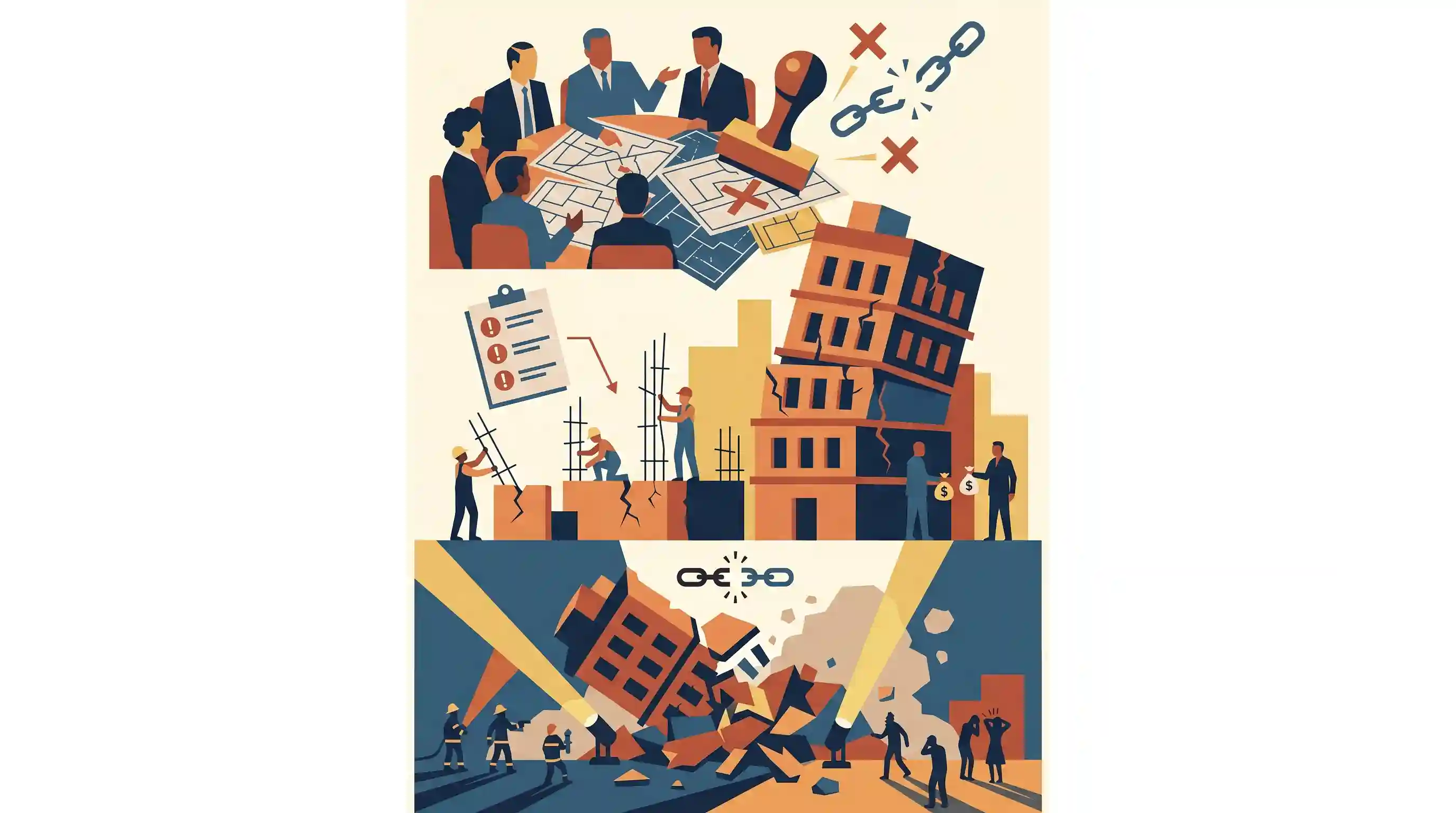
An analysis of systemic regulatory and administrative failures in Lucknow, Uttar Pradesh, focusing on structural safety, municipal bye-law compliance, and urban planning enforcement deficits that lead to catastrophic infrastructure collapses and loss of human life.
Key Points
- The article highlights the regulatory and planning loopholes in Lucknow, where structural collapses and lack of compliance with building bye-laws have resulted in tragic loss of life.
- Urban planning and building construction approvals in Lucknow are governed by the Lucknow Development Authority (LDA) under the statutory framework of the Uttar Pradesh Urban Planning and Development Act, 1973.
- The 74th Constitutional Amendment Act, 1992, provides constitutional status to urban local bodies (municipalities) and lists urban planning, land-use, and building construction regulation as functional items under the Twelfth Schedule.
- The National Building Code of India (NBC) is a comprehensive model code formulated by the Bureau of Indian Standards (BIS) to guide states in creating structural safety, loading limits, and fire hazard rules.
- Man-made structural disasters and subsequent safety interventions are coordinated under the Disaster Management Act, 2005, which establishes disaster management authorities at national (chaired by the Prime Minister), state (chaired by the Chief Minister), and district levels.
Important Terms
74th Constitutional Amendment Act, 1992

A landmark Indian amendment that granted constitutional status to Urban Local Bodies (municipalities), establishing them as a self-governing third tier of local governance.
UPSC context
GS Paper II: Polity and Governance. Tests understanding of democratic decentralisation, urban local governance, and municipal devolution.
National Building Code of India
A comprehensive advisory instrument published by the Bureau of Indian Standards outlining safety guidelines, structural designs, and fire protection requirements for building construction nationwide.
UPSC context
GS Paper III: Disaster Management. Tests knowledge of structural safety, building regulations, and municipal compliance deficits.
Disaster Management Act, 2005
A federal law providing the legal and institutional framework for managing disasters, establishing specialized authorities, and coordinating mitigation, preparedness, and response across India.
UPSC context
GS Paper III: Disaster Management. Tests legislative provisions, institutional roles, and crisis governance frameworks.
Uttar Pradesh Urban Planning and Development Act, 1973
A state law that enables the establishment of statutory development authorities in Uttar Pradesh to plan, coordinate, and regulate rapid urban expansion and land use.
UPSC context
GS Paper I & II: Urbanization and Governance. Tests state legislative mechanisms for municipal planning and zonal development.
Lucknow Development Authority
The statutory urban planning agency responsible for formulating master plans, enforcing building bye-laws, and regulating structural safety and development in Lucknow, Uttar Pradesh.
UPSC context
GS Paper II: Local Administration. Tests regulatory accountability, administrative lapses, and planning implementation challenges.
Bureau of Indian Standards
The national standards body of India operating under the Ministry of Consumer Affairs, responsible for standardisation, product certification, and quality assurance of goods.
UPSC context
GS Paper II: Regulatory Bodies. Tests understanding of statutory quality-control bodies and their role in national standards enforcement.
Prelims Trap
The National Building Code is a legally binding parliamentary act that automatically overrides all state and municipal building bye-laws.
The NBC is a voluntary model code formulated by the BIS. It only gains statutory power when adopted by states or local bodies into municipal bye-laws.
Static Concepts Connected
Structure and leadership of the DDMA
- Ex-officio Chairperson: The District Magistrate, District Collector, or Deputy Commissioner of the district acts as the chairperson of the DDMA.
- Co-chairperson: The elected representative of the local authority, or the Zila Parishad chairperson, serves as the ex-officio co-chairperson of the DDMA.
Devolution of urban planning functions under 74th CAA
- Twelfth Schedule: Introduced 18 functional items for Municipalities, with 'urban planning' and 'regulation of land-use and construction' listed as the top two items.
- Devolution deficit: Though constitutionally listed, actual administrative and financial power to enforce these rules depends on state government enabling legislations.
Cross-Topic Patterns
Urbanization vs Cooperative Federalism
Structural collapses highlight the gap between central technical models (like NBC) and local municipal capacity, showcasing functional friction between Union guidance and State executive domains.
Disaster Mitigation and Article 21
Persistent failure to enforce municipal safety codes leading to loss of life violates the constitutional Right to Life, shifting technical building norms into human rights litigation.

The statutory status of the National Building Code vs 74th CAA devolution of building regulations is ripe for a Prelims statement in 2026.
Linked PYQs · 3
Linked PYQs · 3
- 2024UPPSC_PRELIMSGS1
Which Amendment Acts deal with Local Governance Institutions in India ?
- 2021UPPSC_PRELIMSGS1
The National Disaster Management Division in India is the nodal division in the Ministry of Home Affairs for disaster management. Who is the Ex-officio Chairman of the National Disaster Management Authority?
- 2020UPPSC_PRELIMSGS1
During the 'lockdown', the extraordinary powers used by the Government of India received legal basis from which of the following laws? 1. Mental Health Care Act, 2017 2. Disaster Management Act, 2005 3. Enemy Property Act, 1968 4. Epidemic Diseases Act, 1897 Select the correct answer using the codes given below.
