Pathways to Universal Health Coverage and Public Healthcare
Source:Indian Express ↗
Why It Matters
Public health infrastructure, primary healthcare accessibility, and schemes like Ayushman Bharat are recurring themes in both UPSC Prelims and Mains (GS2). Understanding the balance between market dynamics and state intervention in healthcare is critical for answering policy-based questions.
Summary
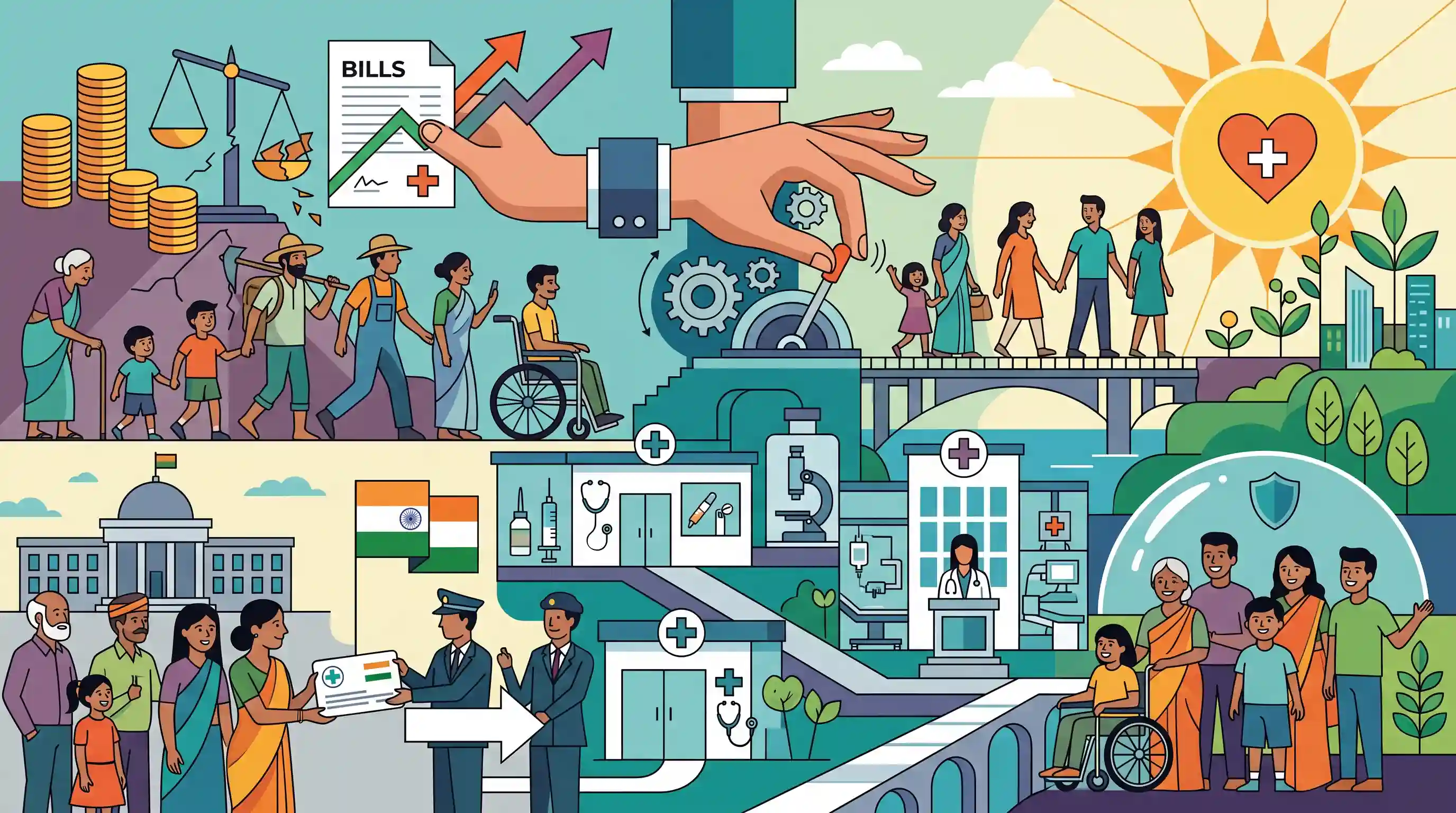
Achieving Universal Health Coverage (UHC) in India requires a multi-pronged approach centered around robust public health infrastructure, reduced out-of-pocket expenditure (OOPE), and the effective implementation of welfare schemes like Ayushman Bharat. The transition towards UHC is not just a moral imperative of a welfare state, but a fundamental prerequisite for sustainable development. Comprehensive state intervention is necessary to regulate market forces in the healthcare sector, ensuring that quality primary and tertiary care is both affordable and accessible at the community level.
Key Points
- Universal Health Coverage (UHC) is essential for equitable social development and acts as a foundation for sustainable development in India.
- High out-of-pocket expenditure (OOPE) continues to be a major barrier, disproportionately affecting vulnerable sections and pushing families into poverty.
- Strengthening primary healthcare infrastructure, particularly at the grassroots level, is a vital precondition for reducing disease burden and ensuring 'Health for All'.
- While schemes like Ayushman Bharat offer critical financial risk protection, they must be complemented by robust state intervention to mitigate the adverse impacts of healthcare marketization.
Important Terms
Universal Health Coverage (UHC)

A health system goal ensuring all individuals access essential, quality health services—including prevention, treatment, and rehabilitation—without suffering financial hardship. It is a key target of Sustainable Development Goal (SDG) 3.
UPSC context
GS Paper II (Social Justice/Health). Tests understanding of equitable development, welfare state obligations, and India's commitment to SDG 3.8.
Ayushman Bharat (PM-JAY)
The world’s largest government-funded health assurance scheme, providing ₹5 lakh annual coverage per family for secondary and tertiary hospitalization to over 12 crore poor and vulnerable families.
UPSC context
GS Paper II (Government Schemes). Tests knowledge of financial protection mechanisms, eligibility criteria, and its role as a UHC pillar.
Out-of-Pocket Expenditure (OOPE)
Direct payments made by households for healthcare services at the point of care, without reimbursement from insurance or government. High OOPE is a primary driver of medical impoverishment in India.
UPSC context
GS Paper III (Economy/Budgeting) and GS II (Health). Evaluates India’s public health financing efficiency and the poverty impact of health costs.
National Health Mission (NHM)
A flagship centrally sponsored scheme subsuming the National Rural (NRHM) and Urban (NUHM) Health Missions. It focuses on strengthening public health systems, maternal-child health, and controlling various diseases.
UPSC context
GS Paper II (Health Governance). Tests understanding of primary healthcare infrastructure, decentralized health delivery, and vertical disease control programs.
Ayushman Bharat Digital Mission (ABDM)
An initiative aimed at creating a unified digital health ecosystem through the Ayushman Bharat Health Account (ABHA). It enables seamless, secure sharing of health records across providers via interoperable digital systems.
UPSC context
GS Paper III (Science & Tech) and GS II (Governance). Evaluates the role of technology in improving healthcare transparency and portability.
Ministry of Health and Family Welfare (MoHFW)
The apex Indian government ministry responsible for formulating and implementing national health policies, family planning, and public health programs. It oversees major missions like NHM and ABDM.
UPSC context
GS Paper II (Statutory/Regulatory Bodies). Tests knowledge of the executive’s role in public health management and inter-sectoral coordination.
Prelims Trap
Out-of-Pocket Expenditure (OOPE) as a percentage of Total Health Expenditure has consistently increased over the last decade.
NHA estimates (2021-22) show OOPE actually declined significantly from 62.6% (2014-15) to 39.4%. Aspirants often assume it is increasing due to inflation.
Static Concepts Connected
What are the key macroeconomic targets of the National Health Policy 2017?
- Public Spending: Increase Government Health Expenditure to 2.5% of GDP by 2025.
- Life Expectancy: Increase Life Expectancy at birth from 67.5 to 70 by 2025.
- Fertility Rate: Reduce Total Fertility Rate (TFR) to 2.1 at national and sub-national levels by 2025.
How does Ayushman Bharat divide responsibilities between primary and tertiary care?
- Health & Wellness Centres: Transforms existing Sub-Health Centres and PHCs to deliver Comprehensive Primary Health Care (CPHC), now renamed Ayushman Arogya Mandirs.
- PM-JAY: Provides cashless cover of ₹5 lakh per family per year specifically for secondary and tertiary care hospitalization to the bottom 40% of the population.
Cross-Topic Patterns
Healthcare OOPE and Multidimensional Poverty (MPI)
High out-of-pocket health expenditure is a primary driver pushing populations back into poverty, directly linking UHC (SDG 3) to the Multidimensional Poverty Index (MPI) parameters of health and nutrition.
Fiscal Federalism and Health Infrastructure
Public health is a State subject. The Centre's interventions like PM-JAY operate as Centrally Sponsored Schemes, frequently causing center-state friction over branding, fund sharing, and implementation models.

2026 prelims will likely test the counter-intuitive decline in OOPE alongside Ayushman Bharat's exact secondary/tertiary coverage scope.
Linked PYQs · 4
Linked PYQs · 4
- 2024MainsGS2
In a crucial domain like the public healthcare system the Indian State should play a vital role to contain the adverse impact of marketisation of the system. Suggest some measures through which the State can enhance the reach of public healthcare at the grassroots level.
- 2021MainsGS2
“Besides being a moral imperative of a Welfare State, primary health structure is a necessary precondition for sustainable development.” Analyze.
- 2018MainsGS2
Appropriate local community-level healthcare intervention is a prerequisite to achieve 'Health for All' in India. Explain.
- 2022PrelimsGS1
With reference to Ayushman Bharat Digital Mission, consider the following statements: 1. Private and public hospitals must adopt it. 2. As it aims to achieve universal health coverage, every citizen of India should be part of it ultimately. 3. It has seamless portability across the country. Which of the statements given above is/are correct?
