Addressing India Persistent Road Safety Crisis
Source:The Hindu ↗
Why It Matters
Road accidents cost India around 1% to 3% of its GDP annually and disproportionately affect the younger demographic. For UPSC aspirants, understanding the intersection of infrastructure development, regulatory frameworks (like the Motor Vehicles Act), and urban planning is crucial for both GS2 (governance/social justice) and GS3 (infrastructure and economy).
Summary
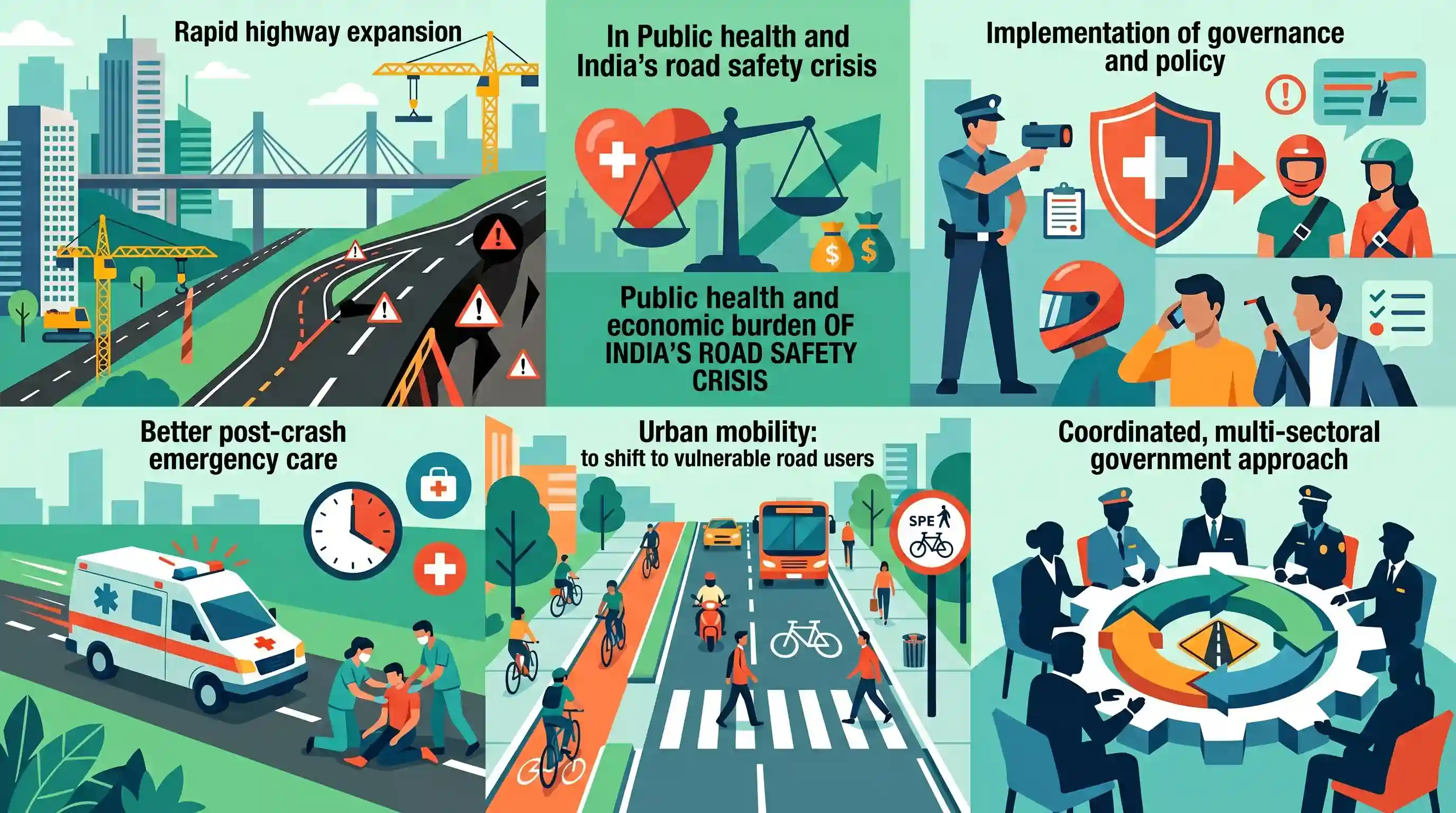
The article emphasizes the urgent need to address India's persistent road safety crisis, framing the high rate of traffic fatalities as a severe public health and economic issue. While the nation is rapidly expanding its highway infrastructure, these efforts are often accompanied by flawed road engineering and inadequate safety measures, leading to 'black spots.' The piece argues that curbing road deaths requires robust implementation of the Motor Vehicles (Amendment) Act, 2019, better post-crash emergency care, and a fundamental shift in urban transport policy that prioritizes the safety of vulnerable road users like pedestrians and two-wheeler riders. Ultimately, reducing road fatalities hinges on a coordinated, multi-sectoral approach across government agencies.
Key Points
- India accounts for about 1% of the world's vehicles but suffers roughly 11% of global road traffic deaths, with over 1.5 lakh fatalities annually.
- A holistic approach centered on the '4 Es'—Engineering (roads and vehicles), Enforcement, Education, and Emergency care—is essential.
- Rapid highway expansion without adequate scientific road engineering often creates 'black spots' that exacerbate fatal accidents.
- Strict enforcement of the Motor Vehicles (Amendment) Act, 2019 by State authorities is necessary to deter critical violations like speeding, driving under the influence, and not wearing helmets or seatbelts.
- Policy needs to shift toward prioritizing the safety of vulnerable road users, including pedestrians, cyclists, and two-wheeler riders, ensuring safe urban mobility.
Important Terms
Motor Vehicles (Amendment) Act, 2019

Legislation that updated India's 1988 Act to include significantly higher penalties for traffic violations, electronic enforcement, protection for Good Samaritans, and a framework for vehicle recalls.
UPSC context
GS II (Governance) and GS III (Infrastructure). Important for policy analysis of road safety and transport regulation.
Brasilia Declaration
A 2015 international commitment (India is a signatory) aimed at halving global road traffic deaths by 2030, aligning with Sustainable Development Goal (SDG) 3.6.
UPSC context
GS II (International Relations). Tests understanding of India's global commitments to public health and safety standards.
National Road Safety Board (NRSB)
A statutory body formed under the 2019 MV Act to advise the government on road safety standards, traffic management, and the adoption of safety technologies.
UPSC context
GS II (Statutory Bodies) and GS III (Infrastructure). Relates to institutional governance in transport.
Black Spots (Road Safety)
A 500-meter road stretch on National Highways where at least five accidents or ten fatalities have occurred over the last three years, requiring urgent engineering intervention.
UPSC context
GS III (Infrastructure). Key technical term for road engineering and disaster-prevention strategies in transport.
Vulnerable Road Users (VRUs)
Road users most susceptible to injuries due to lack of an external vehicle shield, specifically pedestrians, cyclists, and motorized two-wheeler riders.
UPSC context
GS I (Social Issues/Urbanization) and GS III (Infrastructure). Essential for essays on inclusive urban planning and mobility.
Golden Hour
The critical first hour after a traumatic injury when prompt medical and surgical treatment has the highest likelihood of preventing death.
UPSC context
GS II (Public Health/Governance). Crucial for evaluating emergency care systems and post-crash response mechanisms.
Good Samaritan Law
Legal provisions protecting bystanders who provide emergency medical assistance to accident victims from civil or criminal liability and police harassment.
UPSC context
GS II (Governance/Social Justice). Tests knowledge of reforms aimed at incentivizing citizen response in emergencies.
Prelims Trap
"The Brasilia Declaration is a legally binding UN treaty aiming to eliminate vehicular greenhouse gas emissions by 2030."
The Brasilia Declaration focuses on Road Safety (halving traffic deaths, aligning with SDG 3.6), not emissions. Furthermore, it is a non-binding declaration, not a legally binding treaty.
Static Concepts Connected
What are the key interventions of the Motor Vehicles (Amendment) Act, 2019?
- Good Samaritan protection: Shields bystanders assisting crash victims from civil/criminal liability and protects them from police harassment or forced legal testimonies.
- Golden Hour mandate: Introduces a scheme for the cashless treatment of road accident victims during the critical first hour post-injury.
- National Road Safety Board: Provides statutory backing to create a central advisory body on traffic management, safety standards, and road design.
What is the Brasilia Declaration on Road Safety?
- Core objective: A 2015 global framework co-sponsored by the WHO aimed at halving global deaths and injuries from road traffic accidents.
- SDG Alignment: Directly tied to SDG target 3.6 (public health) and SDG target 11.2 (sustainable, safe, and accessible urban transport systems).
- India's commitment: India is a signatory. This international commitment catalyzed India's domestic overhaul of motor vehicle regulations and road safety engineering standards.
Cross-Topic Patterns
Highway Capex vs. Health Burden
Rapid execution of the National Infrastructure Pipeline often bypasses scientific safety audits. This creates 'black spots', turning an infrastructure triumph into a public health crisis that drains ~3% of India's GDP annually.
Inclusive Urban Design vs. Vehicle-centricity
India's urban transport policy requires a paradigm shift within the Smart Cities Mission to prioritize non-motorized transport and vulnerable road users (pedestrians, cyclists) over private automobile-centric planning.

Expect a GS-3 Mains question linking rapid highway infrastructure expansion with the rising economic and health burden of road accidents.
Linked PYQs · 3
Linked PYQs · 3
- 2021MainsGS3
“Investment in infrastructure is essential for more rapid and inclusive economic growth.” Discuss in the light of India's experience.
- 2019MainsGS1
How is efficient and affordable urban mass transport key to the rapid economic development of India?
- 2024MainsGS3
What is the technology being employed for electronic toll collection on highways? What are its advantages and limitations? What are the proposed changes that will make this process seamless? Would this transition carry any potential hazards?
